Checklist
How to Hire Your First Employee as a Utah Contractor
Registrations, workers' comp, and day-one paperwork in order, for Utah contractors hiring a first employee. Plus why a 1099 helper isn't a shortcut.

You've been running the business yourself, maybe with a sub or two. Now the work is steady enough that you need a helper five days a week. Good problem. But your first employee changes your paperwork more than any job you'll take this year.
This checklist puts it in order for a Utah contracting business. This is general information, not legal or tax advice. Check with a CPA, payroll provider, or attorney for your situation.
Don't start with a 1099
The tempting shortcut is to pay your helper as a "sub" on a 1099. In Utah, DOPL is blunt about it: "It is illegal to pay an employee who is an unlicensed contractor on a 1099" [9]. To be legal, DOPL says, an employer needs to withhold federal and state taxes and cover employees with workers' compensation and unemployment insurance [9].
The IRS adds its own risk: if you wrongly classify an employee as an independent contractor, "you can be held liable for employment taxes for that worker plus a penalty" [2]. If the person works your hours, on your jobs, with your tools, treat them as an employee and do it right.
Before the first day: registrations
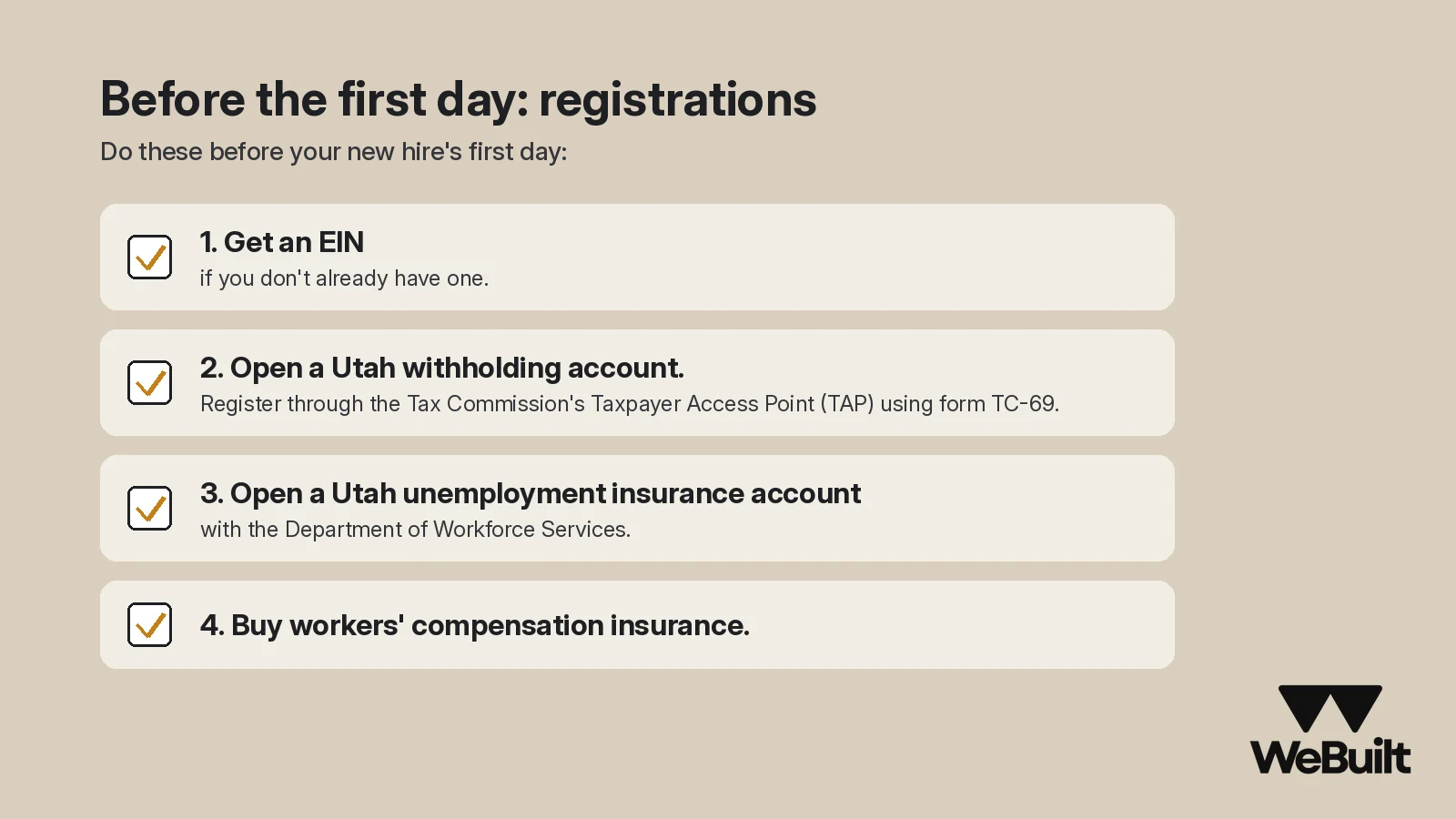
Do these before your new hire's first day:
- Get an EIN if you don't already have one. If you apply by phone or on the IRS website, you can get it immediately [2].
- Open a Utah withholding account. Register through the Tax Commission's Taxpayer Access Point (TAP) using form TC-69 [6].
- Open a Utah unemployment insurance account with the Department of Workforce Services. For 2026, the taxable wage base is $50,700, and overall rates run from 0.1% to 7.1% [5]. New employers get a rate based on their industry's average [5]. New out-of-state contractors are assigned the maximum rate unless they buy an existing business [5].
- Buy workers' compensation insurance. More on this below.
Workers' comp: one employee is enough
Under Utah law, anyone who "regularly employs one or more workers" is an employer for workers' comp purposes [7]. "Regularly" counts even if the work is only for part of the year [7]. So one steady helper puts you in.
Going without is expensive. The Utah Labor Commission lists penalties of at least $1,000, injunctions that can stop your business from operating, and the loss of the "exclusive remedy" protection [8]. That last one means an injured worker could sue you directly.
One more Utah wrinkle: if your business is unincorporated and licensed as a contractor, the law presumes it's the employer of the people who own it, directly or indirectly [7]. That presumption can be rebutted under conditions the statute lists. Read the statute or ask your agent before you assume owners are excluded. The Labor Commission also notes that the corporate-officer exclusion isn't available to corporations that contract out work, such as construction contractors [8].
Day one: the paperwork
- Form I-9. All U.S. employers must complete Form I-9 for every person they hire [1]. Your employee fills out Section 1. You complete and sign Section 2 within 3 business days of the date of hire. USCIS's example: if the employee started work for pay on Monday, Section 2 is due by Thursday [3]. You must physically examine the documents, unless you use E-Verify's alternative procedure [3].
- Form W-4. Ask for a signed W-4 when they start. If you don't get one, withhold as if the employee is single [1].
- Name and Social Security number. Record them exactly as shown on the Social Security card [2]. Don't accept an ITIN in place of an SSN [1].
Within 20 days: report the new hire
Utah requires every employer to report newly hired or rehired employees within 20 days of their first day of work [4]. Online reporting is the preferred method [4]. The penalty is $25 for each failure, or $500 if the failure is intentional [4]. It takes a few minutes. Do it the first week.
Tell DOPL
Your license file changes once you have employees. On DOPL's specialty license application, an applicant with employees provides a workers' comp certificate naming DOPL as certificate holder, plus the Tax Commission withholding and DWS unemployment registrations. Without employees, the applicant provides a workers' compensation coverage waiver from the Labor Commission instead [10]. If you're licensed on a waiver and now hire someone, talk to DOPL and your agent about updating your file.
Your new calendar
- Quarterly: Utah TC-941E withholding returns are due Apr 30, Jul 31, and Oct 31. The fourth quarter goes with the annual return by Jan 31 [6].
- January 31: W-2s must be filed electronically [6].
- Records: keep employment tax records for at least 4 years after the tax is due or paid, whichever is later [2].
A payroll provider can handle most of this for a fee. Many small contractors find it worth it.
Example: a first hire's first month
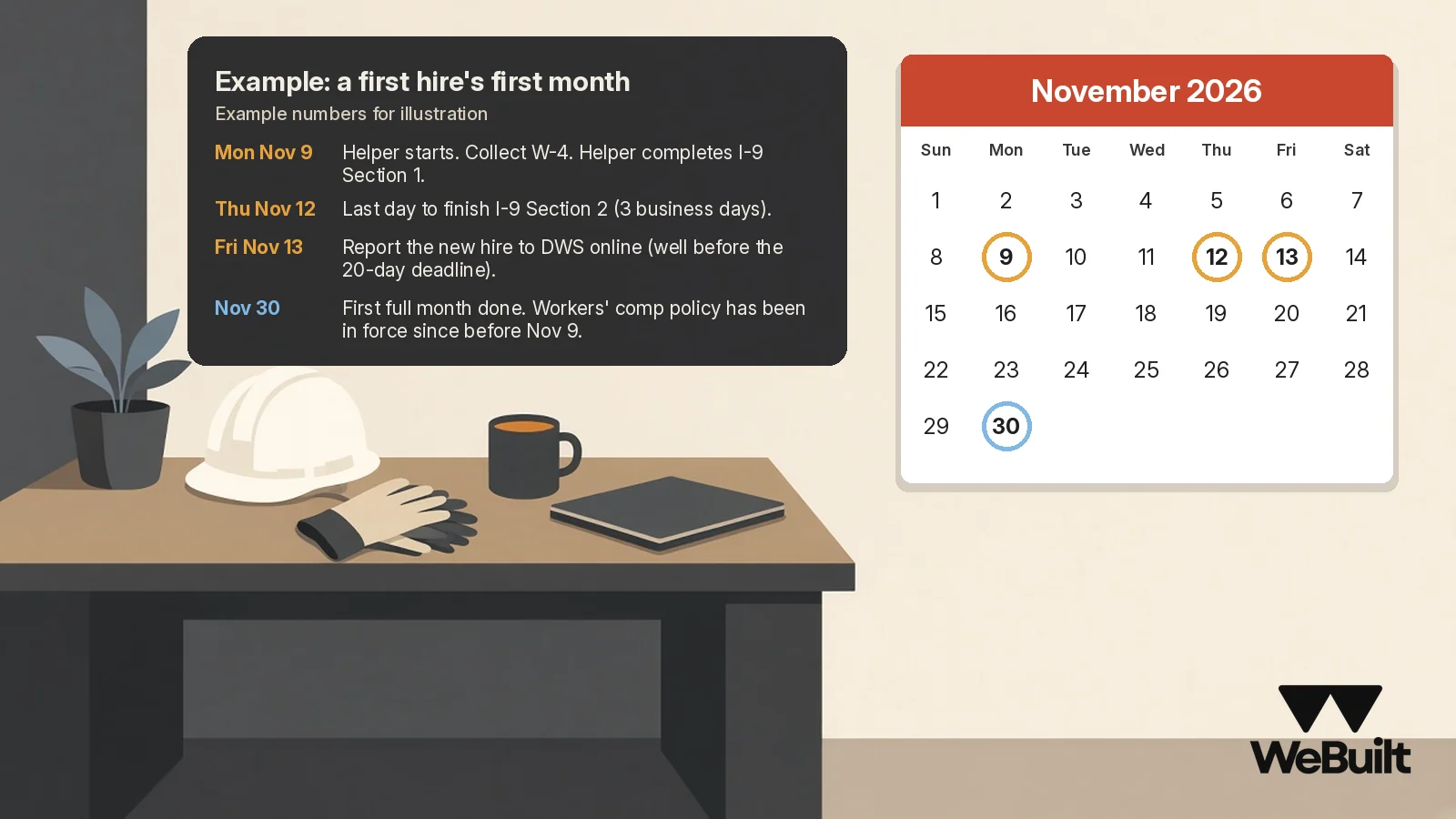
Example numbers for illustration:
| Date | Step |
|---|---|
| Mon Nov 9 | Helper starts. Collect W-4. Helper completes I-9 Section 1. |
| Thu Nov 12 | Last day to finish I-9 Section 2 (3 business days) [3]. |
| Fri Nov 13 | Report the new hire to DWS online (well before the 20-day deadline) [4]. |
| Nov 30 | First full month done. Workers' comp policy has been in force since before Nov 9. |
| Jan 31 | Q4 TC-941E and W-2s due [6]. |
Say the helper earns $20 an hour for 2,000 hours a year (example). That's $40,000, all under Utah's $50,700 unemployment wage base [5], so the whole amount is subject to your assigned rate.
How WeBuilt helps
Your first employee usually becomes the cost that moves profit per job the most. A helper you pay whether the job runs fast or slow is a cost you have to track against the work. When you record labor costs against each job in WeBuilt, along with materials and subs, you see revenue, cost, and margin for that job. That tells you whether your new hire is making you money on the jobs you're pricing, and whether your estimates carry enough labor. WeBuilt doesn't run payroll. It shows what each job actually cost. See what's included today.
FAQ
Do I need workers' comp for just one employee in Utah?
Yes. Utah law treats anyone who regularly employs one or more workers as an employer for workers' comp [7].
How fast do I have to report a new hire in Utah?
Within 20 days of their first day of work [4].
Can I pay my helper on a 1099?
Not if they're really an employee. DOPL says paying an employee who is an unlicensed contractor on a 1099 is illegal [9].
Join the Founding 25
Founding 25 spots are open for Utah contractors who want to see what labor really costs on every job. See the platform and the Founding 25 offer, or book a 15-minute walkthrough.
Sources
- IRS, Hiring employees. Accessed November 2, 2026.
- IRS, Publication 583, Starting a Business and Keeping Records (12/2024). Accessed November 2, 2026.
- USCIS, Completing Section 2 of Form I-9. Accessed November 2, 2026.
- Utah Department of Workforce Services, New Hire Reporting Handbook. Accessed November 2, 2026.
- Utah Department of Workforce Services, Unemployment Insurance Tax Rates. Accessed November 2, 2026.
- Utah State Tax Commission, Withholding overview. Accessed November 2, 2026.
- Utah Code 34A-2-103, Employers enumerated and defined. Accessed November 2, 2026.
- Utah Labor Commission, Industrial Accidents: Employers. Accessed November 2, 2026.
- Utah DOPL, Contracting Frequently Asked Questions. Accessed November 2, 2026.
- Utah DOPL, Specialty Contractor License. Accessed November 2, 2026.