Guide
Morning Crew Huddles: 10 Minutes That Save Hours
A simple 4-part morning huddle for small crews: today's plan, materials, one safety item, and who does what. Keep it to 10 minutes and write it down.
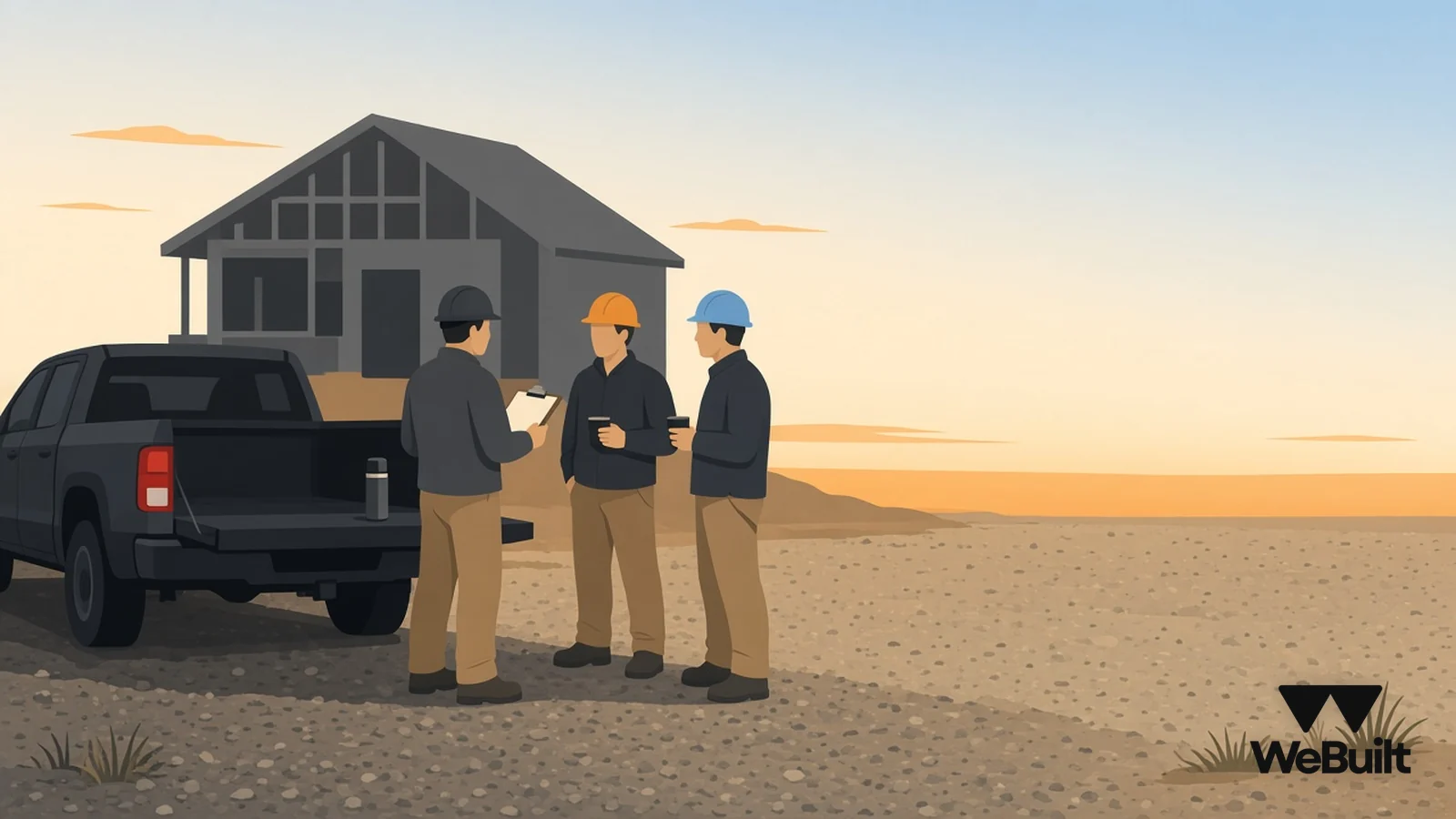
Every contractor has had the morning where the crew shows up, the tile isn't there, two people start the same task, and nobody mentions the open floor opening until someone almost steps in it. By 9 a.m. you've lost an hour and you're still not sure who's doing what.
A morning huddle fixes most of that. Ten minutes, standing up, before tools come out. This guide gives you a simple four-part agenda and a few rules to keep it short.
Why the first 10 minutes decide the day
Most lost time on a small job isn't dramatic. It's small stuff that stacks up:
- Waiting on materials that were supposed to be on site.
- Redoing work because the plan changed and one person didn't hear.
- Hunting for a tool or a key.
- Finding out about a hazard after someone's already in it.
None of those are fixed by working harder. They're fixed by talking for a few minutes before the day starts. We can't give you a study that says how many hours a huddle saves. Nobody we found has measured it reliably. But ask any foreman who runs one, and you'll hear the same thing: fewer surprises.
The 4-part huddle agenda
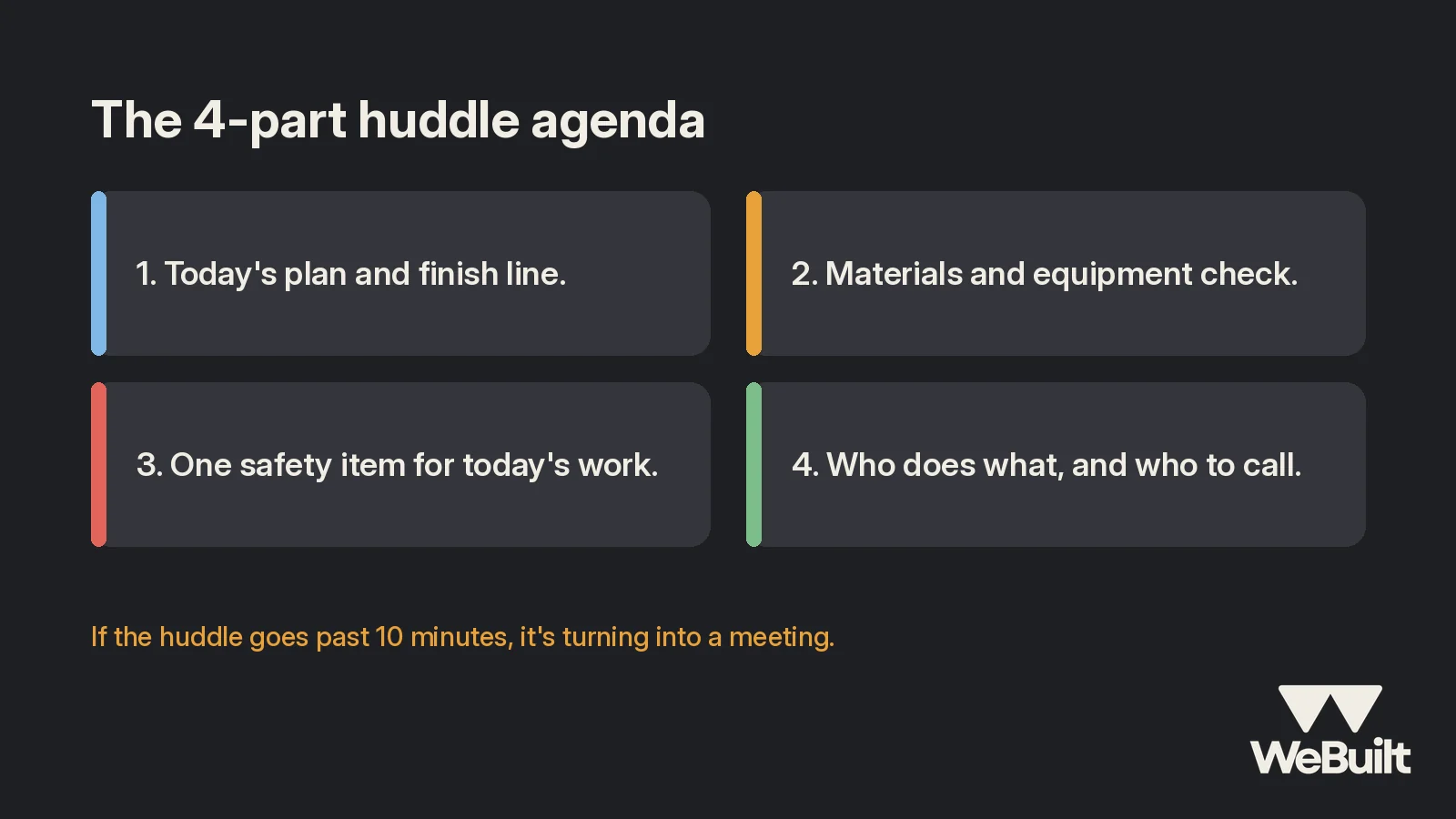
Keep the same four parts every day, in the same order.
1. Today's plan and finish line. What are we getting done today, and what does "done" look like by quitting time? "Hang and tape the basement drywall" is a plan. "Work on the basement" is not.
2. Materials and equipment check. What's on site, what's missing, and who's picking it up? If the delivery is coming at 11, say so, and plan the morning around it.
3. One safety item for today's work. Not a lecture. One thing that matters today: the ladder setup on the stairwell, the saw guard, the trench edge, the extension cords on a wet floor.
4. Who does what, and who to call. Name the person for each task. Name who to call if something goes wrong or the homeowner has a question.
That's it. If the huddle goes past 10 minutes, it's turning into a meeting. Take the long stuff offline with the one or two people it affects.
The safety piece: short and specific
OSHA's construction training rule says the employer "shall instruct each employee in the recognition and avoidance of unsafe conditions and the regulations applicable to his work environment" [1]. A daily huddle is a cheap, regular place to do part of that, alongside whatever formal training you already give.
OSHA's guidance on safety programs makes the same point in plain language: "finding and fixing hazards before they cause injury or illness is a far more effective approach" than reacting after [3]. For small businesses, OSHA suggests you "begin with a basic program and simple goals and grow from there" [3]. A daily huddle is a basic, simple start.
Why bother? The Bureau of Labor Statistics counted 1,032 fatal injuries among construction and extraction workers in 2024, and 370 of those were falls, slips, and trips [2]. Those numbers are down from the year before [2], but each one was somebody's crew member. The one safety item each morning is how you keep today's hazard in front of everyone.
If someone gets hurt
Cover this in your first huddle and repeat it every so often: what to do if someone is injured. In Utah, the Labor Commission says an employer must report an accident within eight hours of when it happens [4]. Make sure your lead knows who calls you and who handles the report. Check the Labor Commission's employer page for the details.
Rules that keep it to 10 minutes
- Stand up. Nobody gets comfortable.
- Same time, same spot. Tailgate, garage, front porch. Start at the same minute every day.
- One person runs it. Usually the lead or foreman.
- Write the plan down. A whiteboard, a clipboard, or a note on your phone. If it isn't written, it'll be remembered differently by 2 p.m.
- End with questions. "Anything I missed?" Then go to work.
Example: one week on a basement finish
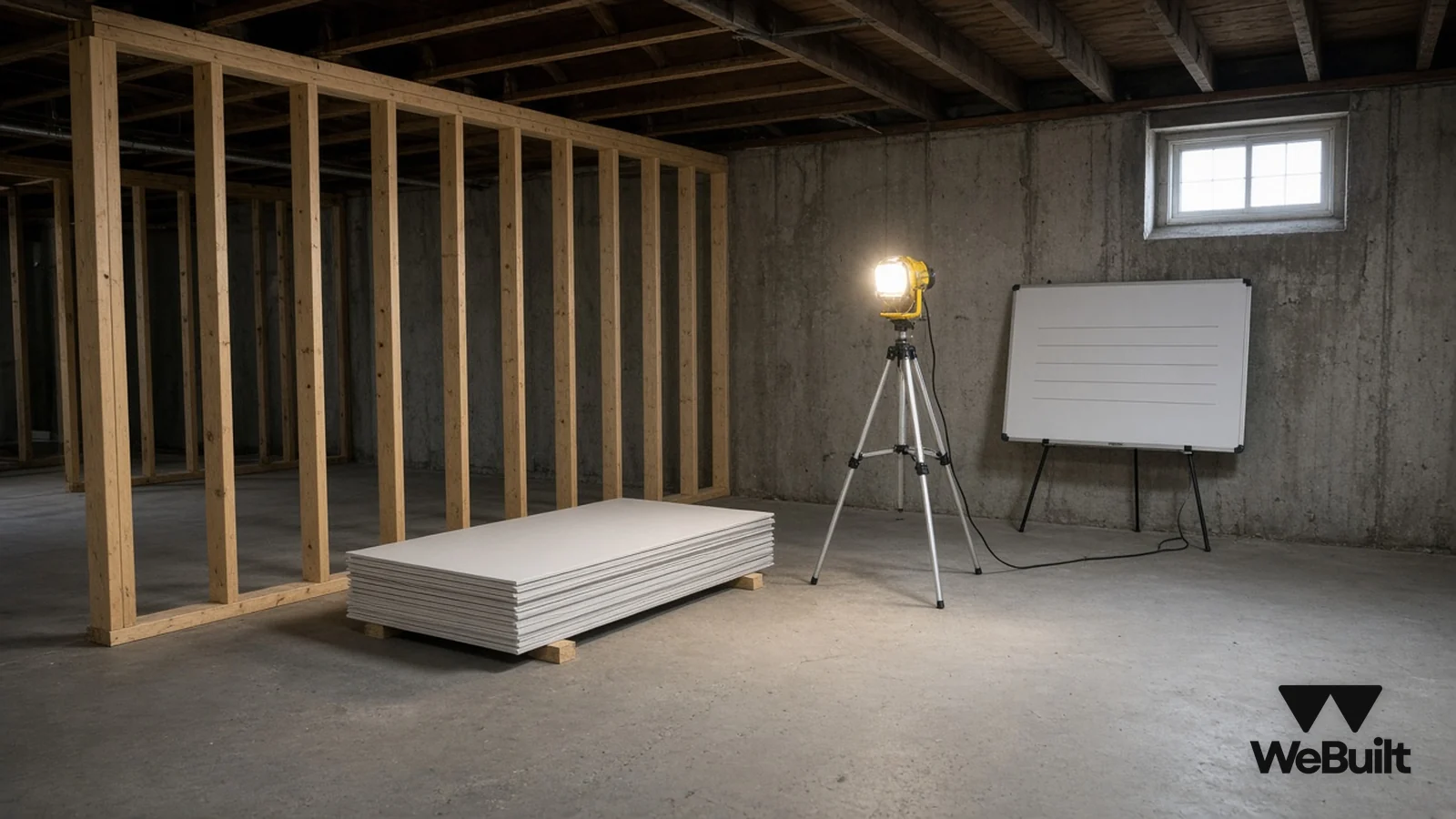
Example numbers for illustration:
A three-person crew is finishing a basement. Their plan for the week, from Monday's huddle:
| Day | Plan | Materials check | Safety item |
|---|---|---|---|
| Mon | Frame two walls and soffit | Studs on site, nails short | Cords on the wet slab |
| Tue | Electrical rough with sub | Boxes arrive 10 a.m. | Ladder at the stairwell |
| Wed | Inspection, start insulation | Insulation on site | Dust masks for insulation |
| Thu | Hang drywall | 42 sheets arriving 7:30 a.m. | Lifting sheets down the stairs |
| Fri | Tape and first coat | Mud and tape on site | Clean path for the homeowner |
On Monday, the materials check catches the nail shortage before anyone runs out at 10 a.m. On Thursday, everyone knows the drywall arrives at 7:30, so the stair path is clear and two people are ready to carry. Small things, every day.
After the huddle: write down what slipped
At the end of the day, take two minutes to note what didn't go to plan: the delivery that came late, the extra half day on framing. That note does two jobs. It sets up tomorrow's huddle, and it tells you why the job's hours and costs are different from the estimate.
How WeBuilt helps
The huddle sets the plan. Job costing tells you what the plan actually cost. When the crew's hours, the extra material run, and the sub's bill are recorded against the job in WeBuilt, you see revenue, cost, and margin for that job as it goes. So when framing runs a half day long, you see what that did to profit per job that week, not at the end. Put the two together and you know where time and money are going on every active job. See what's included today.
FAQ
How long should a morning crew meeting be?
About 10 minutes. If it runs longer, move the long topics to a separate talk with the people involved.
Does a huddle count as safety training?
It can be part of how you instruct workers on hazards [1], but it doesn't replace any training your work requires. Keep records of formal training separately.
What should I do if someone is hurt on a Utah job?
Get them care first. Then report the accident within eight hours, as the Utah Labor Commission requires [4].
See it on your jobs
Book a 15-minute walkthrough with Ian and bring a job your crew is on now. Founding 25 spots are open for Utah contractors.
Sources
- eCFR, 29 CFR 1926.21 Safety training and education (current text). Accessed November 2, 2026.
- U.S. Bureau of Labor Statistics, Census of Fatal Occupational Injuries Summary, 2024 (released Feb 19, 2026). Accessed November 2, 2026.
- OSHA, Recommended Practices for Safety and Health Programs. Accessed November 2, 2026.
- Utah Labor Commission, Industrial Accidents: Employers. Accessed November 2, 2026.