Guide
How to Estimate Labor Costs: Add Burden and Real Productive Hours
Bidding labor at the wage rate is the fastest way to lose money. Learn how to add labor burden and productive hours so your labor estimate holds up.

Labor is the line on an estimate that moves the most and gets checked the least. Materials have a price list. Labor has a guess. And when the guess is built on the wage instead of the real cost, every hour on the job loses a little money.
A good labor estimate has three parts: the hours the work will take, the loaded rate for each hour, and a reality check on productive time.
Part 1: Hours come from your history, not your hopes
Start with how long the work actually took last time, not how long it should take. If you've been job costing, you have this. If not, start writing down crew hours by job and by task now.
BuildingAdvisor's estimating guide makes a useful point: being off by a few percent on one item is one thing, but leaving an item out completely means you're 100% off on that item's labor and materials [4]. So walk the whole job, task by task: demo, prep, layout, install, cleanup, punch list, and the trips in between.

Part 2: The loaded rate (labor burden)
The wage is only part of what an hour costs you. On top of it you pay Social Security and Medicare, unemployment insurance, workers' comp, and any paid time off, health insurance, or retirement you offer. That extra is called labor burden.
Here's what the Bureau of Labor Statistics found for the construction industry in June 2026 [1]:
| Construction industry, private employers (June 2026) | Per hour worked |
|---|---|
| Wages and salaries | $36.13 |
| Benefits (all kinds) | $15.84 (30.5% of total pay) |
| Of which, legally required (Social Security, Medicare, unemployment, workers' comp) | $4.42 (8.5%) |
| Total compensation | $51.96 |
Put another way, benefits added about 44 cents for every dollar of wages in that average. Your number depends on what you offer. Estimate.Pro puts the typical loaded rate at the wage plus 28-35% [2], and Toran Accounting says burden often runs 25-40% depending on state and benefits [3]. For the Mountain region, which includes Utah, BLS reported benefits at 27.7% of private-industry compensation across all industries [1].
One note for anyone tracking these numbers over time: BLS says it will remove workers' comp costs from this survey starting with the December 2026 data [1]. Your comp premium doesn't go away, so keep it in your own burden math.
How to figure your own burden
- Add up a year of employer payroll taxes, workers' comp premiums, and benefits you pay.
- Divide by a year of field wages.
- That's your burden percentage. Toran recommends updating it every year from actual payroll costs [3].
Part 3: Not every paid hour is a productive hour
Your crew is on the clock for the morning load-out, the drive, the supply run, setup, and cleanup. Those hours are real costs, but they don't move the job forward. If you estimate "hours to install" and price them at the paid rate, the travel and setup get left out.
The fix is to price productive hours at a rate that covers the unproductive ones.

Example: a 120-hour interior job
Example numbers for illustration. Use your own payroll figures.
| Step | Math | Result |
|---|---|---|
| Base wage | $28.00/hr | |
| Labor burden (example 30%) | $28.00 × 1.30 | $36.40 per paid hour |
| Paid hours per day | 8 | |
| Productive hours per day (example) | after load-out, drive, setup, cleanup | 6.5 |
| Cost per productive hour | ($36.40 × 8) ÷ 6.5 | $44.80 |
| Productive hours the job needs | from your history | 120 |
| Labor cost to estimate | 120 × $44.80 | $5,376 |
| What the bare-wage estimate would say | 120 × $28.00 | $3,360 |
That's a $2,016 gap on one modest job, and none of it is profit yet. Overhead and profit still go on top. See our post on contractor overhead for that part.
Common labor estimating mistakes
- Pricing at the wage. In the example above, that alone understates labor by about 38%.
- Forgetting non-production time. Drive time, supply runs, and cleanup are real hours.
- Using one burden number forever. Comp rates, benefits, and payroll taxes change. Update it at least yearly [3].
- Ignoring crew mix. A lead at $34 and a helper at $20 doesn't average out to $27 if the lead does most of the hours. Estimate by who will actually do the work.
- Leaving out tasks. Missing a task means you're 100% off for that task [4].
Check the estimate against the job
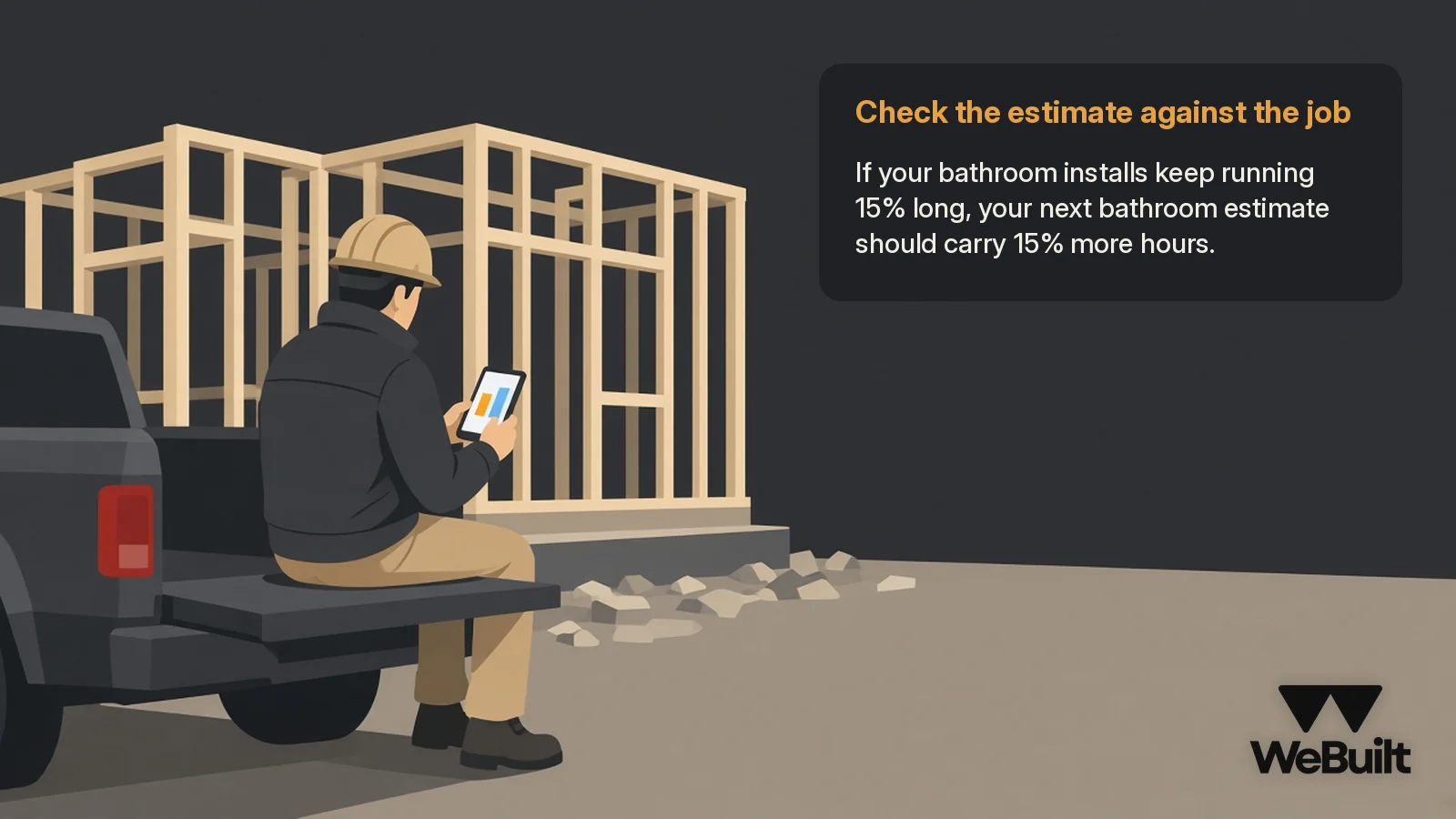
The only way to know whether your hours and productivity numbers are right is to track actual crew hours by job and compare. If your bathroom installs keep running 15% long, your next bathroom estimate should carry 15% more hours.
WeBuilt tracks labor and other costs on every job and shows profit per job, so you can see whether your labor estimates are holding up. See the platform.
FAQ
What is labor burden?
The employer costs on top of wages: payroll taxes, workers' comp, unemployment insurance, and any benefits. In the BLS construction-industry average for June 2026, benefits were 30.5% of total compensation [1].
What burden percentage should I use?
Figure your own from payroll. As a sanity check, sources put it around 25-40% of wages [2][3].
Should travel and setup time be in the estimate?
Yes. Either list them as their own hours or price productive hours high enough to cover them, as in the example above.
How WeBuilt helps
A labor estimate is only as good as the hours behind it, and those come from knowing how long past jobs really took. WeBuilt tracks each job's actual costs, including crew labor, against your estimate, so you can see when a job's labor ran over and by how much. After a few jobs, you have your own history to estimate from instead of a hopeful guess. If you log labor at your loaded rate, the profit you see on each job reflects what those hours really cost you. WeBuilt doesn't calculate your labor burden or run payroll, so you'll still figure that rate from your own payroll numbers.
Want to see it on your own jobs? Book a 15-minute walkthrough with Ian
Get your labor numbers right
Book a 15-minute walkthrough with Ian and see estimated vs. actual labor on real jobs. Founding 25 spots are open for Utah contractors.
Sources
- U.S. Bureau of Labor Statistics, Employer Costs for Employee Compensation, June 2026 (Table 4 and Table 7). Accessed November 2, 2026.
- Estimate.Pro, The Contractor's Guide to Job Costing (Without an Accountant). Accessed November 2, 2026.
- Toran Accounting, Construction Job Costing: Best Practices. Accessed November 2, 2026.
- BuildingAdvisor, Detailed Estimating Instructions. Accessed November 2, 2026.