Guide
Utah's 20-Day Preliminary Notice Rule: Protect Your Lien Rights
Miss Utah's 20-day preliminary notice and you can lose lien rights on the job. Here's who files, when, what to include, and how to track it.

Nobody starts a job expecting not to get paid. But when it happens, your strongest tool in Utah is a construction lien, and that tool depends on a short online filing most crews forget about: the preliminary notice. Miss it and, in most cases, the lien is gone.
This is a plain-language overview, not legal advice. Talk to a construction attorney about a specific job.
What a preliminary notice is
A preliminary notice is a filing on Utah's State Construction Registry (SCR) that says, "I'm working on this property." Under Utah law, a person who wants to claim a construction lien must file a preliminary notice with the registry no later than 20 days after the day they start providing construction work on the property [1]. The SCR's own page puts it simply: contractors, subcontractors, and suppliers file within 20 days after they start working, and that filing gives them the right to lien the property if they don't get paid [2].
If you don't file as required, you may not claim a construction lien [1].
Who has to file
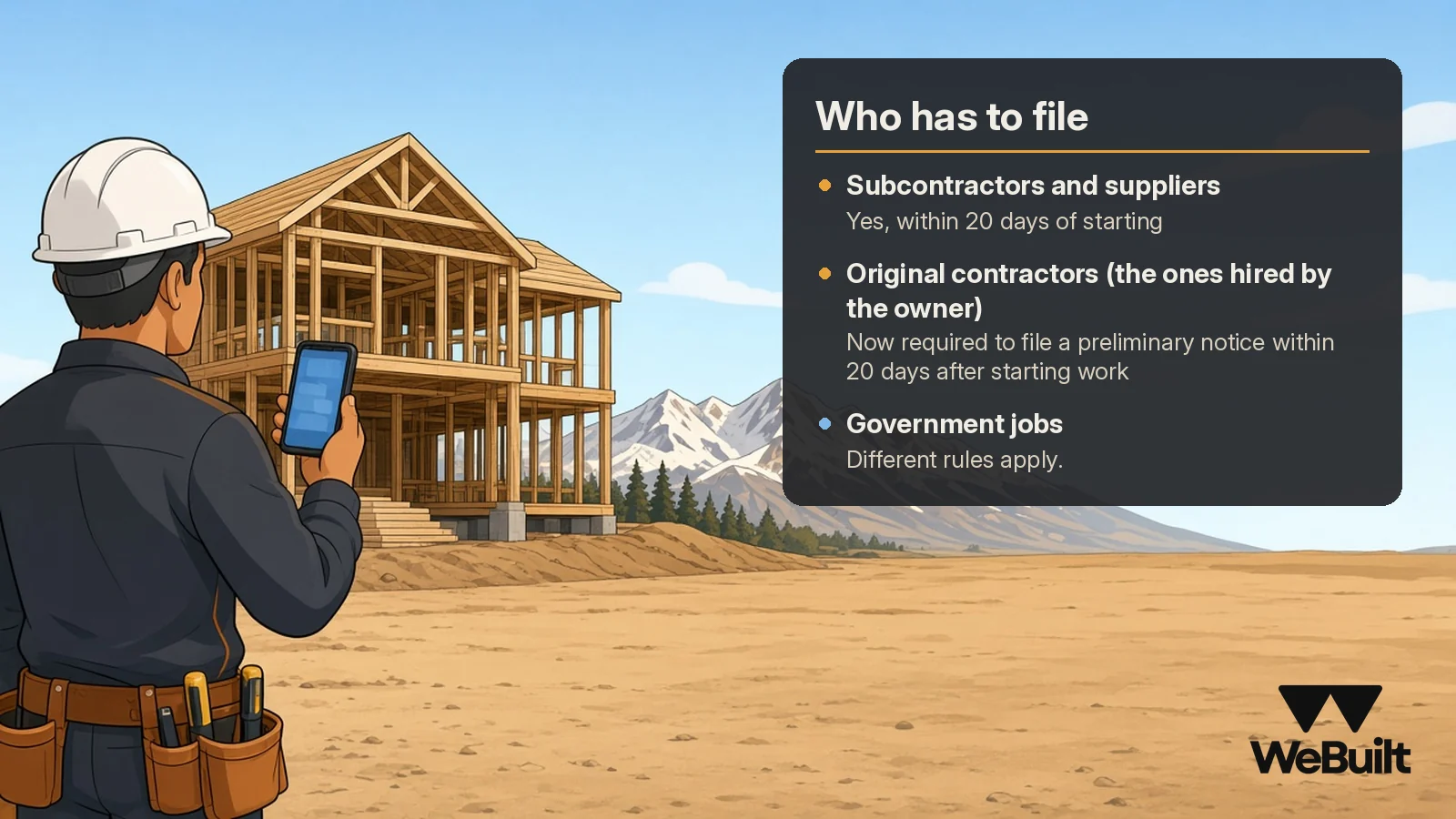
- Subcontractors and suppliers. Yes, within 20 days of starting [2].
- Original contractors (the ones hired by the owner). The SCR's contractor guide says original contractors are now required to file a preliminary notice within 20 days after starting work to keep their lien rights [3].
- Government jobs. Different rules apply. A notice of commencement is filed on government jobs, and subcontractors file by the later of 20 days after starting or 20 days after the notice of commencement [3][4].
What if you're late?
You can still file after day 20, but it only helps going forward. A late filer can't claim a lien for work provided before the date five days after the notice is filed [1]. And a preliminary notice has no effect at all if it's filed more than 10 days after a notice of completion is filed for the project [1].
The SCR guide adds that once a notice of completion is filed, the time to file a lien drops to 90 days instead of 180 [3].
What the notice has to include
Utah law lists the required details [1]:
- Your name, address, phone number, and email
- Name and address of whoever hired you
- Name of the record or reputed owner
- Name of the original contractor
- Project address or a description of the location
- The county
- The tax parcel ID number, or one of the allowed alternatives (for example, the building permit entry number)
The person filing has the burden to prove they substantially complied [1]. Get the parcel number right.
Example: how the dates work
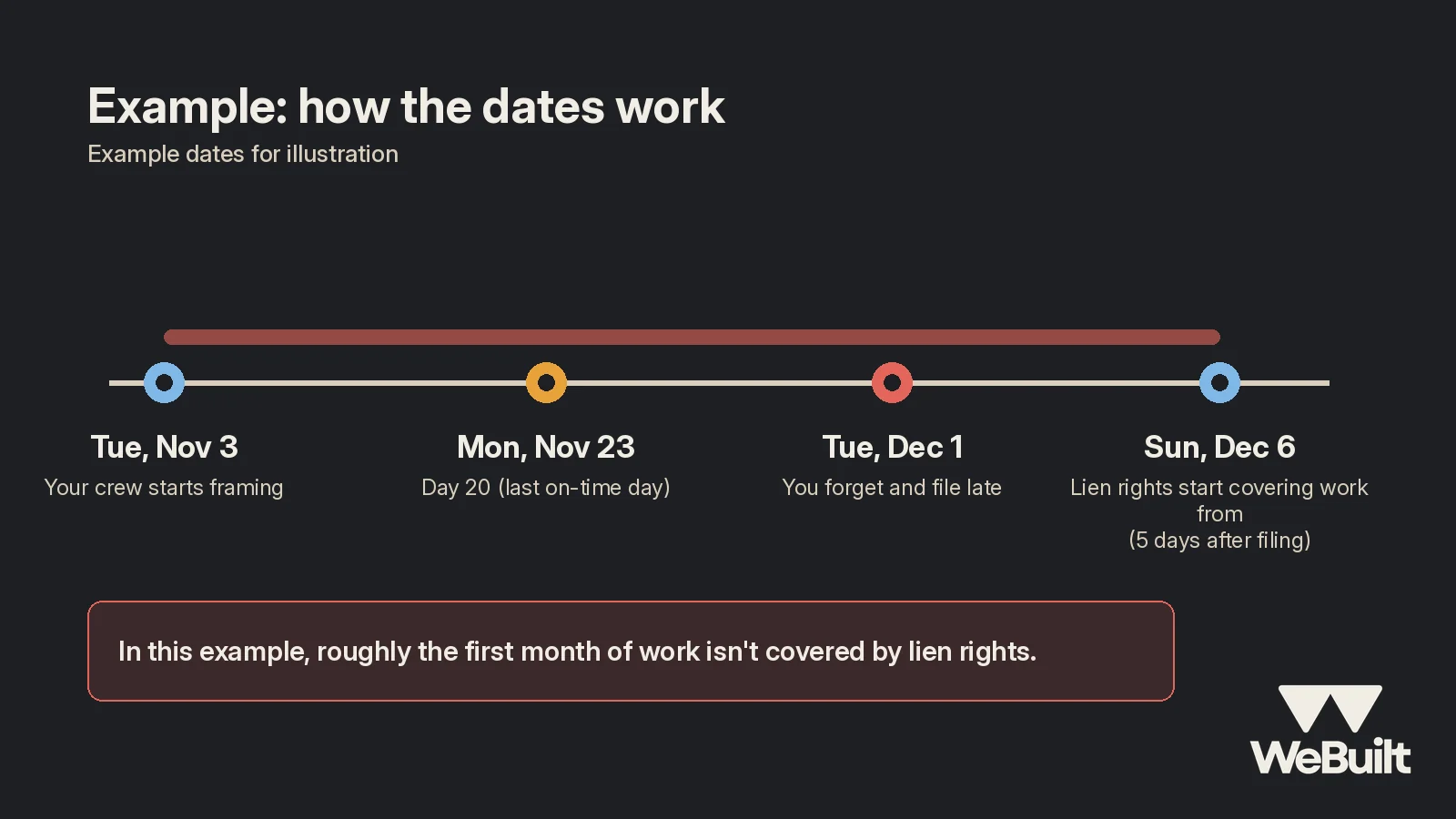
Example dates for illustration:
| Event | Date |
|---|---|
| Your crew starts framing | Tue, Nov 3 |
| Day 20 (last on-time day) | Mon, Nov 23 |
| You forget and file late | Tue, Dec 1 |
| Lien rights start covering work from | Sun, Dec 6 (5 days after filing) |
In this example, roughly the first month of work isn't covered by lien rights. On a $30,000 framing package, that could be most of the job.
Tips for original contractors
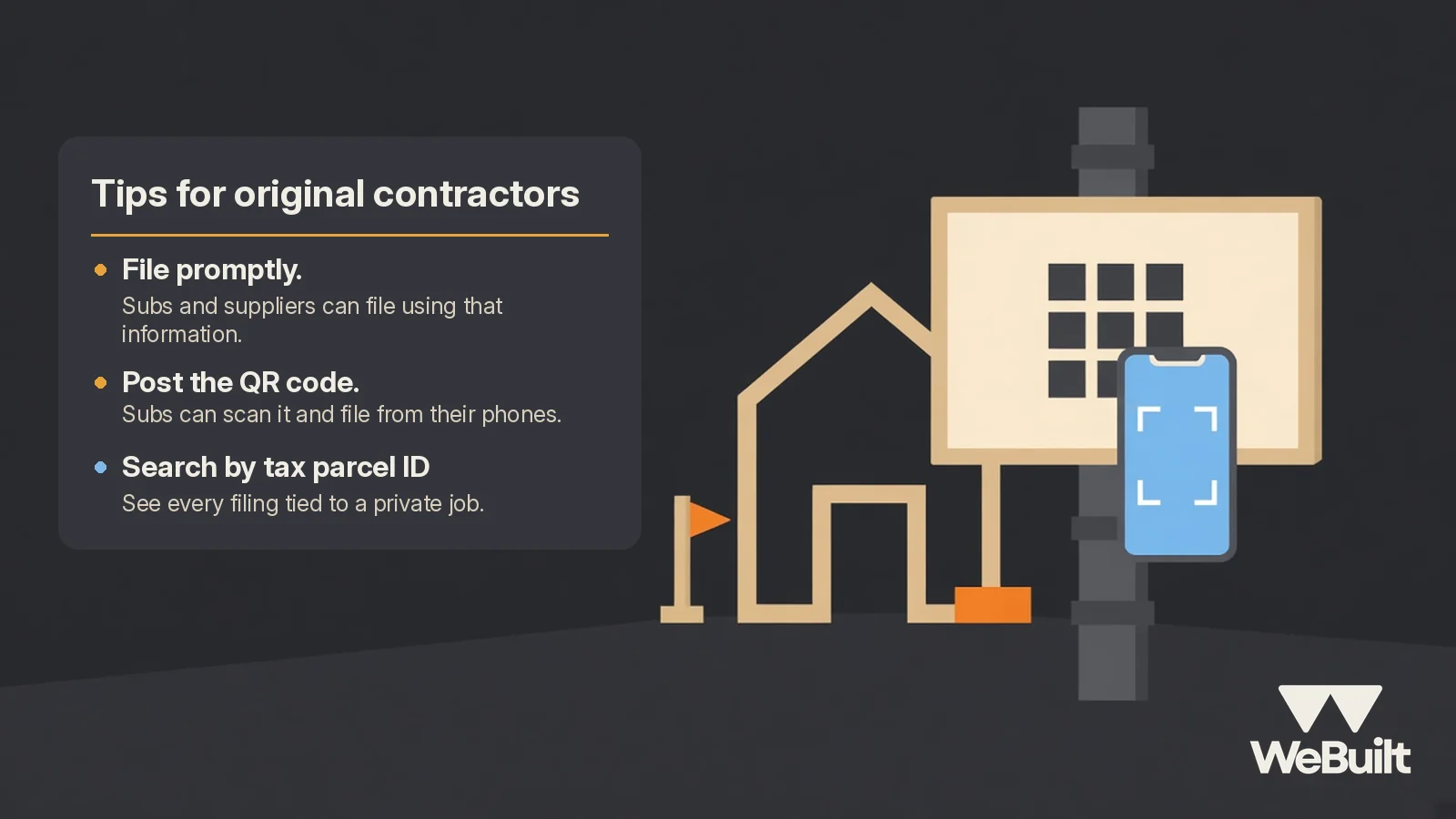
The SCR suggests a few habits that make life easier for everyone on the job [3]:
- File promptly. When the original contractor files early, subs and suppliers can file using that information.
- Post the QR code. The SCR lets you post the QR code for your preliminary notice on the jobsite, so subs can scan it and file from their phones.
- Search by tax parcel ID to see every filing tied to a private job.
A quick start-of-job checklist
- Write down the day you (or your crew) first did work on the site. That's day 1.
- Count forward 20 days and put the deadline on your calendar and the job file.
- Look up the project in the State Construction Registry, or create it if you're the original contractor [3].
- Fill in every required field: your name and address, the customer's name, the property address, and a description of your work [1].
- Save the filing confirmation with the job.
- If you hire subs, remind them they have their own 20-day clock.
Why this matters more now
Utah's Residence Lien Recovery Fund, which used to pay some unpaid subs and suppliers on homes, is now depleted [5]. Commerce says unpaid subcontractors and suppliers now have to rely on standard legal avenues to collect [5]. That makes your own lien rights, and your own records, more important.
Make it a start-of-job habit
The simplest fix is to treat the preliminary notice like ordering the dumpster: it happens on day one of every job. Put it on your job-start checklist, record the filing date with the job, and set a reminder for day 15 in case it slipped.
WeBuilt keeps each job's costs and details in one place, so your start date and what you've spent are easy to find if you ever need to back up a claim. See how it works.
FAQ
How many days do I have to file a preliminary notice in Utah?
No later than 20 days after you start providing construction work on the property [1][2].
Do original contractors have to file one?
The SCR's contractor guide says original contractors are now required to file within 20 days to keep their lien rights [3].
What happens if I file late?
You can't lien for work done before the date five days after you file, and a notice filed more than 10 days after a notice of completion has no effect [1].
How WeBuilt helps
A lien protects work you can prove you did, and that starts with good records on every job. WeBuilt keeps each job's costs in one place, so you can see what you've actually spent on a job and how it's tracking against your estimate. If a customer stops paying, you already know what that job has cost you to date, instead of piecing it together from receipts in the truck. To be clear, WeBuilt doesn't file preliminary notices or liens, and it won't track your 20-day deadline on the State Construction Registry. That part is still on you. What it does is make the money side of each job easy to see.
Want to see it on your own jobs? Book a 15-minute walkthrough with Ian.
Want a hand getting organized?
Book a 15-minute walkthrough with Ian to see how WeBuilt keeps every job's numbers in one place. Ask about the Founding 25 offer for Utah crews.
Sources
- Utah Code 38-1a-501, Preliminary notice (Justia). Accessed November 2, 2026.
- Utah State Construction Registry, File Preliminary Notice. Accessed November 2, 2026.
- Utah State Construction Registry, Guide for Contractors. Accessed November 2, 2026.
- Utah Code 38-1b-202, Preliminary notice on government projects. Accessed November 2, 2026.
- Utah Dept. of Commerce, Utah's Residence Lien Recovery Fund is Officially Depleted (June 2026). Accessed November 2, 2026.