Guide
Utah Sales Tax on Construction Materials: What Contractors Owe
In Utah, contractors usually pay sales tax on materials they install and don't charge it to the customer. Here's how Pub 42 works and the mistakes to avoid.

"Do I charge sales tax on this?" is one of the most common questions new Utah contractors ask, and the answer surprises a lot of people. For most furnish-and-install work, you pay the tax when you buy the materials, and you don't charge sales tax to the customer.
This is a plain-language summary of Utah State Tax Commission guidance, not tax advice. Talk to your CPA or the Tax Commission about your situation.
The basic rule: you're the consumer
Utah treats building materials like lumber, nails, brick, and cement as personal property until they're built into a structure. Once installed, they become real property [1]. The sale of real property, and labor on real property, isn't subject to sales tax [2].
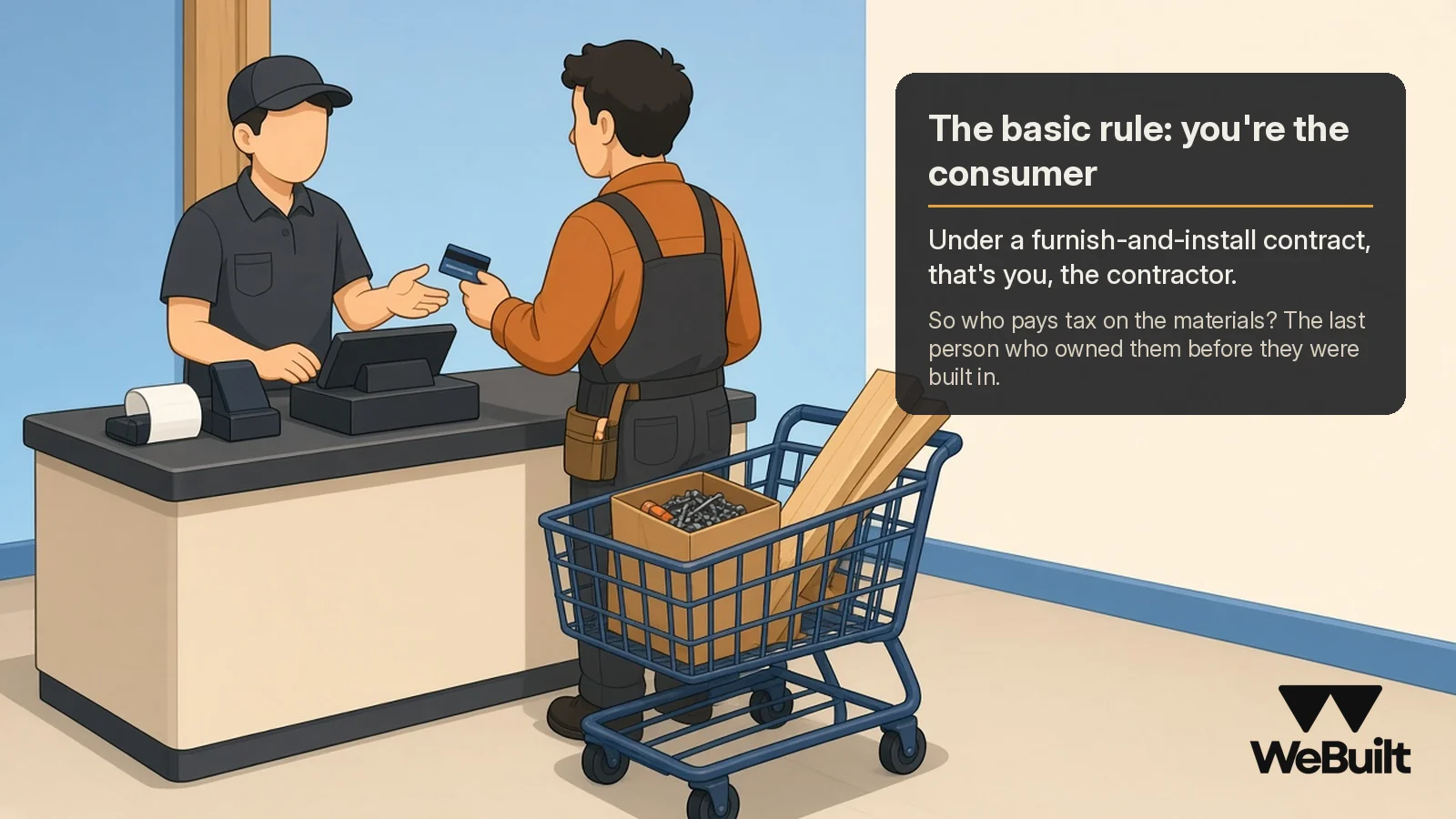
So who pays tax on the materials? The last person who owned them before they were built in. Under a furnish-and-install contract, that's you, the contractor [1]. The rule is the same whether the contract is lump sum, time and materials, or cost-plus [2]. Pub 25 says it directly: the contractor is the final consumer and must pay sales and use tax on materials converted to real property [3].
Fixtures that become part of the building, like furnaces or built-in air conditioning, are treated the same way as construction materials [2].
Pub 42's own example
The Tax Commission's example: a homeowner hires a contractor to remodel a basement under a furnish-and-install contract. The contractor buys and installs all the materials, so the contractor pays sales tax on those purchases. The contractor's charge to the homeowner isn't taxable, because the sale of a finished real property improvement isn't taxable [1].
There's one twist. If the property owner buys the materials for a contractor to install, the owner pays the sales tax, not the contractor [1].
Three things you may not do
Pub 42 lists "incorrect practices." Under a furnish-and-install contract, a contractor may not [1]:
- Collect sales tax from the customer on the job
- Offset the tax you paid on materials with tax you wrongly collected from the customer
- Show the tax you paid on materials, or anything that looks like tax, as a separate line on the customer's invoice or contract
And if you do collect sales tax by mistake, you have to send it to the Tax Commission unless you refund it to the customer [1].
When it gets more complicated
Buying tax-free "for resale." If you buy materials tax-free for resale and then install them, you owe use tax on those materials [1][2]. Some contractors do both, for example a company that installs storm doors and also sells doors over the counter [1]. In that case you need records for what you sold and what you installed [2].
Selling materials to a sub. A Tax Commission ruling notes that if a contractor resells materials to a subcontractor, that sale is taxable [4].
Do you need a sales tax license? If you buy all materials from vendors who collect Utah tax and you don't sell anything over the counter, a sales tax license isn't required [2]. If you also make direct sales, you need a license and must collect tax on those sales [2].
Example: a furnish-and-install deck
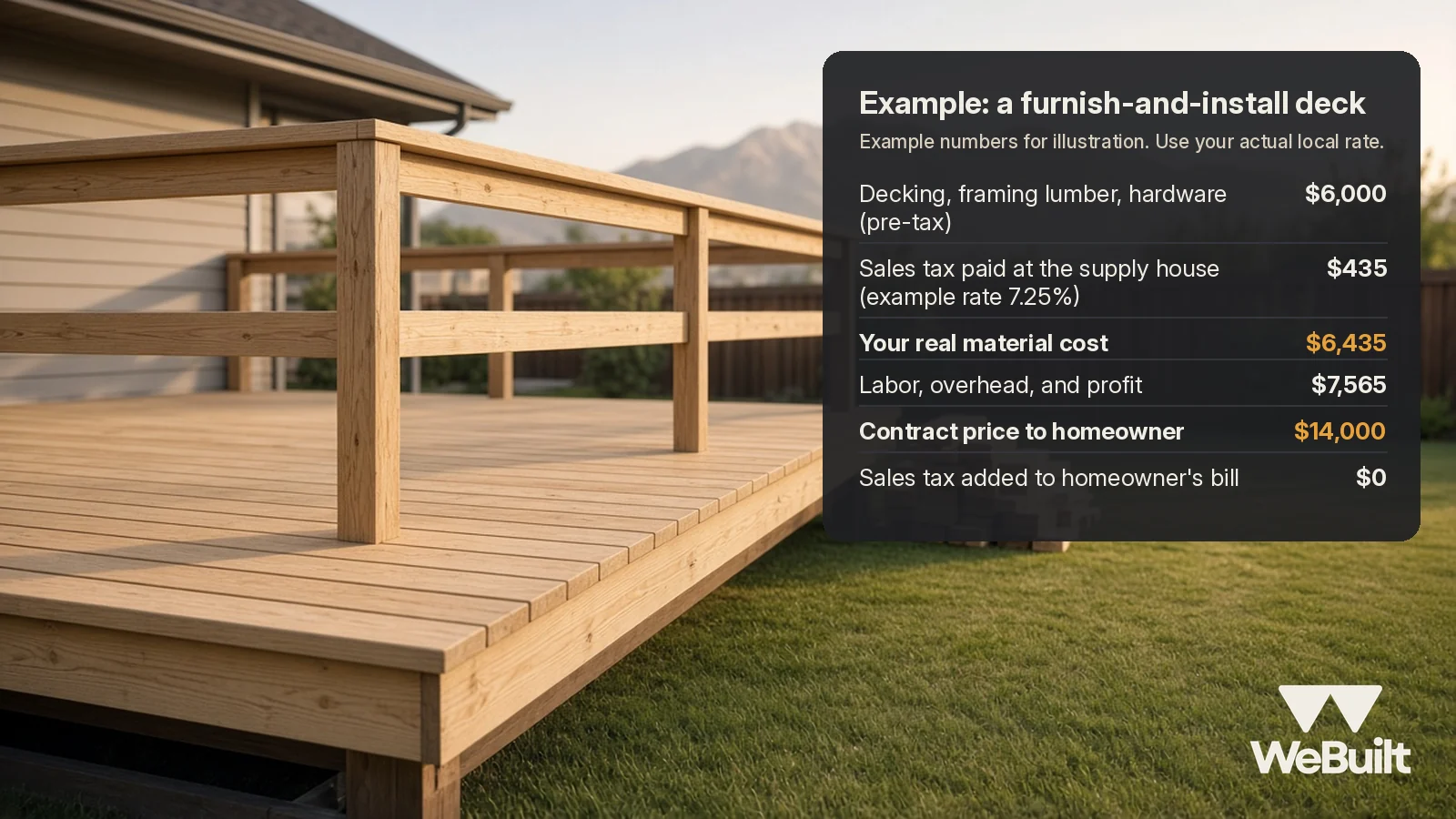
Example numbers for illustration. Use your actual local rate.
| Item | Amount |
|---|---|
| Decking, framing lumber, hardware (pre-tax) | $6,000 |
| Sales tax paid at the supply house (example rate 7.25%) | $435 |
| Your real material cost | $6,435 |
| Labor, overhead, and profit | $7,565 |
| Contract price to homeowner | $14,000 |
| Sales tax added to homeowner's bill | $0 |
The mistake to avoid: estimating materials at $6,000 because that's the shelf price, then forgetting the $435. On one deck, that's a dinner. Across a year of jobs, it's real money. The tax you pay is part of your material cost, so it belongs in your estimate and your job cost.
Quick reference: who pays the tax?
| Situation | Who pays sales or use tax on the materials |
|---|---|
| You furnish and install (any contract type) | You, the contractor, when you buy them [1][2] |
| The owner buys the materials, you install | The owner [1] |
| You bought tax-free for resale, then installed | You owe use tax [1][2] |
| You sell materials without installing them | Buy them tax-free for resale and collect sales tax from the buyer [1] |
| You resell materials to a subcontractor | That sale is taxable [4] |
If your business mixes these, talk to your CPA about how to set up your purchasing and records.
Keep the receipts with the job
The rule also says contractors must keep books and records to account for materials sold and materials consumed when they buy tax-free [2]. The simplest habit for everyone: every receipt, tax included, gets tied to a job number.
WeBuilt tracks costs on every job, including what you actually paid for materials, so the tax shows up where it belongs: in the job's profit. See how it works.
FAQ
Do Utah contractors charge sales tax on remodeling jobs?
Not on a furnish-and-install job. The contractor pays tax on the materials, and the charge to the owner for the finished improvement isn't taxable [1].
Can I list the tax I paid as its own line on the invoice?
No. Pub 42 says you may not show the tax on materials, or any amount that looks like tax, as a separate item [1].
What if I bought materials tax-free and then installed them?
You owe use tax on those materials [1][2].
How WeBuilt helps
The sales tax you pay at the supply house is part of what a job really costs, and it's easy to leave out when you estimate from shelf prices. WeBuilt tracks each job's actual costs against your estimate, so when you log what you really paid for materials, tax included, it lands in that job's numbers. At the end of the job you see what it actually made, not what it would have made if materials were tax-free. To be clear, WeBuilt doesn't file sales or use tax, track your tax license, or tell you what you owe. That's still a job for you and your CPA. It just keeps the true cost on the right job.
Want to see it on your own jobs? Book a 15-minute walkthrough with Ian.
Questions about your job costs?
Book a 15-minute walkthrough with Ian to see job costing that includes your real material cost. Founding 25 spots are open for Utah contractors.
Sources
- Utah State Tax Commission, Publication 42: Sales Tax Information for Sales, Installation and Repair of Tangible Personal Property Attached to Real Property. Accessed November 2, 2026.
- Utah Admin. Code R865-19S-58, Materials and Supplies Sold to Owners, Contractors and Repairmen of Real Property (via Cornell LII). Accessed November 2, 2026.
- Utah State Tax Commission, Publication 25: Sales and Use Tax General Information. Accessed November 2, 2026.
- Utah State Tax Commission, Private Letter Ruling 96-164. Accessed November 2, 2026.