Guide
Contractor Overhead: How to Find Your True Hourly Cost
Your crew's wage isn't your real cost per hour. Learn how to add up overhead, spread it over billable hours, and price every job to cover it.
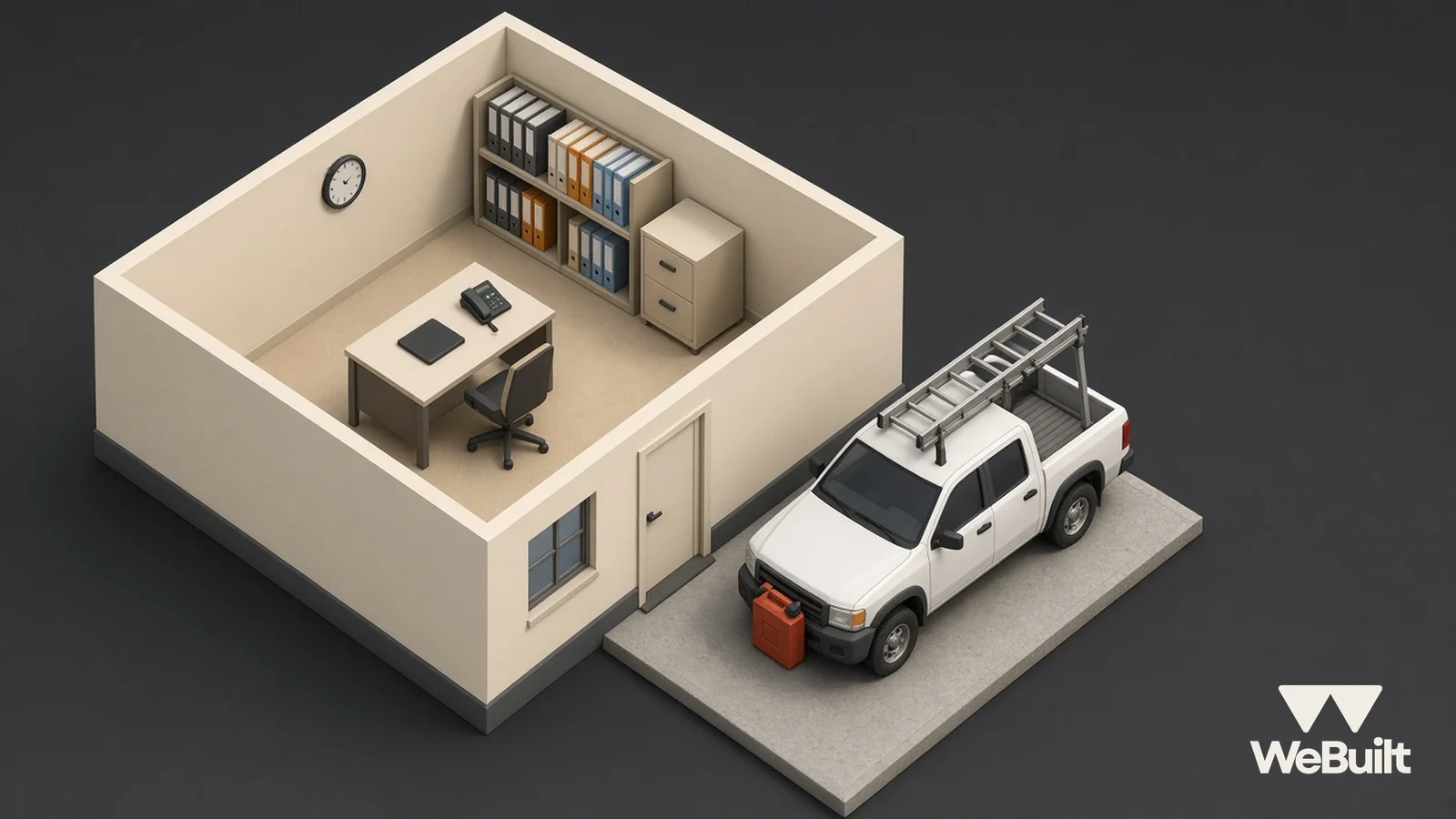
.Ask a contractor what an hour of labor costs and you'll usually hear the wage. Ask what an hour costs the business and things get quiet. That second number is the one that decides whether you're making money, and it's built mostly from overhead.
What counts as overhead
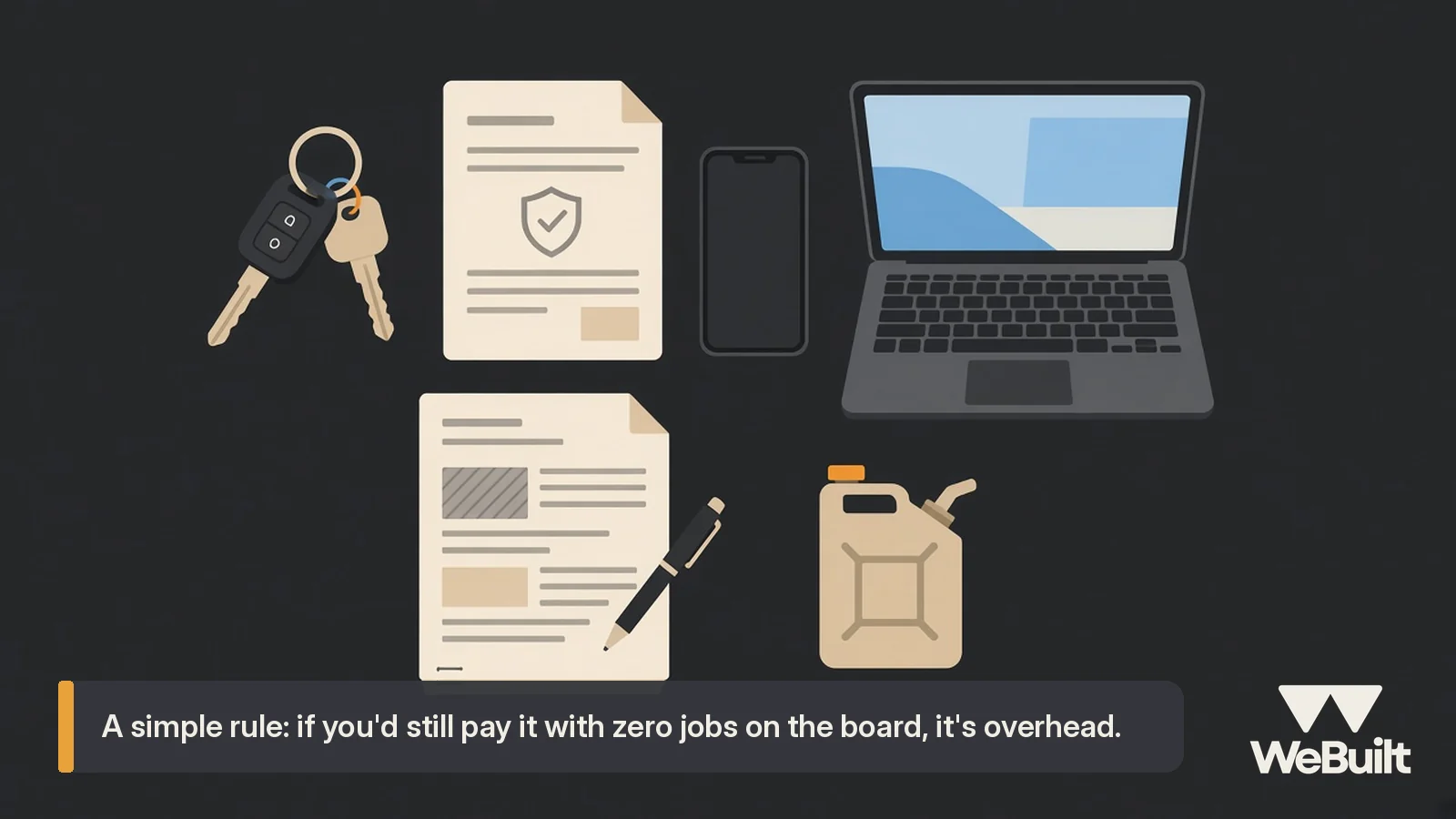
Overhead is what it costs to run the business that isn't tied to one job. Buildertrend's list: rent, office salaries, liability insurance, utilities, marketing, and software [1]. Projul adds vehicle payments and fuel, licenses, accounting and legal help, and one item many owners skip: the owner's salary is overhead, not job cost [2]. Procore's list also includes tools, office equipment, and debt payments [3].
Direct job costs are different. Those are the materials, labor, subs, permits, equipment rental, and dump fees for a specific job [4]. A simple rule: if you'd still pay it with zero jobs on the board, it's overhead.
Step 1: Add up a year of overhead
Use your last 12 months, or your last quarter times four. Buildertrend suggests running a profit-and-loss report for a recent period, quarterly being a good benchmark [1]. Make sure job costs aren't hiding in overhead accounts, and overhead isn't hiding in job costs. Buildertrend quotes Carla Merrill of Builder's GoTo: "Only true overhead costs should be listed in expense accounts. Project-specific costs must be in your cost of goods sold" [1].
Step 2: Turn it into a percentage
There are two common ways [1]:
- Overhead ÷ direct costs, if you price with markup
- Overhead ÷ revenue (income), if you price with margin
In Buildertrend's example, $75,000 of quarterly overhead is 15% of $500,000 in direct costs, or 10% of $750,000 in income [1]. Pick one method and stick with it, and revisit it at least quarterly [1].
Step 3: Turn it into an hourly number
Percentages work for pricing whole jobs. For hourly work, small service calls, and T&M jobs, it helps to know overhead per billable hour. The key word is billable. Your crew is paid for drive time, supply runs, cleanup, and rain days. Only some of those hours get billed to a customer.
Example: a three-person crew
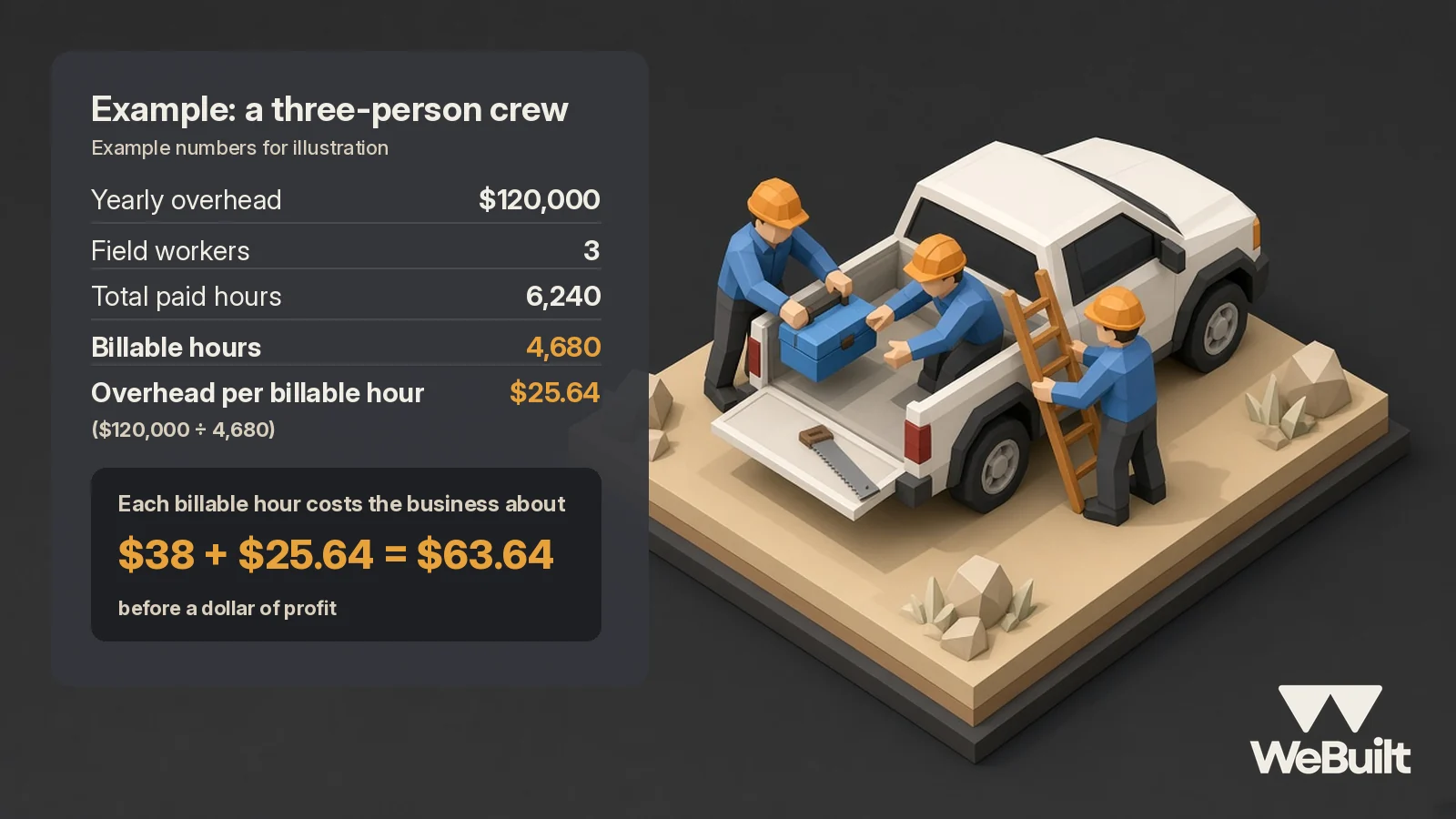
Example numbers for illustration:
| Item | Amount |
|---|---|
| Yearly overhead (truck, insurance, phone, software, office, owner salary) | $120,000 |
| Field workers | 3 |
| Paid hours per worker per year (40 × 52) | 2,080 |
| Total paid hours | 6,240 |
| Share of paid hours that are billable (example) | 75% |
| Billable hours | 4,680 |
| Overhead per billable hour ($120,000 ÷ 4,680) | $25.64 |
Now add labor. Say an average worker's loaded labor cost (wage plus taxes, comp, and benefits) is $38 an hour. Estimate.Pro notes that loaded labor typically runs 28-35% above the wage [4], and Toran Accounting puts labor burden at 25-40% depending on state and benefits [5].
So in this example, each billable hour costs the business about $38 + $25.64 = $63.64 before a dollar of profit. If you're charging $65 an hour, you're making about $1.36 an hour.
Step 4: Use it in your prices
- Hourly and T&M work: Your rate has to clear the true hourly cost, plus profit.
- Bid work: Use your overhead percentage in the pricing formula: selling price = cost ÷ (1 − overhead % − profit %) [1].
- Slow months: Overhead doesn't drop when work does. Fewer billable hours means a higher cost per hour, so know your number before you take a cheap job just to stay busy.
How your number compares
Don't assume your overhead is "normal." Buildertrend cites NAHB data showing general overhead for home builders ranges from 10% to 25%, depending on business size and structure [1]. Carla Merrill of Builder's GoTo, quoted by Buildertrend, warns that builders who assume a fixed 10% overhead "risk losing money on every job" if their real number is higher [1]. She also says she's worked with builders whose overhead turned out to be half or more of their total markup [1].
That's why the hourly number is useful. Buildertrend's advice is to revisit your overhead percentage at least quarterly, because it changes as your business grows [1]. Once you know an hour has to cover about $25 of overhead in the example above, a cheap hourly rate or a "quick favor" job looks very different.
Common mistakes
- Leaving out your own pay. If the business only "profits" because you work for free, it isn't profitable [2].
- Using paid hours instead of billable hours. This makes your hourly cost look lower than it is.
- Setting it once and forgetting it. Insurance renewals, a new truck payment, or a new hire all move the number [1].
Keep the job side honest too
Overhead tells you what each hour has to cover. Job costing tells you whether each job actually covered it. WeBuilt tracks costs on every job and shows profit per job, so you can see which work clears your true hourly cost. Here's what the app does today.
FAQ
Is my salary overhead or job cost?
If you mostly run the business (selling, estimating, managing), your salary is overhead [2]. If you swing a hammer on a job, track those field hours as job labor, and the rest as overhead.
Should overhead be a percentage of costs or of sales?
Either works if you stay consistent. Use cost if you price with markup, and sales (income) if you price with margin [1].
How often should I recalculate overhead?
At least quarterly, and any time a big fixed cost changes [1].
How WeBuilt helps
Knowing your true hourly cost is half the picture. The other half is whether each job actually covered it. WeBuilt tracks the costs on every job, including labor and materials, against your estimate and shows you the profit on each one when it's done. If a job looked fine on paper but barely cleared your overhead, you'll see it in the numbers instead of finding out at the end of the quarter. That makes it easier to spot the cheap "quick favor" jobs that cost more than they bring in. WeBuilt doesn't calculate your overhead rate for you, so you'll still work that number out with your books or your accountant.
Want to see it on your own jobs? Book a 15-minute walkthrough with Ian.
Want to see it on your numbers?
Book a 15-minute walkthrough with Ian. Founding 25 spots are open for Utah contractors.
Sources
- Buildertrend, How to Price Your Projects for Profitability. Accessed November 2, 2026.
- Projul, Markup vs Margin in Construction Explained. Accessed November 2, 2026.
- Procore, Construction Markup vs Profit Margin. Accessed November 2, 2026.
- Estimate.Pro, The Contractor's Guide to Job Costing. Accessed November 2, 2026.
- Toran Accounting, Construction Job Costing: Best Practices. Accessed November 2, 2026.