Guide
How to Get a Utah Contractor License as a Specialty Trade
Step by step from DOPL's own pages: classifications, the 25-hour course, 2026 insurance minimums, fees, and why specialty-only applicants skip the exam.

You've been doing roofs, flatwork, drywall, or floors for years. Maybe you've been working under someone else's license, or as a sub on small jobs. Now you want your own Utah license.
For specialty trades, it's more manageable than people expect. Here's the order to do it in, taken from DOPL's own pages. This is general information, not legal advice. DOPL requirements change. Check DOPL's current pages before you apply.
General vs. specialty: pick your classifications
Utah licenses general contractors (like B100 general building) and specialty contractors (S-classifications). A specialty license covers a defined scope of work. Some examples from DOPL's application form [5]:
| Classification | Scope |
|---|---|
| S220 | Carpentry and flooring |
| S230 | Masonry, siding, stucco, glass, and rain gutter |
| S260 | Asphalt and concrete |
| S270 | Drywall, paint, and plastering |
| S280 | Roofing |
| S310 | Foundation, excavation, and demolition |
| S330 | Landscape and recreation |
You may select up to three specialty classifications [5]. One exception: R-101 may not have any other specialty classification [5]. The exact scope of each classification is in Utah Administrative Code R156-55a-301c through 301al [5]. Read yours before you apply so you don't license for less than the work you do.
Step 1: Set up the business
Licenses are issued to an entity, and the entity must be registered with the Utah Division of Corporations [4]. So form your business entity and register it first, and get a federal EIN. Sole proprietors may use their Social Security number [1].
Step 2: Take the 25-hour pre-licensure course
Specialty contractors need a 25-hour pre-licensure course. General, plumbing, and electrical contractors need 30 hours [1]. DOPL lists the approved providers: ABC, UHBA, and AGC [1][2]. Pick one, take it, and keep your completion certificate.
Step 3: Experience and exams (good news for specialty)
No experience is required for a specialty contractor license [4]. General contractor licenses require two years, or 4,000 hours [4].
You may have heard you need to pass the Business and Law exam. DOPL's exam page lists that exam for B100, E100, H100, R100, E200, E201, P200, and P201 [3]. Specialty classifications aren't on that list [3]. If you're applying only for S-classifications, you don't schedule that exam. If you're also applying for one of the listed classifications, check DOPL's exam page for what applies to you.
Step 4: Insurance
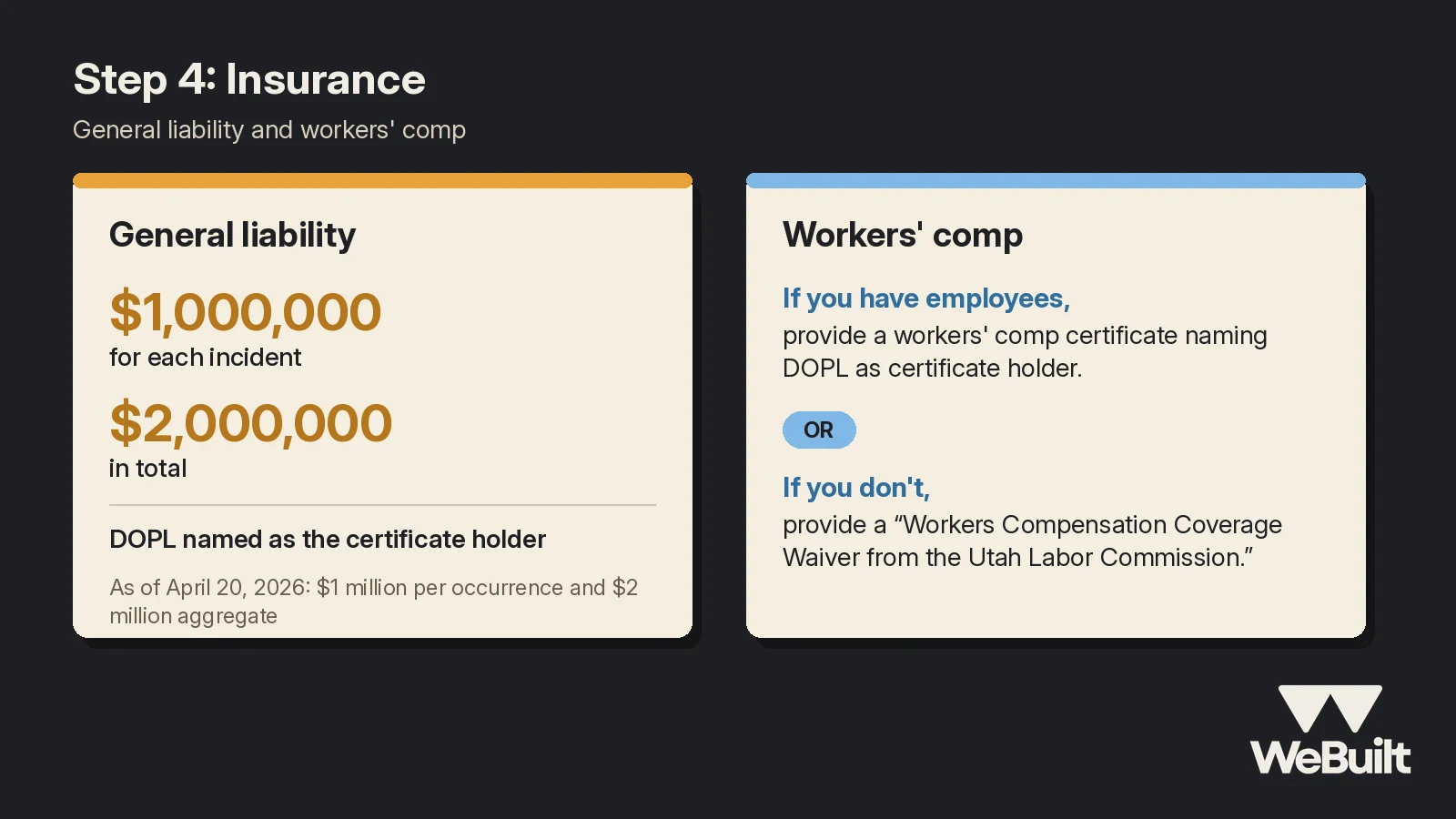
As of April 20, 2026, DOPL raised the general liability minimum to $1 million per occurrence and $2 million aggregate [2]. The specialty license page lists "$1,000,000 for each incident and $2,000,000 in total," with DOPL named as the certificate holder [1].
For workers' comp:
- If you have employees, provide a workers' comp certificate naming DOPL as certificate holder [1].
- If you don't, provide a "Workers Compensation Coverage Waiver from the Utah Labor Commission" [1].
Step 5: Registrations if you have employees
An applicant with employees also provides a Utah Tax Commission withholding registration and a Department of Workforce Services unemployment registration [1]. If you're hiring your first helper soon, see our first employee checklist.
Step 6: Apply and pay the fees
The application form lists the fees [5]:
- $50 per qualifier
- $175 per classification
- $1 Electronic Reference Library surcharge
- $20 for each owner with less than 8% ownership [5]
The application also asks financial responsibility questions, covering judgments and liens in the last 8 years and bankruptcy in the last 7 [5]. Before DOPL issues the license, a bond may be required [5]. Fees are non-refundable [4]. If you haven't heard back after 4 weeks, DOPL says to contact its office [4].
Example: what the DOPL fees add up to
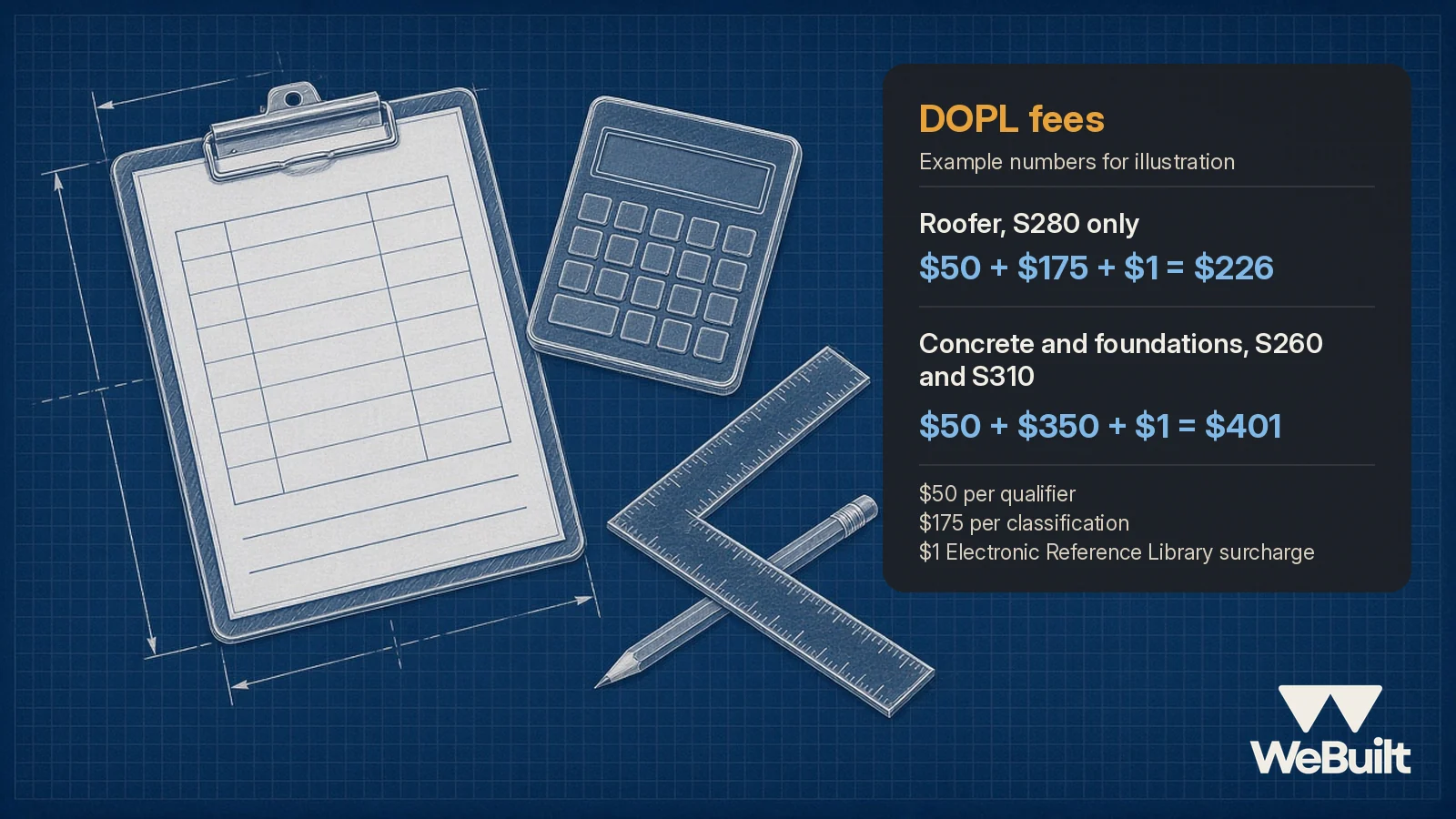
Example numbers for illustration (arithmetic from the form's fee lines, not a DOPL-stated total):
| Applicant | Qualifiers | Classifications | DOPL fees |
|---|---|---|---|
| Roofer, S280 only | 1 | 1 | $50 + $175 + $1 = $226 |
| Concrete and foundations, S260 and S310 | 1 | 2 | $50 + $350 + $1 = $401 |
That's DOPL's application fees only. The course, insurance, entity filing, and any bond are separate.
Common mistakes that slow an application down
- Licensing too narrow. If you pour footings and flatwork, check whether your work needs S310 as well as S260 before you apply [5].
- Wrong certificate holder. DOPL must be named as certificate holder on the liability certificate [1]. Ask your agent to get it right the first time.
- Applying before the entity exists. The license goes to the entity, so register the business first [4].
- Hiring before you register. If you add an employee, you need the withholding and unemployment registrations, and workers' comp in place of the waiver [1].
- Forgetting the renewal date. Licenses expire on November 30 of odd years [4], no matter when you got yours.
After you're licensed
- Renewal: all contractor licenses expire on November 30 of each odd year [4]. The next is November 30, 2027. Mark it now.
- Don't loan your license. Loaning a license is a class A misdemeanor [4].
- No reciprocity. Utah uses licensure by endorsement instead [4], so a license from another state doesn't transfer automatically.
How WeBuilt helps
Getting licensed is when a lot of specialty contractors start bidding their own work for the first time. That's the moment to know whether each job actually makes money. WeBuilt keeps your customers, estimates, and jobs together, and as you record costs against each job, it shows revenue, cost, and margin for that job. Starting with your first licensed job, you'll see profit per job instead of guessing from the bank balance. That history makes your next roof or slab easier to price. See what's included today.
FAQ
Do I need to pass the Business and Law exam for a Utah specialty license?
Not for specialty-only applicants. DOPL lists that exam for B100, E100, H100, R100, E200, E201, P200, and P201 [3].
How many hours is the Utah pre-licensure course for specialty contractors?
25 hours. General, plumbing, and electrical contractors need 30 [1].
What insurance do I need for a Utah contractor license?
General liability of at least $1 million per occurrence and $2 million aggregate [2], plus workers' comp or a Labor Commission waiver [1].
Join the Founding 25
Founding 25 spots are open for newly licensed Utah contractors who want profit per job from day one. See the platform and the Founding 25 offer, or book a 15-minute walkthrough.
Sources
- Utah DOPL, Specialty Contractor License. Accessed November 2, 2026.
- Utah DOPL, Contracting. Accessed November 2, 2026.
- Utah DOPL, Exam Information. Accessed November 2, 2026.
- Utah DOPL, Contracting Frequently Asked Questions. Accessed November 2, 2026.
- Utah DOPL, Contractor Application, All Classifications (form v.20260930). Accessed November 2, 2026.