Article
Cash vs. Accrual for Contractors: What Changes in Your Reports
The same job can look great one month and terrible the next. How cash and accrual methods change contractor reports, with one job shown both ways.
You look at October's numbers and the bathroom job you're running is deep in the red. In December, the same job looks like the best thing you did all year. Nothing about the job changed. The timing did.
That's the difference between the cash method and the accrual method, and it changes what your reports tell you. This is general information, not tax or accounting advice. Your accounting method affects your taxes. Talk to your CPA before you change anything.
The two methods in plain words
The IRS puts it simply. Under the cash method, you "report income in the tax year you receive it, and deduct expenses in the tax year in which you pay" them [1]. Under an accrual method, you generally "report income in the tax year you earn it," even if the money comes later [1].
Cash is about when money moves. Accrual is about when the work and the bills happen.
One job, two very different pictures
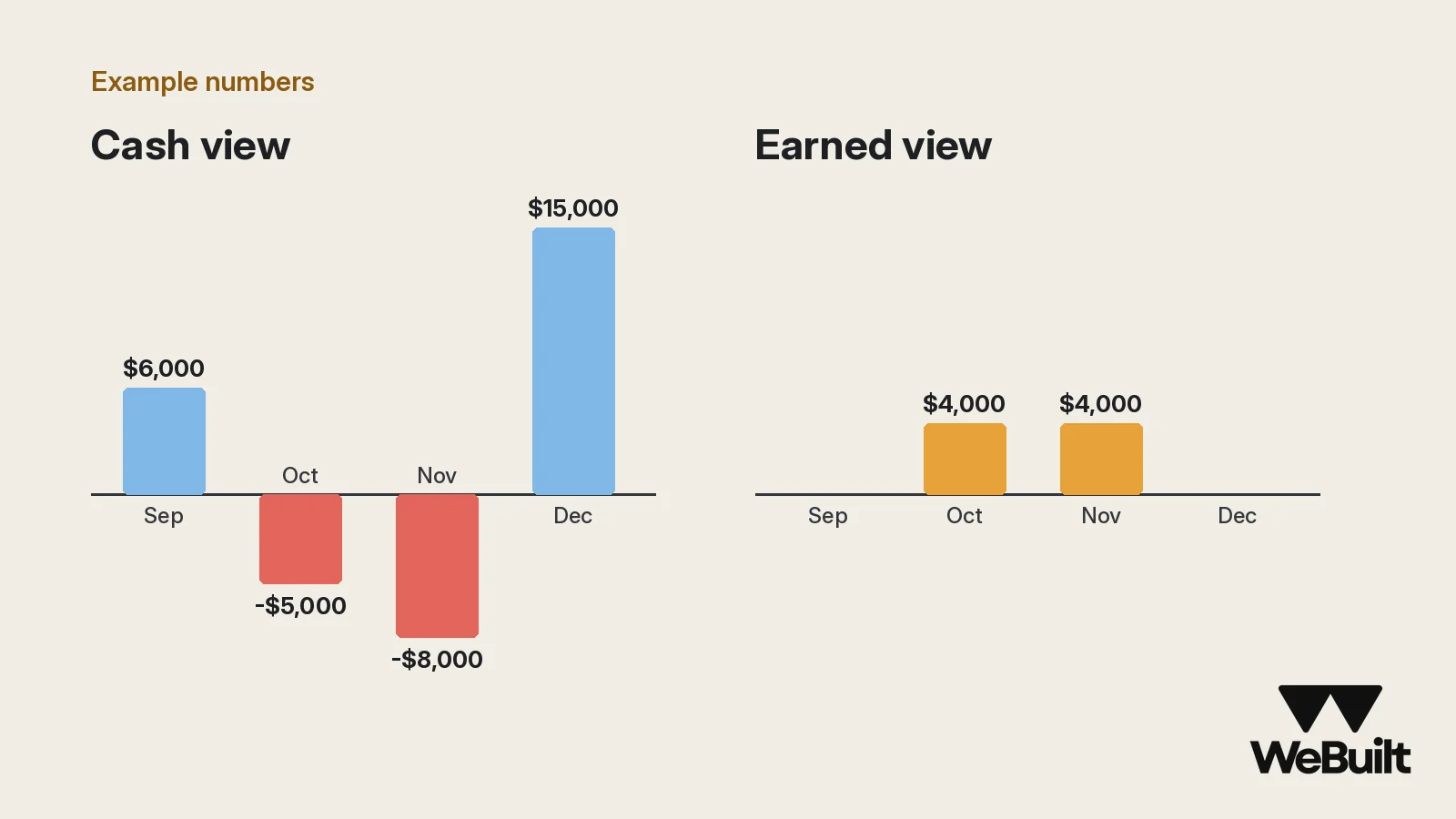
Example numbers for illustration, made up for this post. A $30,000 bathroom remodel with $22,000 of total cost. The job should make $8,000.
- September: the homeowner pays a $6,000 deposit. No work yet.
- October: the crew does about 60% of the work. You pay $9,000 for materials and $5,000 in labor. A $9,000 draw comes in.
- November: the crew finishes. You pay $6,000 in labor and $2,000 to the plumber.
- December: the final $15,000 check arrives.
Cash view (when money moved):
| Month | Money in | Money out | Job "profit" that month |
|---|---|---|---|
| September | $6,000 | $0 | $6,000 |
| October | $9,000 | $14,000 | -$5,000 |
| November | $0 | $8,000 | -$8,000 |
| December | $15,000 | $0 | $15,000 |
| Total | $30,000 | $22,000 | $8,000 |
Earned view (matched to the work done):
| Month | Earned (share of work done) | Cost of that work | Job profit that month |
|---|---|---|---|
| September | $0 | $0 | $0 |
| October | $18,000 (60%) | $14,000 | $4,000 |
| November | $12,000 (40%) | $8,000 | $4,000 |
| December | $0 | $0 | $0 |
| Total | $30,000 | $22,000 | $8,000 |
Both add up to $8,000. But on a cash view, October and November together show a $13,000 loss on a job that's doing fine. If you judged the job by those two months, you'd think it was a disaster.
The earned view here is a management view for illustration. How a contract's income is reported on your tax return can follow different rules, and that's a question for your CPA.
Traps that come with the cash method
You can't park checks. It's tempting to hold a December check until January to push income into next year. The IRS says no: "You cannot hold checks or postpone taking possession of similar property from one tax year to another" [1]. That's called constructive receipt.
Prepaid materials make running jobs look bad. Pay for cabinets in October for a job that bills in December, and October looks like a loss. That's not a problem with the job. It's a problem with reading a cash report as if it were a job report.
Deposits make jobs look better than they are. The flip side: a big deposit can make a month look great before you've done any work.
What the accrual view shows
An accrual view lines up what you've earned with what it cost to earn it. That's closer to the question most contractors actually care about: did this job make money, and is it on track? It's also why many contractors review jobs on an earned basis even when their CPA files taxes on cash.
Who can use which method
This part is CPA territory, so here's just the outline. Small business taxpayers have more choices about accounting methods. For the 2025 Schedule C instructions, that generally means average annual gross receipts of $31 million or less for the 3 prior tax years, indexed for inflation [2]. (You may see an older $26 million figure in Publication 538, which is the 2022 text.)
Construction adds wrinkles. Long-term contracts and home construction contracts have their own rules under section 460 of the tax code [1]. Percentage-of-completion and completed-contract methods are names you'll hear. We're not going to explain them here, because the details depend on your contracts and your size. Ask your CPA whether they apply to you.
One more note: if you run two separate businesses, you can use a different method for each, but only if each one keeps "a complete and separate set of books and records" [1].
Changing methods isn't a mid-year switch
Changing your accounting method generally requires IRS approval, usually on Form 3115 [1]. It's something you plan with a CPA, not something you decide in December because a report looked bad.
A practical setup for a small contractor

- File taxes however your CPA advises. Cash, accrual, or something else, that's their call with you.
- Review jobs on an earned basis every month. For each running job, compare the share of work done to the cost spent so far.
- Keep job costs coded to the job. If costs aren't assigned to the right job, neither view will tell you the truth. A clean chart of accounts helps.
- Watch cash separately. Cash timing still matters for payroll. A weekly cash forecast covers that side.
When to call your CPA
- You're growing fast and getting close to the gross receipts threshold.
- You've started taking jobs that run across tax years.
- You carry materials inventory between jobs.
- You're thinking about changing methods.
How WeBuilt helps
WeBuilt isn't accounting software and doesn't pick your accounting method. What it does is job costing. You record costs against each job, and WeBuilt shows revenue, cost, and margin for that job, so you can see what the job is really earning regardless of when checks clear. That's the earned-versus-cost view from the example above, kept job by job. Your customers, estimates, and jobs stay together, so each job carries the price you quoted. Your books stay with your bookkeeper and CPA. Profit per job stays in front of you. See what's included today.
FAQ
What's the difference between cash and accrual for a contractor?
Cash reports income when you receive it and expenses when you pay them. Accrual generally reports income when you earn it [1].
Can I hold a check until January to lower this year's income?
No. Under the constructive receipt rule, you can't hold checks to move income from one tax year to another [1].
Can I switch from cash to accrual on my own?
Changing your accounting method generally requires IRS approval, usually on Form 3115 [1]. Plan it with your CPA.
Want a quick look?
Book a 15-minute walkthrough with Ian and bring a job that looked wrong on last month's report. We'll show you its profit the way WeBuilt shows it.
Sources
- IRS, Publication 538, Accounting Periods and Methods (Rev. January 2022). Accessed November 2, 2026.
- IRS, Instructions for Schedule C (Form 1040) (2025). Accessed November 2, 2026.