Guide
Contractor Cash Flow: Why Profitable Jobs Can Still Leave You Broke
Profit is on paper. Cash is when money moves. Where contractor cash flow gaps come from, Utah's commercial retainage rule, and a weekly forecast.

You priced the job right. The margin is there. And yet it's Thursday, the crew gets paid tomorrow, and the account is thinner than it should be.
That's not a math mistake. It's timing. Profit is what a job earns on paper. Cash is when the money actually moves. This guide shows where the gaps come from and gives you a one-page weekly forecast to see the tight weeks before you hit them. This is general information, not legal, tax, or accounting advice.
Profit is not cash
Your books can tell a different story from your bank account depending on how you keep them. Under the cash method, you report income in the tax year you receive it and usually deduct expenses in the year you pay them [4]. Under an accrual method, you generally report income when you earn it, even if the money comes in later [4]. The SBA sums up the cash method this way: it "shows cash flow clearly" but "limits predictive value" [3].
Either way, a job that will make $8,000 of profit can still pull more than $10,000 out of your account in the middle, because you pay for it before the homeowner or GC pays you.
Where the gaps come from
- Payroll goes out every week. Your crew doesn't wait for the draw.
- Materials get bought up front. Cabinets, shingles, wire, and lumber are paid for days or weeks before you bill for the work they go into.
- Draws lag the work. A draw tied to "rough-in complete" comes after the rough-in is done and paid for.
- The final check waits on the punch list. Often the biggest single amount, and the last to arrive.
- Retainage on commercial work. If you sub on commercial jobs, part of every draw can be held until the end.
You're not the only one
This isn't just a contractor problem. In the Federal Reserve Banks' 2026 report on small employer firms (all industries, not construction only), 50% reported uneven cash flow as a financial challenge in the prior 12 months, and 54% reported trouble covering operating expenses such as payroll, rent, and inventory [1]. 73% pointed to increased costs of goods, services, or wages [1].
How did firms with financial challenges respond? 54% used personal funds and 47% used cash reserves [1]. In other words, a lot of owners are covering timing gaps out of their own pocket.
Retainage in Utah (commercial work only)
If you work on nonresidential projects, Utah law limits retainage. Retention withheld "may not exceed 5%" of each billing, and the total withheld "may not exceed 5% of the total construction price" [2]. It has to sit in an interest-bearing account, accounted for separately [2].
Release is due within 45 days of the later of several events, such as receiving your billing statement, a certificate of occupancy or final acceptance notice, or permitted occupancy or use [2]. Your billing statement has to include documentation of lien releases or waivers [2].
On a project that's part residential and part nonresidential, this section applies only to the nonresidential part [2]. It doesn't govern a homeowner remodel. Ask an attorney if you're unsure how it applies to your contract.
The one-page weekly forecast
Every Monday, fill in the next six to eight weeks:
Starting cash + money expected in - payroll - materials - subs - overhead = ending cash
Then set a floor: the lowest balance you're comfortable with (for example, two weeks of payroll). Any week that dips below the floor gets flagged in red.
The SBA suggests making sure someone is managing accounts receivable, accounts payable, available cash, bank reconciliation, and payroll [3]. For a small contractor, that someone is usually you, on Monday morning, with this sheet.
Example: a $40,000 job over six weeks
Example numbers for illustration (not from any source):
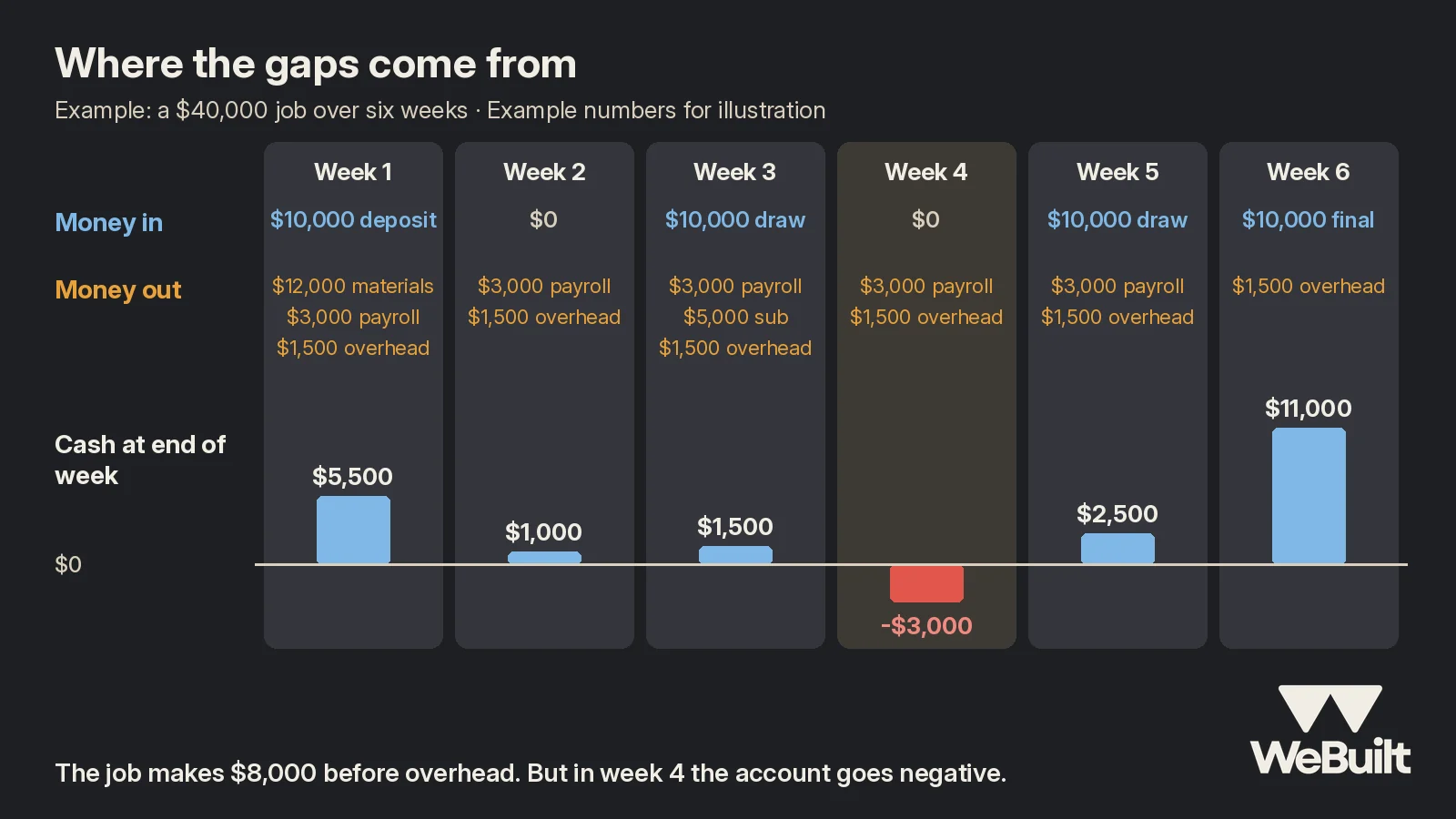
A $40,000 remodel with a $10,000 deposit, two $10,000 draws, and a $10,000 final. The job costs $32,000: $12,000 of materials up front, $3,000 a week in payroll for five weeks, and a $5,000 sub. You start with $12,000 in the bank and spend $1,500 a week on overhead.
| Week | Start | In | Out | End |
|---|---|---|---|---|
| 1 | $12,000 | $10,000 deposit | $12,000 materials, $3,000 payroll, $1,500 overhead | $5,500 |
| 2 | $5,500 | $0 | $3,000 payroll, $1,500 overhead | $1,000 |
| 3 | $1,000 | $10,000 draw | $3,000 payroll, $5,000 sub, $1,500 overhead | $1,500 |
| 4 | $1,500 | $0 | $3,000 payroll, $1,500 overhead | -$3,000 |
| 5 | -$3,000 | $10,000 draw | $3,000 payroll, $1,500 overhead | $2,500 |
| 6 | $2,500 | $10,000 final | $1,500 overhead | $11,000 |
The job makes $8,000 before overhead. But in week 4 the account goes negative. Without the forecast, that's a surprise on payday. With it, you see it in week 1 and can move the second draw earlier in the contract, delay a materials buy, or line up credit.
Levers you can pull

- Deposits and draw schedules in the contract. Tie draws to milestones that come early enough to cover your costs.
- Buy materials closer to install. Don't pay for week-five cabinets in week one if lead times allow it.
- Sequence jobs. Avoid starting two big material buys in the same week.
- Set up a line of credit before you need it. It's easier to arrange when you're not in a hurry.
- Know which jobs are worth the cash. A job that ties up a lot of cash for six weeks to make a thin profit may not be one to repeat.
How WeBuilt helps
The forecast tells you when cash is tight. Job costing tells you which jobs are worth the cash they tie up. WeBuilt shows revenue, cost, and margin for each job as you record costs against it, so you know profit per job while the work is running and after it closes. Put the two side by side and you can see which kinds of work earn enough to justify a big materials buy or a long wait for the final check. WeBuilt doesn't forecast cash or replace your accounting software. It keeps the profit side of each job clear. See what's included today.
FAQ
Why do profitable contractors run out of cash?
Because costs go out before money comes in. Payroll, materials, and subs are paid during the job, while draws and the final check come later.
How far ahead should a contractor forecast cash?
Six to eight weeks, updated every Monday, is a practical window for most small crews.
How much retainage can be held in Utah?
On nonresidential work, retention may not exceed 5% of each billing or 5% of the total construction price [2]. It doesn't apply to homeowner remodels.
Get a clear view of every job
Book a 15-minute walkthrough with Ian and bring a job that felt tight. Founding 25 spots are open for Utah contractors.
Sources
- Federal Reserve Banks, Small Business Credit Survey: 2026 Report on Employer Firms. Accessed November 2, 2026.
- Utah Code 13-8-5, Retention proceeds. Accessed November 2, 2026.
- U.S. Small Business Administration, Manage your finances. Accessed November 2, 2026.
- IRS, Publication 583, Starting a Business and Keeping Records (12/2024). Accessed November 2, 2026.