Template
Chart of Accounts for Small Contractors: Keep It Simple
Separate job costs from overhead so your margins make sense. A starter chart of accounts for small contractors, the 2026 1099 change, and Utah sales tax.
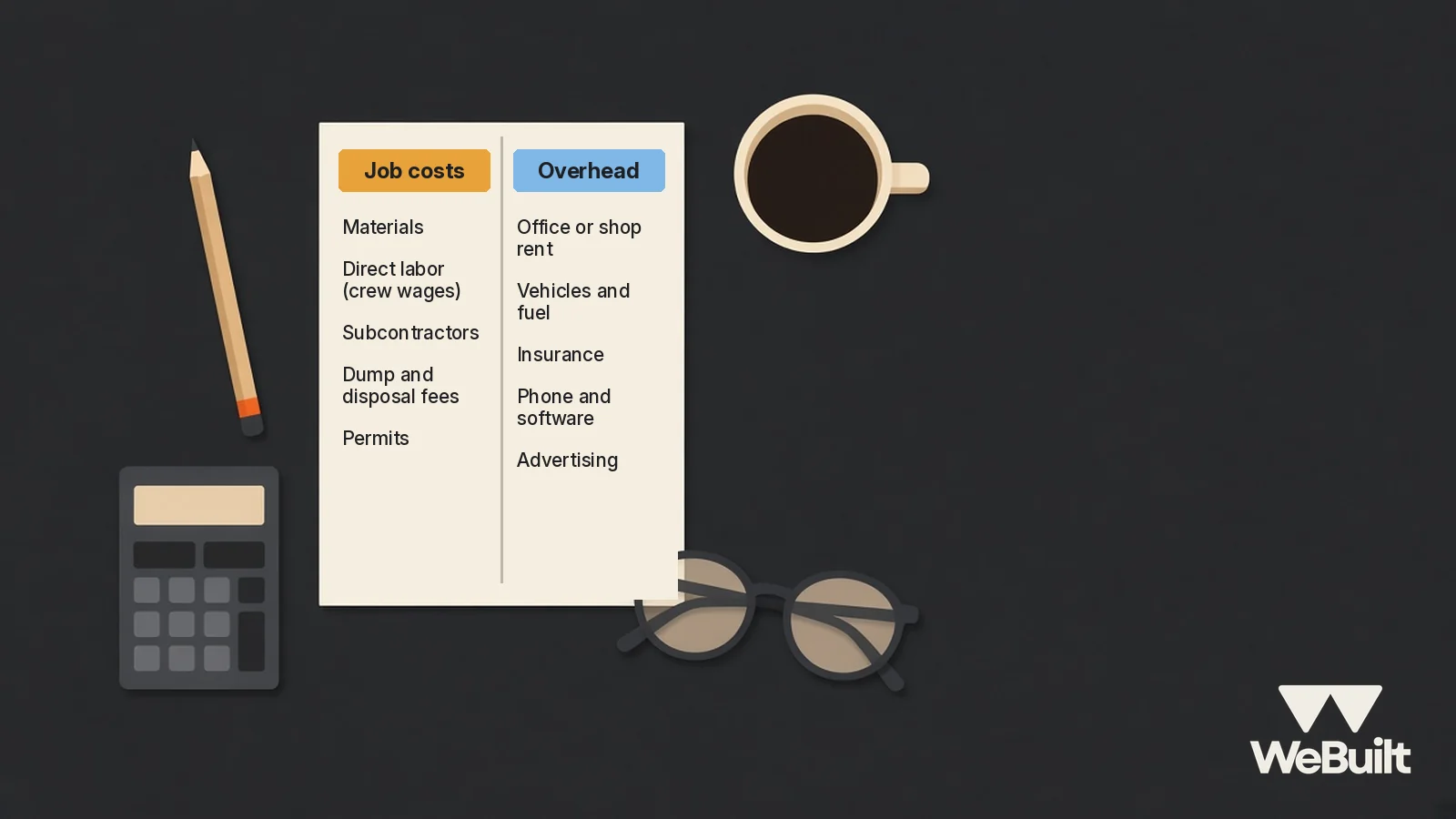
Your chart of accounts is just the list of buckets your money gets sorted into. It sounds like bookkeeper stuff, and it is. But it decides what your profit and loss report can tell you.
If materials for a roof and the shop's phone bill land in the same bucket, your gross margin is meaningless. Get the buckets right and the report starts answering real questions. This is general information, not tax or accounting advice. Have your CPA or bookkeeper review your chart of accounts.
Why the list matters
The IRS doesn't require a specific kind of records in most cases. You can use any system "that clearly shows your income and expenses" [1]. In a double-entry system, accounts show income, expenses, assets, liabilities, and net worth [1]. If you use software, the IRS expects your documentation to include "Charts of accounts and detailed account descriptions" [1].
So you get to choose the list. The goal is a short one that separates the two kinds of cost that matter most to a contractor.
The split that matters: job costs vs. overhead
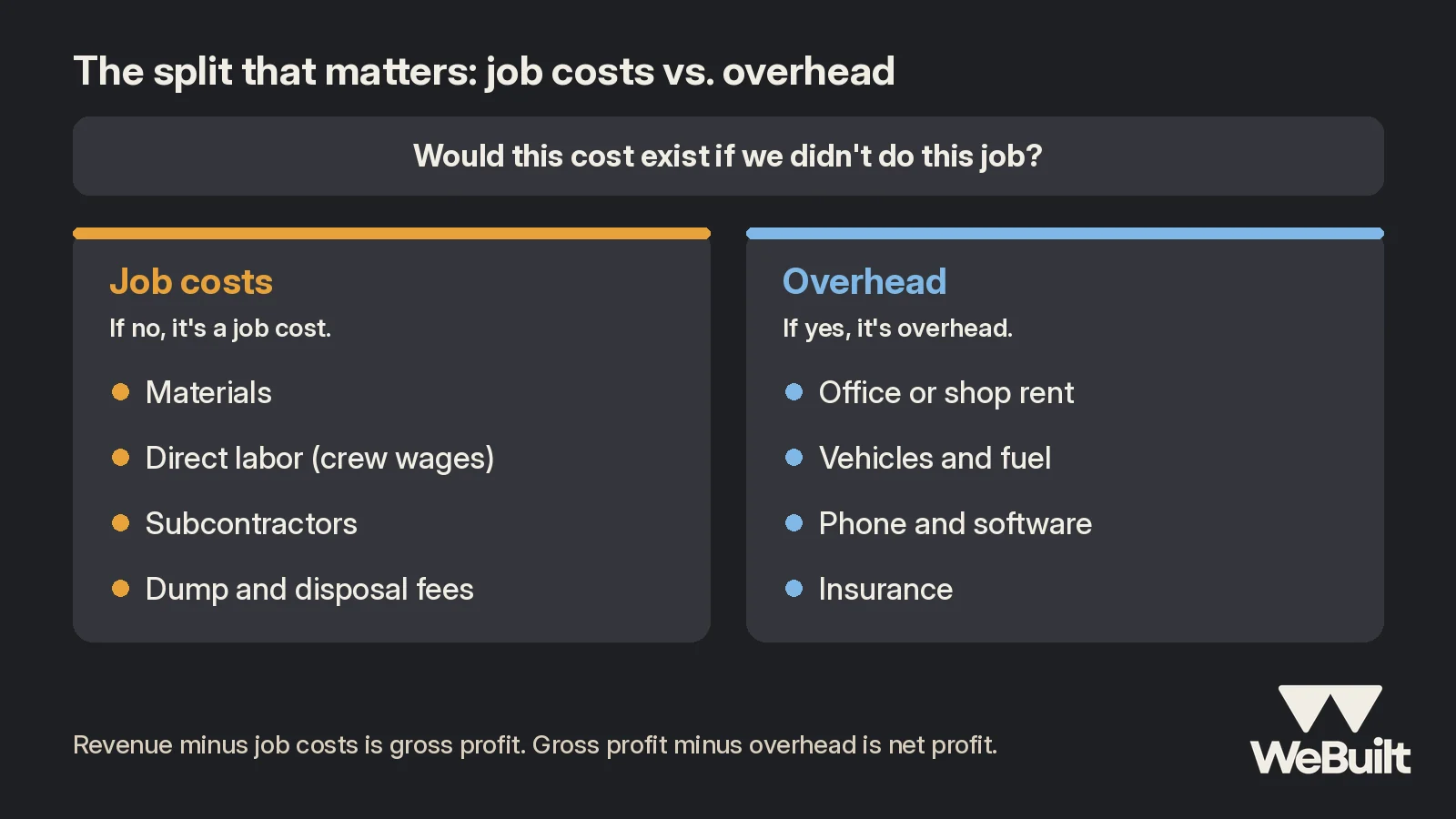
Job costs (often called cost of goods sold, or COGS) are costs that exist because you did a particular job: the shingles, the crew's hours on that roof, the plumber you subbed, the dumpster.
Overhead is what it costs to stay in business whether or not you do any one job: shop rent, office phone, software, advertising, the bookkeeper.
The simple test: would this cost exist if we didn't do this job? If no, it's a job cost. If yes, it's overhead.
Revenue minus job costs is gross profit. That tells you if your pricing works. Gross profit minus overhead is net profit. That tells you if the business works.
A starter chart of accounts
This is an editorial starting point, not an industry standard. Adjust it with your CPA.
Income - Contract revenue - Change order revenue
Job costs (COGS) - Materials - Direct labor (crew wages) - Payroll taxes on direct labor - Subcontractors - Equipment rental - Dump and disposal fees - Permits
Overhead - Office or shop rent - Vehicles and fuel - Insurance - Phone and software - Advertising - Office wages - Professional fees (CPA, attorney)
Other (not expenses) - Owner draws - Loan principal
That's about twenty accounts. You can run a small contracting business on it for years.
Contract labor vs. wages
Keep subs and employees in separate accounts. On Schedule C, contract labor (people you don't treat as employees, like independent contractors) goes on line 11, while wages to employees go elsewhere, on line 26 [2].
Watch the 1099 rule change. For amounts paid before 2026, the Form 1099-NEC reporting threshold is $600. For amounts paid in 2026, it's $2,000 [3]. After 2026, the IRS points you to Pub. 1099 for the inflation-adjusted number [3]. If you have 10 or more information returns, you must file electronically [3]. A clean subcontractors account makes this easy in January.
Utah sales tax on materials
On a furnish-and-install contract, Utah treats the contractor as the last owner of the materials. The contractor pays sales tax when buying them, and the sale to the property owner isn't taxable [5]. You may not show that tax, or anything that looks like tax, as a separate line on the customer's bill or contract [5].
The bookkeeping takeaway: on furnish-and-install jobs, the sales tax you pay on materials is part of the materials job cost. It doesn't belong in a separate "sales tax payable" account. Confirm with your CPA, especially if you also sell materials without installing them.
Keep it clean
- Separate bank account. The IRS says one of the first things to do is open a business checking account and keep it separate from your personal one [1].
- Reconcile monthly. The IRS recommends reconciling your checking account each month [1].
- Someone owns it. The SBA suggests making sure someone is managing receivables, payables, available cash, bank reconciliation, and payroll [4].
- Keep employment records. If you have employees, keep employment tax records for at least 4 years [1].
Example: one month, two ways
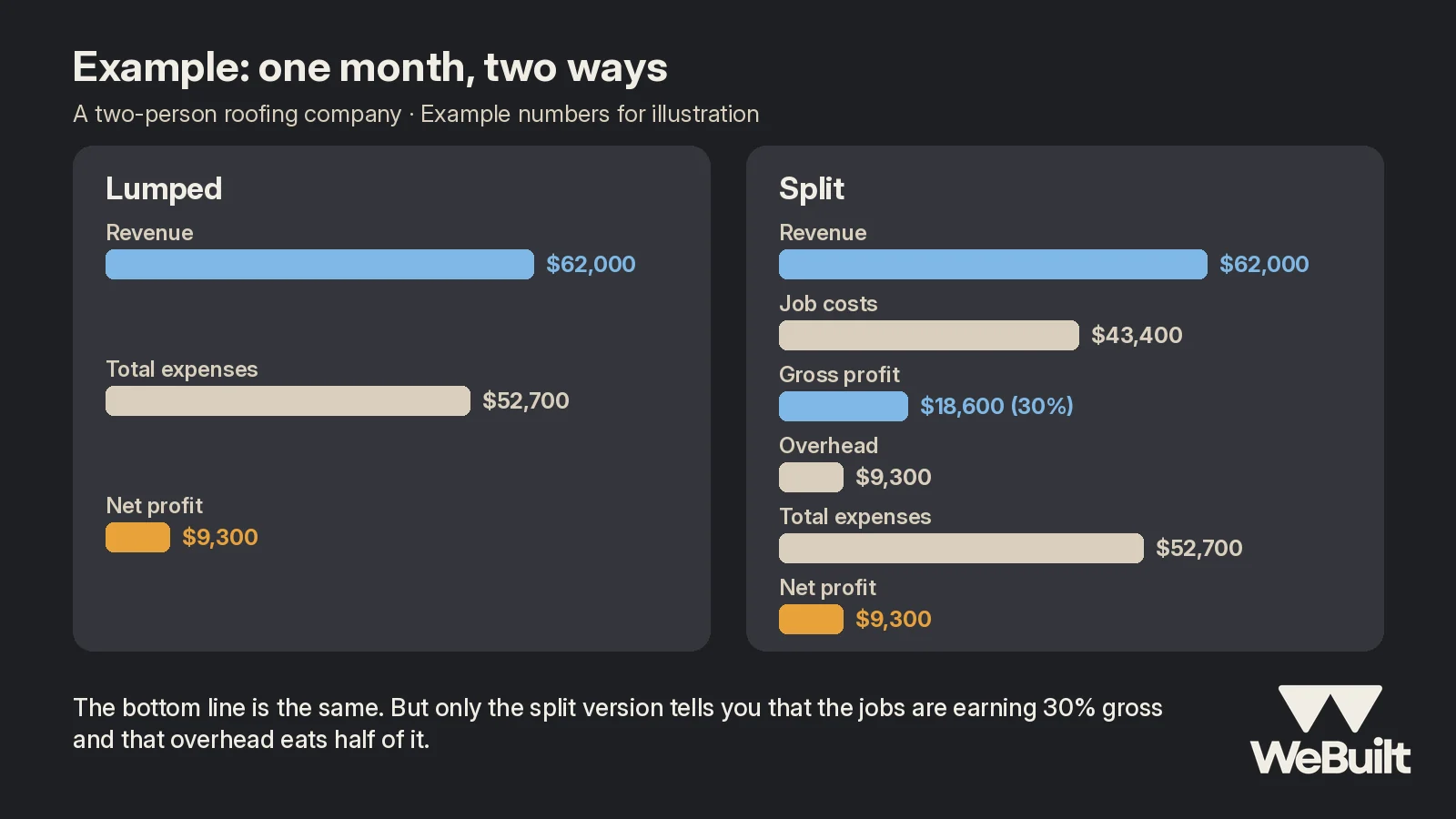
Example numbers for illustration:
A two-person roofing company's month, first with everything lumped into "Expenses," then split.
| Lumped | Split | |
|---|---|---|
| Revenue | $62,000 | $62,000 |
| Job costs | n/a | $43,400 |
| Gross profit | n/a | $18,600 (30%) |
| Overhead | n/a | $9,300 |
| Total expenses | $52,700 | $52,700 |
| Net profit | $9,300 | $9,300 |
The bottom line is the same. But only the split version tells you that the jobs are earning 30% gross and that overhead eats half of it. That's what you need to know before you change your prices.
Don't over-build it
The IRS's own sample recordkeeping system carries a single total for materials to Schedule C [1]. You don't need 200 accounts. Detail by job (which roof, which kitchen) belongs in job costing, not in your chart of accounts. Keep the chart short and let job costing carry the job-by-job detail.
How WeBuilt helps
Your chart of accounts gives you company-level totals: all materials, all subs, all overhead. It can't tell you which job made money. That's what job costing is for. In WeBuilt, you record costs against each job, and it shows revenue, cost, and margin for that job, so you see profit per job alongside the company totals your bookkeeper keeps. WeBuilt isn't a general ledger and doesn't replace your accounting software. It tracks the job costs you record so the job-by-job picture stays clear. See what's included today.
FAQ
What's the difference between job costs and overhead?
Job costs exist because of a specific job. Overhead exists whether or not you do that job. The test: would this cost exist if we didn't do this job?
Do I need to send a 1099 to every sub?
It depends on the amount and the type of payee. For amounts paid in 2026, the 1099-NEC threshold is $2,000 [3]. Ask your CPA about your subs.
Where does Utah sales tax on materials go?
On furnish-and-install work, you pay the tax when you buy the materials [5], so it's part of your materials job cost. Confirm with your CPA.
Join the Founding 25
Founding 25 spots are open for Utah contractors who want profit per job next to their books. See the platform and the Founding 25 offer, or book a 15-minute walkthrough.
Sources
- IRS, Publication 583, Starting a Business and Keeping Records (12/2024). Accessed November 2, 2026.
- IRS, Instructions for Schedule C (Form 1040) (2025). Accessed November 2, 2026.
- IRS, Am I required to file a Form 1099 or other information return?. Accessed November 2, 2026.
- U.S. Small Business Administration, Manage your finances. Accessed November 2, 2026.
- Utah State Tax Commission, Publication 42, Sales and Use Tax Information for Contractors (Rev. 07/26). Accessed November 2, 2026.