Article
Markup vs. Margin: Why 'Profitable' Jobs Still Lose Money
A 25% markup is not a 25% profit. See how markup and margin differ, why it quietly eats contractor profit, and the one formula that fixes your pricing.

Here's a story a lot of small contractors know. You bid a job, add 25% on top of your costs, win it, finish it, and get paid. Then you look at the bank account at the end of the quarter and wonder where the profit went.
Often nothing went "wrong" on the job. The problem is in how the price was built. Markup and margin sound like the same thing. They aren't, and the gap between them is where profit disappears.
Markup and margin use different starting points
Both start with the same dollars: price minus cost. The difference is what you divide by [1]:
- Markup = (price − cost) ÷ cost
- Margin = (price − cost) ÷ price
Because the price is always bigger than the cost, margin is always a smaller number than markup on the same job [1]. Procore describes it the same way: markup is based on job cost, while gross margin is based on the sale price [2].
The conversion table to tape to your wall
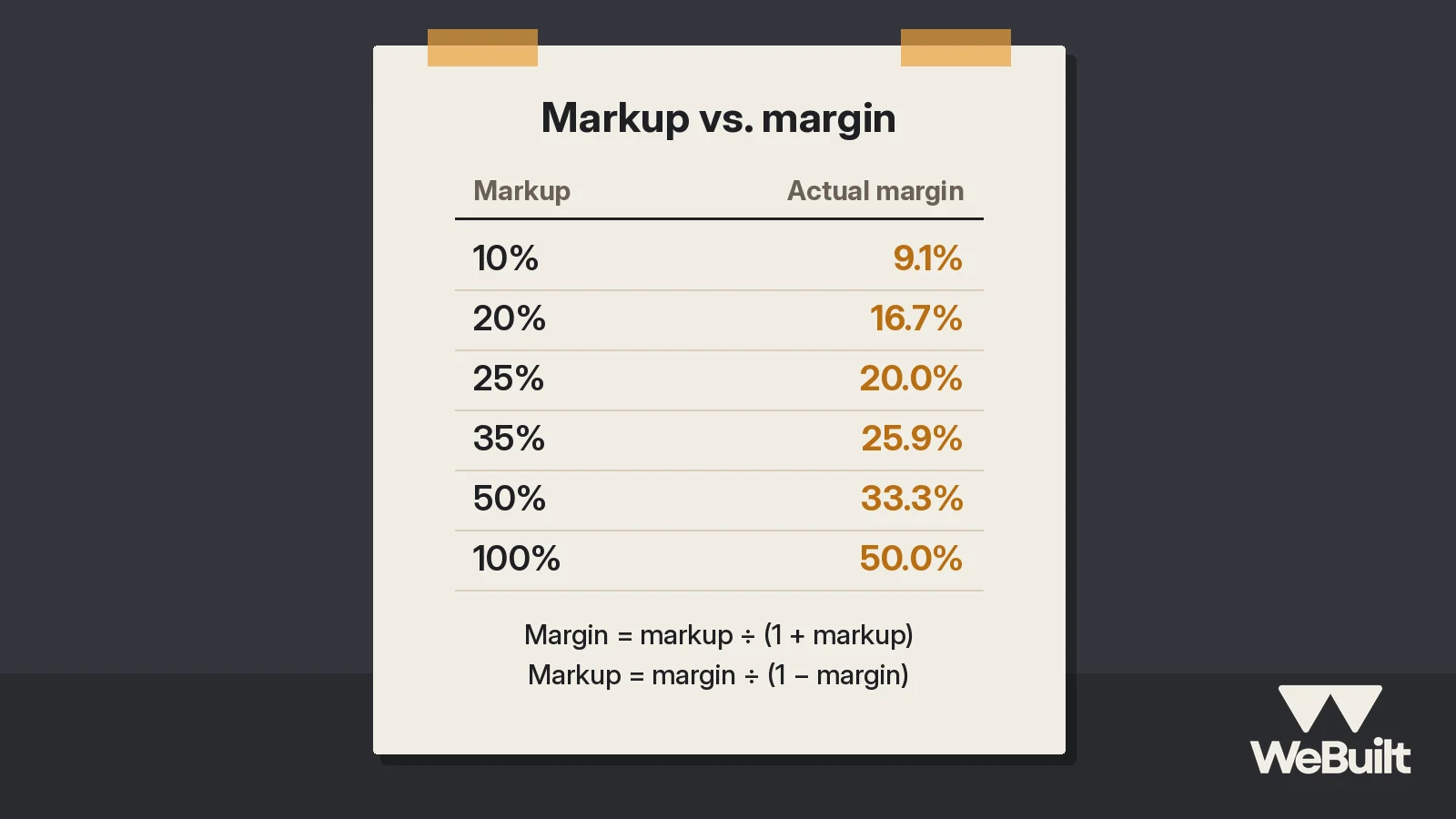
Here's what common markups actually leave you as margin [1]:
| Markup | Actual margin |
|---|---|
| 10% | 9.1% |
| 20% | 16.7% |
| 25% | 20.0% |
| 35% | 25.9% |
| 50% | 33.3% |
| 100% | 50.0% |
The formulas, if you want to work it out yourself [1]:
- Margin = markup ÷ (1 + markup)
- Markup = margin ÷ (1 − margin)
Why this quietly loses money
Your overhead (truck, insurance, phone, software, office help, and your own salary) is usually figured as a share of what you sell, not what the job costs. So if overhead runs 15% of sales and you want 10% profit, you need a 25% margin, not a 25% markup.
Buildertrend shows the fix with one formula [3]:
Selling price = cost ÷ (1 − overhead % − profit %)
In their example, a $100,000 job with 15% overhead and a 10% profit goal works out to $133,333, which is a 33.3% markup, not 25% [3].
Example: the same job priced two ways
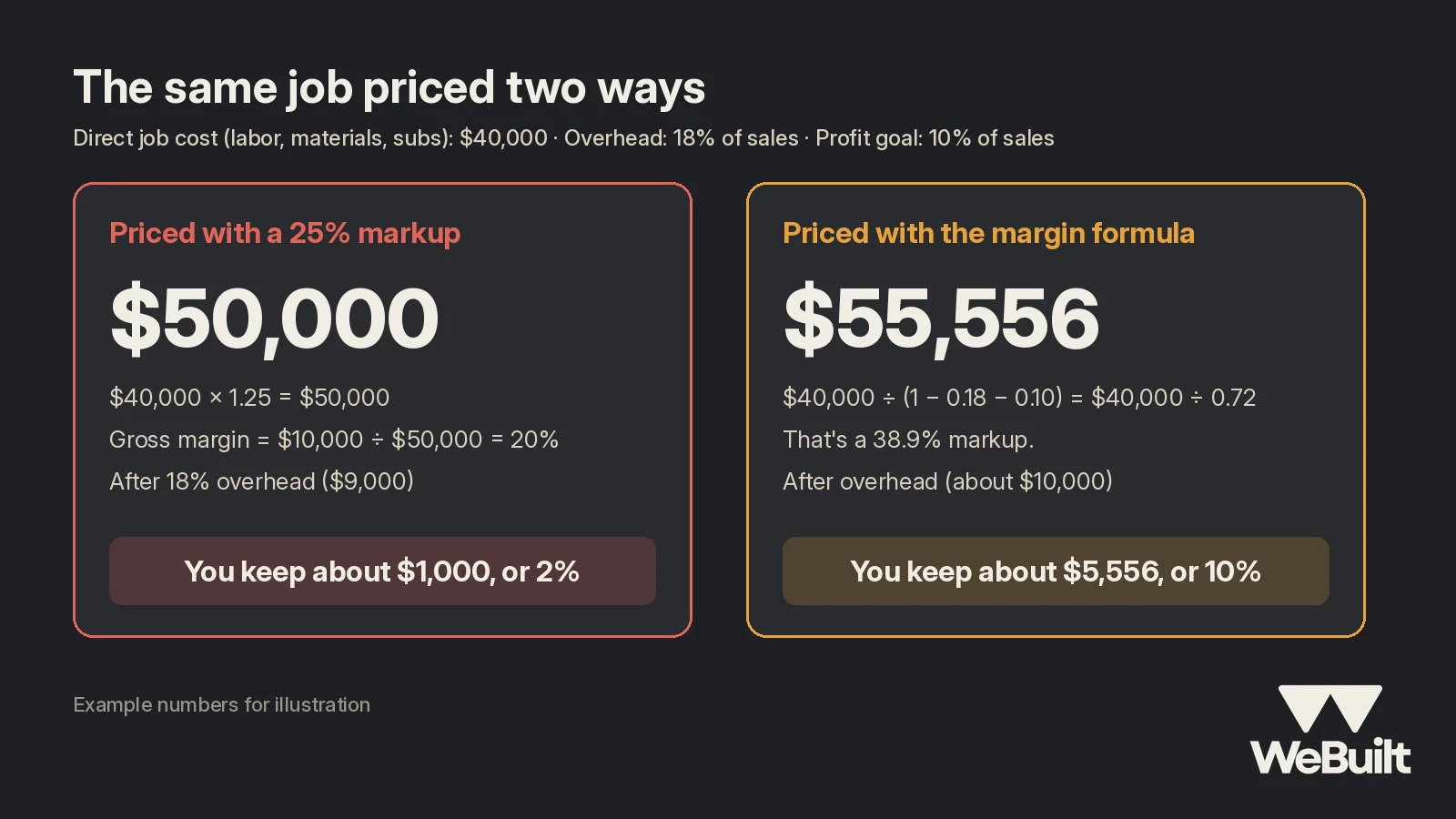
Example numbers for illustration:
- Direct job cost (labor, materials, subs): $40,000
- Overhead: 18% of sales
- Profit goal: 10% of sales
Priced with a 25% markup: $40,000 × 1.25 = $50,000. Gross margin = $10,000 ÷ $50,000 = 20%. After 18% overhead ($9,000), you keep about $1,000, or 2%.
Priced with the margin formula: $40,000 ÷ (1 − 0.18 − 0.10) = $40,000 ÷ 0.72 = $55,556. That's a 38.9% markup. After overhead (about $10,000), you keep about $5,556, or 10%.
Same job, same crew, same materials. The only difference is about $5,500 of profit that was never in the price.
What markup should you use?
There's no one right number, because it depends on your overhead. Buildertrend's guest expert, Carla Merrill of Builder's GoTo, warns that many builders assume overhead is a fixed 10% because that's the "industry average," and lose money when their real overhead is higher [3]. Buildertrend also cites NAHB figures showing general overhead for home builders can range from 10% to 25%, depending on the size and structure of the business [3].
So the order matters:
- Figure your real overhead as a percentage of sales.
- Pick the profit you want as a percentage of sales.
- Use the formula above to get the price, or convert the total margin to a markup with markup = margin ÷ (1 − margin) [1].
For a sense of what's typical, Buildertrend cites the Association of Professional Builders' 2025 report: new home builders with a documented sales process reached a median gross markup of 25%, compared with 20% for those without [3]. That's one survey of home builders, not a target for your trade, but it shows how thin the gap between profit and loss can be.
Three places margin leaks after the bid
Even with the right formula, margin can slip away while the job is running:
- Labor runs long. If your bid used the wage instead of the loaded rate, every hour is underpriced. A $25 wage can cost the business $32-$34 an hour once taxes, comp, and benefits are added [4].
- Small materials runs. A dozen trips to the supply house that never get tied to the job.
- Free changes. "While you're here" work that never became a change order.
That's why the price is only half the story. You also need to see, during the job, whether the margin you bid is the margin you're getting.
How to check your own numbers
Pull your last five finished jobs. For each one, write down the price, the total direct cost, and the gross margin (price minus cost, divided by price). Then compare that margin to your overhead percentage. If the margin isn't clearly bigger than overhead, those jobs didn't make money, even if they felt busy and paid on time.
WeBuilt does this for every job automatically: log costs as they happen and it shows the profit on each job, so you can see which jobs pay and which don't. See the platform.
How WeBuilt helps
The markup-versus-margin mistake usually stays hidden until the job is done and the money doesn't add up. WeBuilt helps you catch it by tracking each job's actual costs against your estimate and showing what every job really made. Instead of guessing whether that 25% markup left you anything after overhead, you can look at finished jobs and see the real margin on each one. Over a few months, that shows you which kinds of work are pricing out right and which ones need a higher number. WeBuilt won't set your prices for you, but it gives you the real numbers to price from.
Want to see it on your own jobs? Book a 15-minute walkthrough with Ian
FAQ
Is a 25% markup the same as a 25% profit?
No. A 25% markup is a 20% gross margin, and that's before overhead comes out [1].
How do I turn a margin goal into a markup?
Markup = margin ÷ (1 − margin). For a 25% margin, that's 0.25 ÷ 0.75 = 33.3% [1].
What's the simplest way to price a job so overhead and profit are covered?
Use selling price = cost ÷ (1 − overhead % − profit %) [3]. Then check during the job that actual costs are staying near the estimate.
See your profit per job
Book a 15-minute walkthrough with Ian and we'll show you profit per job on real numbers. Founding 25 spots are open for Utah contractors.
Sources
- Projul, Markup vs Margin in Construction Explained. Accessed November 2, 2026.
- Procore, Construction Markup vs Profit Margin. Accessed November 2, 2026.
- Buildertrend, How to Price Your Projects for Profitability. Accessed November 2, 2026.
- Estimate.Pro, The Contractor's Guide to Job Costing. Accessed November 2, 2026.