Guide
How to Follow Up on Estimates When Remodeling Demand Is Flat
Remodeling spending is forecast flat. A simple follow-up schedule and scripts to win more of the estimates you already sent, without being pushy.

It's easy to spend your marketing money and time chasing new leads. Meanwhile, a stack of estimates you already wrote sits there going cold. You did the site visit, measured, priced it, and sent it. The homeowner said "looks great, let us think about it." Then nothing.
In a market that isn't growing, those quiet estimates are the cheapest work you'll ever win. This guide gives you a follow-up schedule, three short scripts, and a simple way to keep track.
The market: flat spending, careful customers
Harvard's Joint Center for Housing Studies expects annual spending on home improvements and repairs to "remain relatively flat through late 2027" [1]. It expects year-over-year growth in renovation and repair spending to reach just 1.5 percent by the third quarter, with annual spending hovering around $525 billion through the third quarter of next year [1]. The Joint Center also notes that retail spending on building products has been flat to negative and remodeling permits have stagnated [1].
Remodelers themselves aren't panicking. NAHB's Remodeling Market Index came in at 62 for the third quarter of 2026, up one point from the previous quarter [2]. The leads and inquiries component rose two points to 53 [2]. But NAHB Remodelers Chair Elliott Pike also said remodelers report that economic uncertainty "is making some potential customers hesitant to move forward with projects" [2].
Put those together and you get the picture most remodelers already feel: people are still calling and asking for prices, but they're slower to say yes. The pie isn't growing. The way to grow is to win a bigger slice of the estimates you already sent.
Why estimates go quiet
An estimate rarely goes quiet because the homeowner hated it. More often, one of these happened:
- They're nervous about money. That's the hesitation NAHB describes [2].
- They're comparing. They have two or three numbers and can't tell what's different.
- The scope feels too big. The full kitchen is more than they planned to spend this year.
- Life got busy. Holidays, kids, work. Your estimate slid down the pile.
Only one of those is a "no." The rest are "not yet," and a polite follow-up is how you find out which.
A simple follow-up schedule
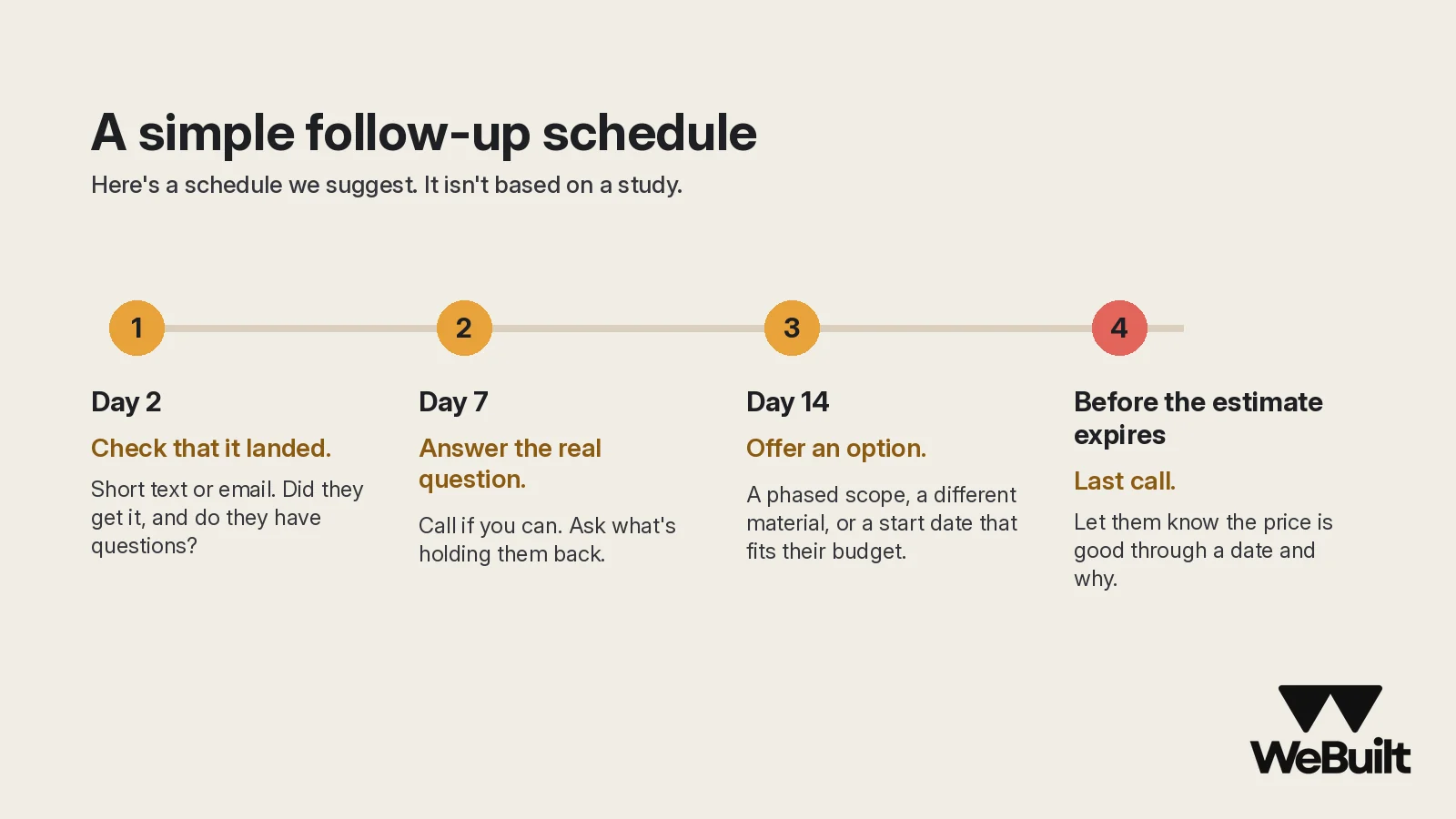
Here's a schedule we suggest. It isn't based on a study. It's a reasonable rhythm that keeps you in front of the homeowner without being a pest.
- Day 2: Check that it landed. Short text or email. Did they get it, and do they have questions?
- Day 7: Answer the real question. Call if you can. Ask what's holding them back.
- Day 14: Offer an option. A phased scope, a different material, or a start date that fits their budget.
- Before the estimate expires: Last call. Let them know the price is good through a date and why.
That last step matters more this year. Construction input prices have climbed, and AGC reports copper and brass mill shapes up 30.0% year over year [3]. A "good through" date on your estimate protects you from old prices, and it gives you an honest reason to call.
Three scripts you can use this week
Keep it short and human. Use your own words, but here's a starting point.
Day 2 check-in (text): "Hi Sarah, this is Mike with Ridgeline Remodeling. Just making sure the bathroom estimate came through. Happy to walk through any line on it. No rush."
Day 7 call (find the real objection): "I wanted to see where you've landed on the bathroom. A lot of folks we talk to are waiting on something: budget, timing, or comparing bids. Is any of that going on for you?"
Then listen. If it's money, go to the phased option. If it's comparing, offer to walk through what's included in your number so they can compare apples to apples.
Day 14 (offer an option): "If the full scope is more than you want to take on right now, we could do the shower and tile this winter and the vanity and lighting in the spring. Want me to price it that way?"
(Names and company in these scripts are made up for illustration.)
Track every open estimate in one place
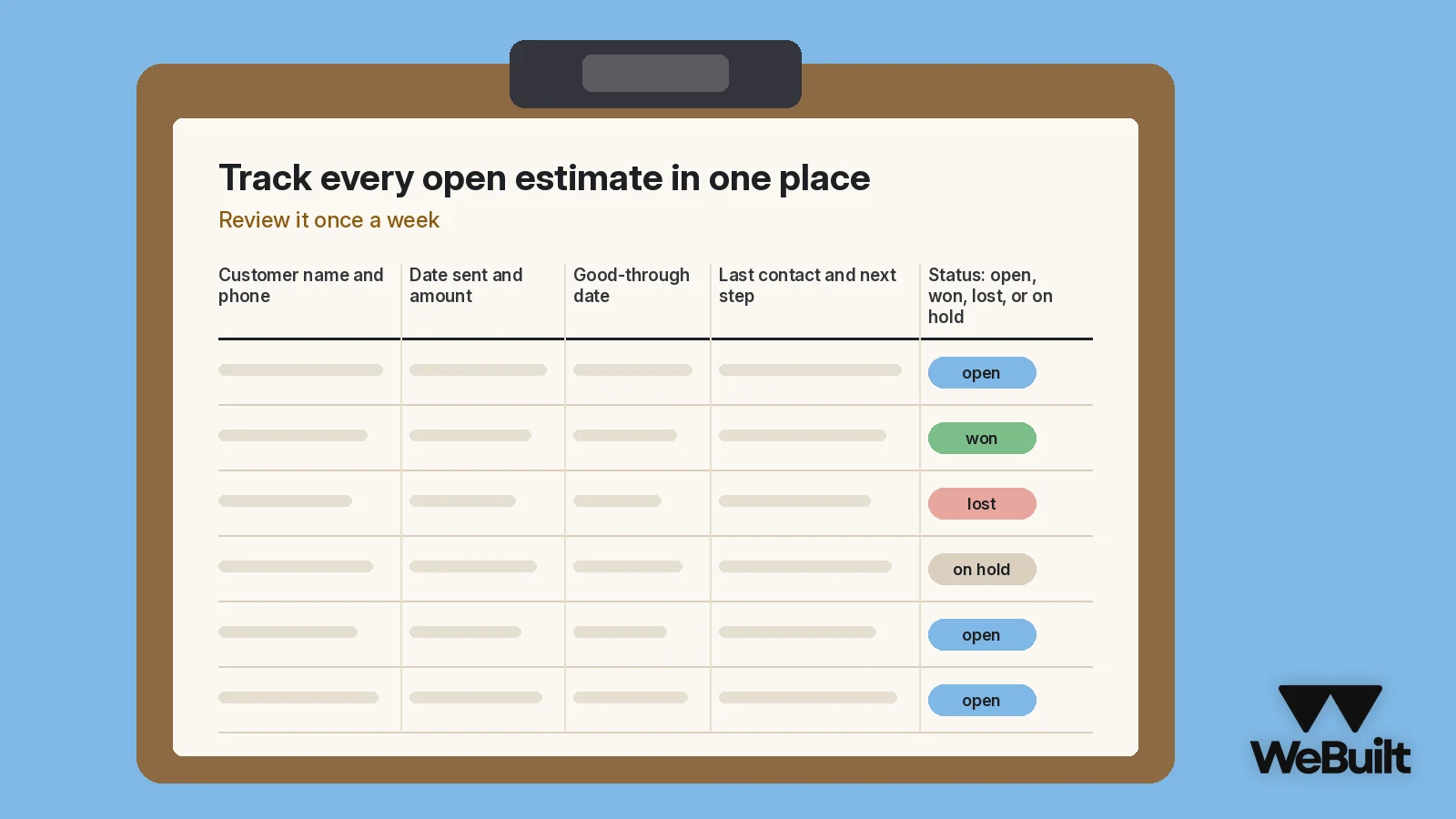
Follow-up fails when it lives in your head. Keep one list of every open estimate with:
- Customer name and phone
- Date sent and amount
- Good-through date
- Last contact and next step
- Status: open, won, lost, or on hold
Review it once a week, the same day you look at your active jobs. When you mark an estimate lost, write down why. After a few months, you'll know whether you're losing on price, timing, or scope.
Example: what follow-up is worth
Example numbers for illustration:
Say a remodeler sends 20 estimates in a quarter, averaging $18,000 each. Without a follow-up routine, 4 turn into jobs.
| Without follow-up | With a follow-up routine | |
|---|---|---|
| Estimates sent | 20 | 20 |
| Jobs won | 4 | 6 |
| Revenue won | $72,000 | $108,000 |
Two extra wins from the same 20 estimates is $36,000 in new work, with no new ads and no new site visits. Your results will differ, but even one extra job a quarter pays for the time it takes to make the calls.
How WeBuilt helps
Following up only pays if the jobs you win actually make money. WeBuilt keeps your customers, estimates, and jobs together, so when a quiet estimate turns into a signed job, the job already carries the numbers you priced it with. As you record costs against that job, WeBuilt shows revenue, cost, and margin for it, which is profit per job you can check while the work is still going. Over a season, that tells you which kinds of jobs are worth chasing hardest when you follow up, and which ones you should price differently next time. You still make the calls and decide what goes to the homeowner. See what's included today.
FAQ
How many times should I follow up on an estimate?
We suggest about four touches: day 2, day 7, day 14, and just before the estimate expires. That's a suggestion, not a rule. Stop when the homeowner says no.
Is it pushy to call about an estimate?
Not if you're helping. Asking what's holding them back and offering options is service. Many homeowners are simply hesitant right now [2].
Should my estimates have an expiration date?
Yes. With material prices up sharply this year [3], a good-through date protects your price and gives you a natural reason to check in.
Want help tightening your sales process?
Book a 15-minute walkthrough with Ian and bring a few of your open estimates. We'll show you how WeBuilt keeps each one tied to the customer and the job.
Sources
- Harvard Joint Center for Housing Studies, Remodeling Spending Continues to Stagnate (Oct 22, 2026). Accessed November 2, 2026.
- NAHB, Remodeling Market Sentiment Remains Stable in Third Quarter Despite Headwinds (Oct 8, 2026). Accessed November 2, 2026.
- Associated General Contractors of America, Construction Input Costs Rise 11.9% From September 2025 to September 2026 (Oct 15, 2026). Accessed November 2, 2026.