Checklist
Setting Expectations With Homeowners Before Day One
Most homeowner complaints start as unclear expectations. A pre-start checklist for remodelers: hours, dust, schedule, changes, updates, and the punch list.
Ask a remodeler about their worst job and you'll rarely hear about bad tile or a crooked cabinet. You'll hear about a homeowner who expected something different: that the crew would be gone by 3, that the kitchen would be usable on weekends, that "a few weeks" meant three.
Most of that is avoidable with one conversation before day one, put in writing. This checklist walks through it. This is general information, not legal advice. DOPL's model agreement is optional. Have an attorney review your own contract.
Why expectations go wrong
Utah's Division of Occupational and Professional Licensing (DOPL) says it plainly. DOPL and the Division of Consumer Protection "often receive complaints" and then learn that no agreement exists, or that the agreement "lacks the specificity to make clear what the expectations are" [1].
That's why DOPL publishes a free model residential construction agreement [1]. It's optional and "not intended as legal or professional advice" [1], but it's a good checklist of what to talk about before you start. The sections below lean on it.
The pre-start conversation: living with the job
Sit down with the homeowner a week or so before start and agree on the practical stuff. Write it down and give them a copy.
- Work hours. What time the crew arrives and leaves, and whether you work Saturdays.
- Noise. Which days will be loud (demo, tile cutting) so they can plan around them.
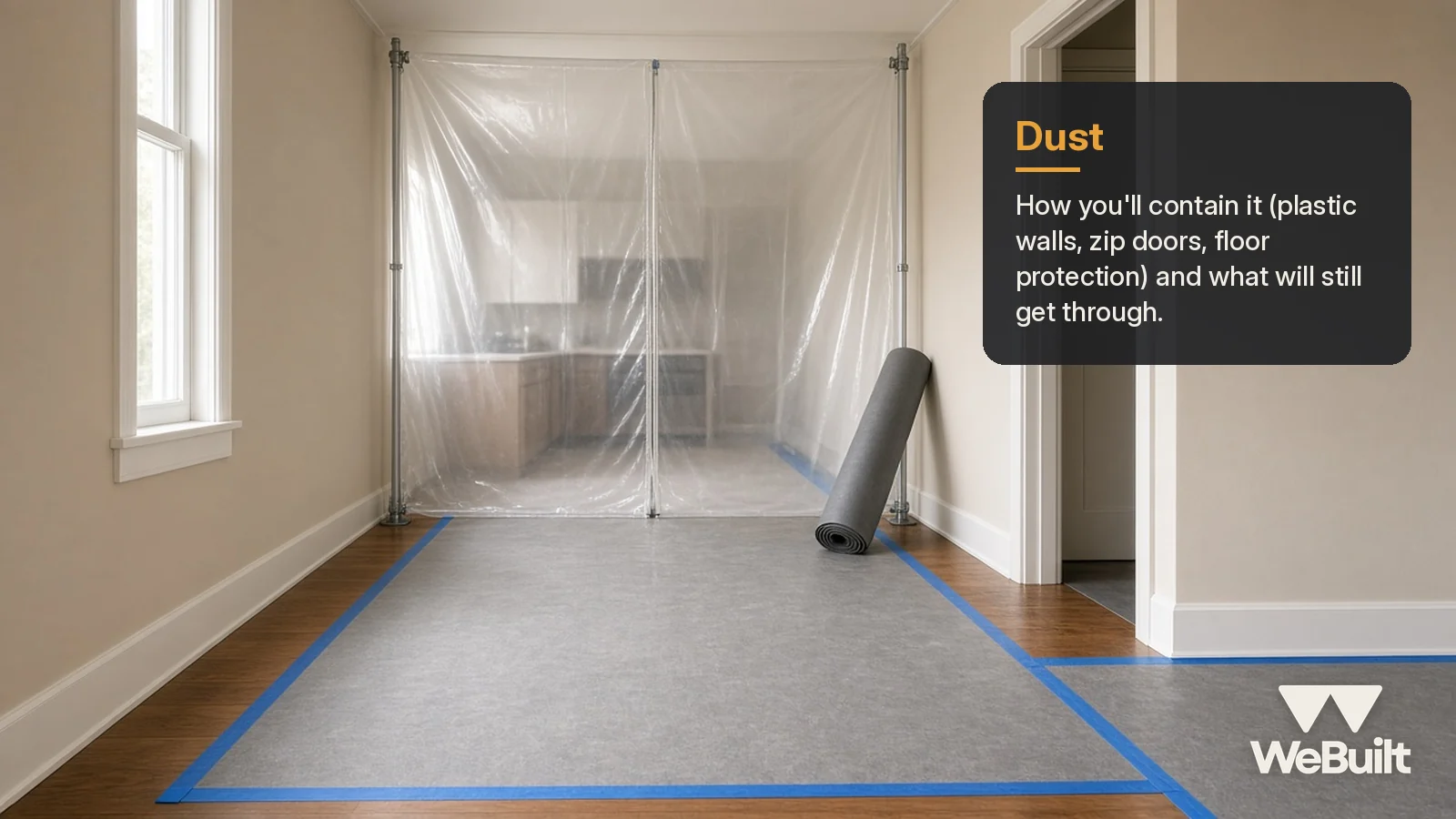
- Dust. How you'll contain it (plastic walls, zip doors, floor protection) and what will still get through.
- Off-limits rooms. Where the crew won't go, and which bathroom they can use, if any.
- Kitchen and bath access. When the homeowner loses use of them and for how long.
- Pets and kids. Where they'll be during work hours.
- Parking, dumpster, and deliveries. Where the truck, the dumpster, and material drops go.
Schedule: dates, decisions, and delays
DOPL's model contract has the contractor start "within 15 calendar days after receiving all necessary permits and approvals" [1]. It also calls for a written estimated schedule "that includes subcontractor activities, material delivery milestones, and deadlines for your decisions" [1].
That last part is the one people skip. If the homeowner hasn't picked tile by the date you need to order it, the schedule moves. Put decision deadlines on the schedule so they see it coming.
For delays, the model contract has the contractor notify the owner "within a reasonable amount of time (no longer than seven days)" [1]. Tell them sooner if you can.
Changes: price and time before the work
Under DOPL's model contract, before you do changed work, you give the homeowner a written estimate of the cost and time it adds. Then you both sign a change order [1]. The model agreement includes a change order form as Exhibit B [1].
Explain this before day one, not when the first change comes up. "Any time something changes, I'll show you the price and the days before we do it, and we'll both sign" goes over much better at the kitchen table than in the middle of demo.
Site visits and the weekly walk
The model contract lets the owner inspect the work "at reasonable times during normal business hours, but you cannot interfere" [1]. A simple way to handle that: offer a set weekly walk-through. The homeowner gets a regular look, and the crew isn't interrupted every afternoon.
How you'll communicate
Agree on three things:
- One point of contact. Usually you or your lead. Not whoever is on the ladder.
- One channel. Text, call, or email. Pick what the homeowner actually reads.
- A rhythm. For example, a short end-of-day text when something changed, and a weekly summary of what's done, what's next, and what decisions are coming.
The model contract also has the contractor promptly notify the owner in writing of safety hazards or injuries [1]. Mention that you will.
Older homes: lead-safe work comes first
If the house was built before 1978, the EPA's lead rules apply. Anyone paid to do work that disturbs paint in housing built before 1978 must be certified, including sole proprietors [3]. There's a minor-repair exemption for small areas, but window replacement and demolition are always covered [3].
Before the work starts, you also give the owner the EPA's lead pamphlet, no more than 60 days before beginning, and get a written acknowledgment [4]. That acknowledgment can be part of your written contract [4], so it fits naturally into the pre-start meeting.
The finish line: punch list and warranty
"Done" needs to mean the same thing to both of you. In DOPL's model contract, the punch list is made within ten days of substantial completion, and the contractor completes it "within 21 days" [1]. The model warranty covers repairing defects "within three years from the substantial completion date" [1]. Whatever your terms are, say them out loud before you start.
Protect the homeowner, and yourself
Utah's Residence Lien Recovery Fund is now depleted [2]. Homeowners can still be protected through a Certificate of Compliance, which requires a written contract, a licensed contractor, and the contractor having been paid in full. Once it's issued, the lienholder must remove the lien within 15 days [2]. That's one more reason every homeowner job should have a written contract and a licensed contractor.
Example: a bathroom remodel pre-start sheet
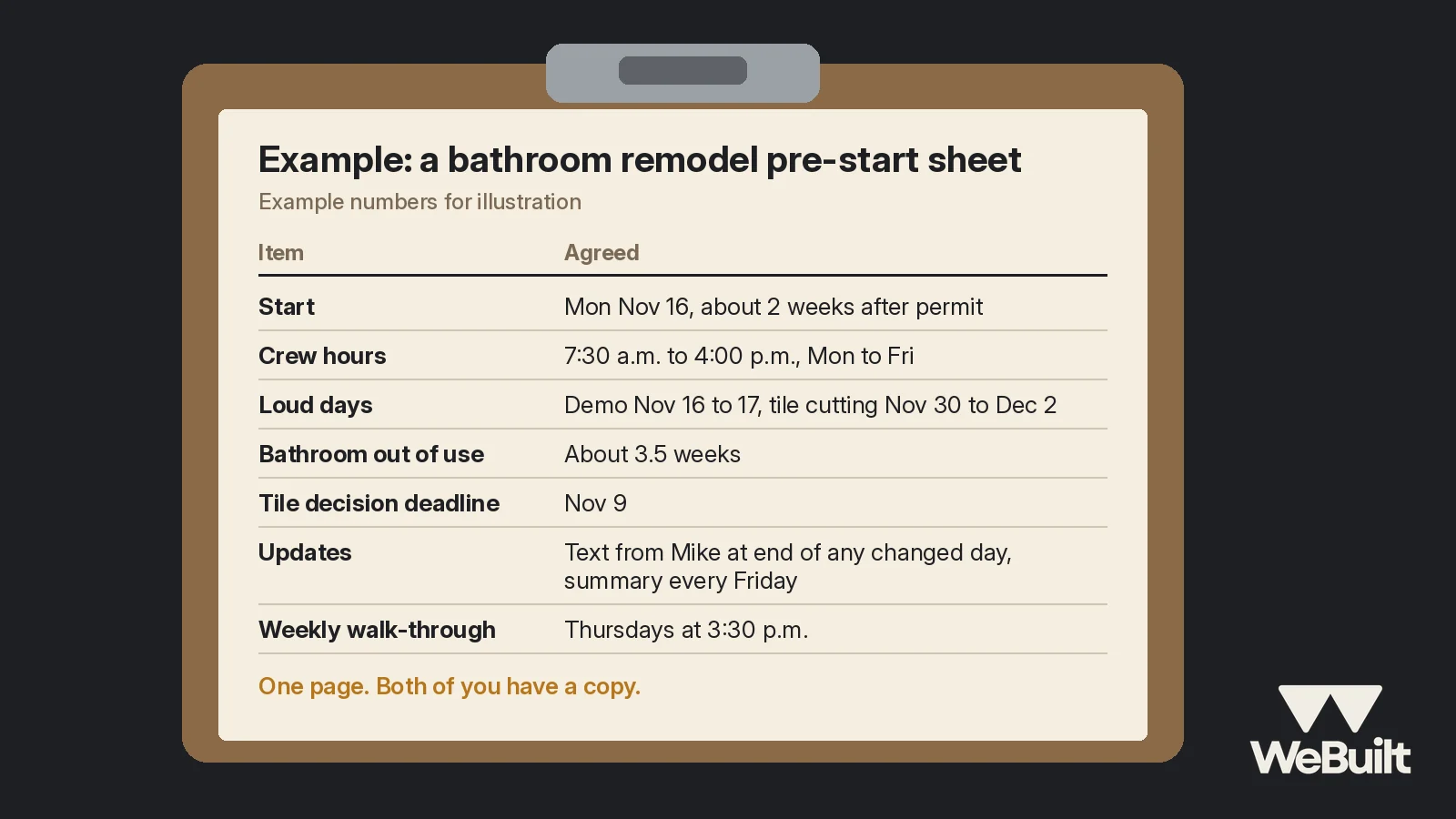
Example numbers for illustration:
| Item | Agreed |
|---|---|
| Start | Mon Nov 16, about 2 weeks after permit |
| Crew hours | 7:30 a.m. to 4:00 p.m., Mon to Fri |
| Loud days | Demo Nov 16 to 17, tile cutting Nov 30 to Dec 2 |
| Bathroom out of use | About 3.5 weeks |
| Tile decision deadline | Nov 9 |
| Updates | Text from Mike at end of any changed day, summary every Friday |
| Weekly walk-through | Thursdays at 3:30 p.m. |
One page. Both of you have a copy. Most of the "I didn't know" calls never happen.
How WeBuilt helps
Expectations and change orders both end up in the job's numbers. When a homeowner signs a change, the job's price and cost both move. WeBuilt keeps your customers, estimates, and jobs together, and as you record costs against each job, it shows revenue, cost, and margin for that job. Recording each approved change against the job keeps profit per job honest, so you can see whether a remodel that grew still made money. WeBuilt doesn't send homeowner updates or collect signatures. It keeps the job's numbers straight while you handle the conversation. See what's included today.
FAQ
What should I tell a homeowner before a remodel starts?
Hours, noise, dust, off-limits rooms, the schedule with their decision deadlines, how changes work, how you'll update them, and what "done" means. Put it in writing.
Do I have to use DOPL's model contract in Utah?
No. It's optional [1]. It's a useful checklist of what to cover. Have an attorney review your own contract.
When do I give the homeowner the EPA lead pamphlet?
For pre-1978 housing, no more than 60 days before renovation starts, with written acknowledgment [4].
Start your next job on the right foot
Book a 15-minute walkthrough with Ian and bring your pre-start checklist. Founding 25 spots are open for Utah remodelers.
Sources
- Utah DOPL, Construction Contract (model residential construction agreement). Accessed November 2, 2026.
- Utah Department of Commerce, Utah's Residence Lien Recovery Fund Is Officially Depleted: What Now? (June 11, 2026). Accessed November 2, 2026.
- U.S. EPA, Renovation, Repair and Painting Program: Contractors. Accessed November 2, 2026.
- eCFR, 40 CFR 745.84 Information distribution requirements (current text). Accessed November 2, 2026.