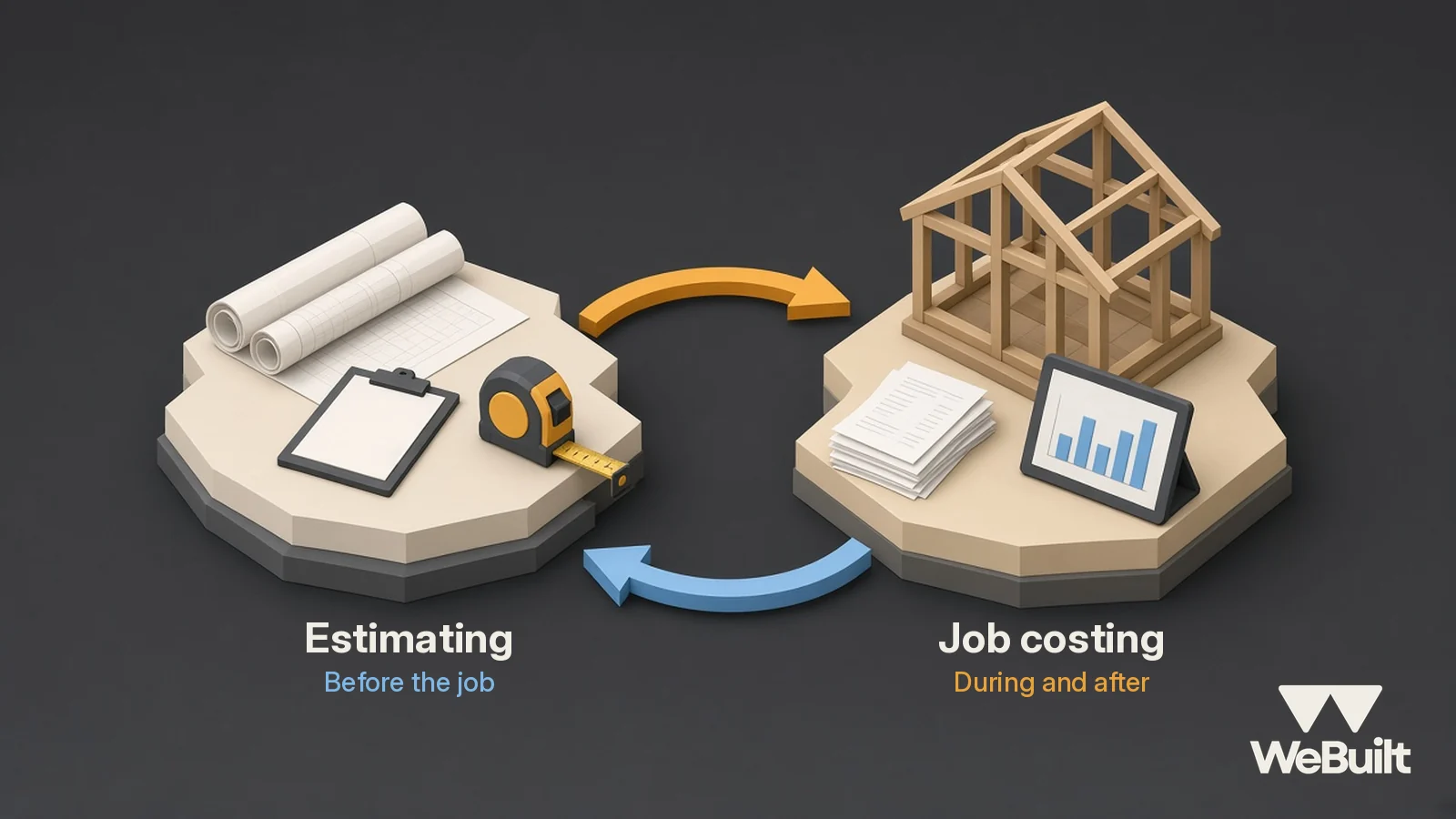
Guide
Waste Factors for Roofing and Concrete: How Much Extra to Order
How much extra shingle and concrete to order, with plain waste factor ranges, worked examples, and tips for supplier rounding so you don't come up short.
Every roofer and concrete finisher has a story about coming up short. A second shingle delivery that doesn't quite match. A truck that's 20 minutes away while the slab starts to set. Running short costs more than a little extra material, but ordering big "just in case" on every job also adds up.
A waste factor is the extra you plan for on purpose. Here's how to pick one.
Roofing: measure the real roof, then add waste
Start with the sloped roof area, not the footprint. A steeper roof has more area than the ground it covers. CalcSummit's guide applies a pitch factor first, then adds waste to the true sloped area [1].
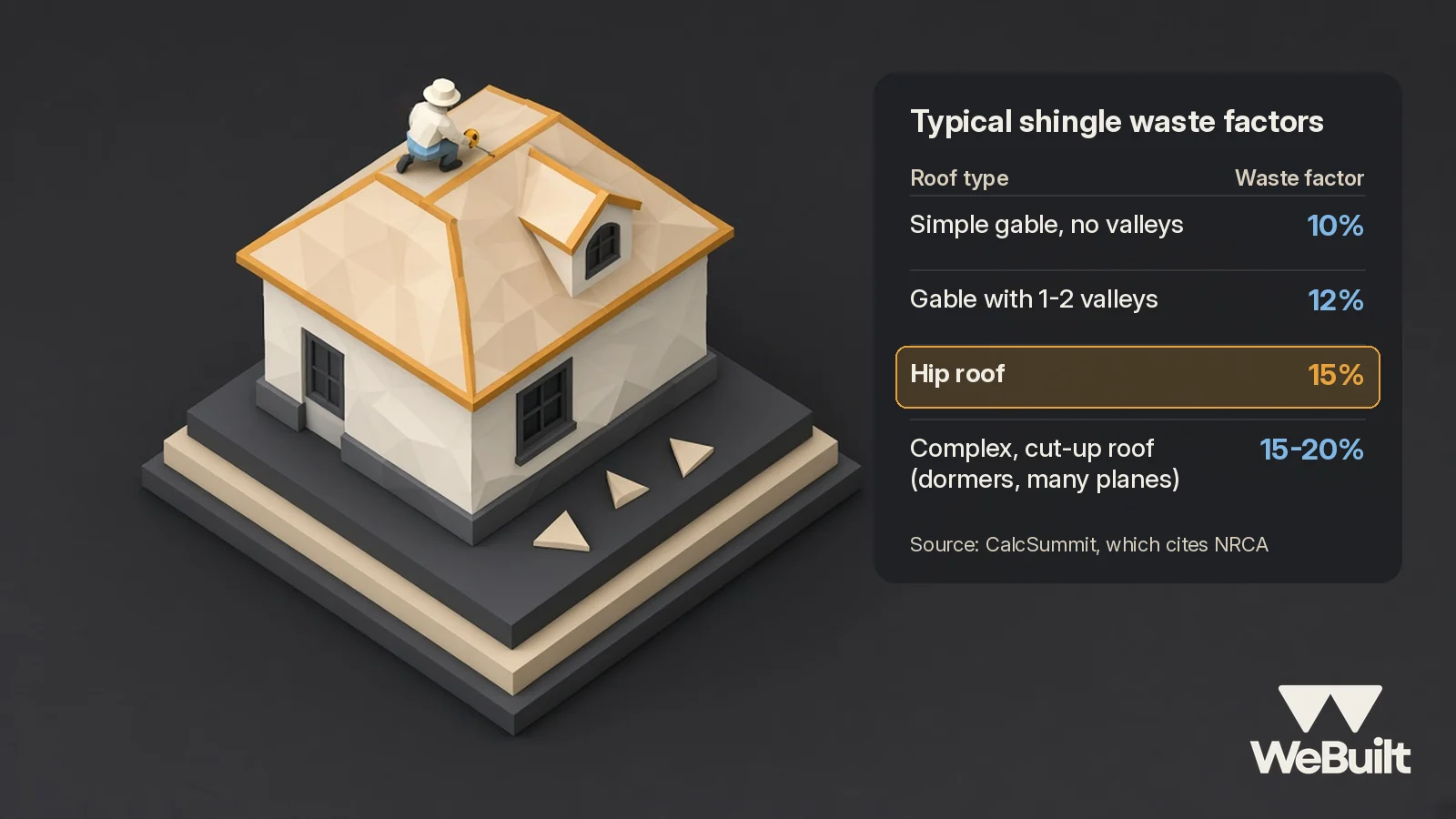
Typical shingle waste factors
| Roof type | Waste factor |
|---|---|
| Simple gable, no valleys | 10% |
| Gable with 1-2 valleys | 12% |
| Hip roof | 15% |
| Complex, cut-up roof (dormers, many planes) | 15-20% |
Source: CalcSummit, which cites NRCA [1].
For context, NRCA's review of the asphalt roofing manufacturers' (ARMA) residential manual says most asphalt shingle roofs need anywhere from 2% to 10% extra shingles for trim waste, and the amount depends on valleys, dormers, hips, ridges, and penetrations [2]. Many estimators use the higher ranges in the table above to also cover starter, mistakes, and odd cuts. Pick a number for each roof style you do and then check it against your actual leftovers.
Ridge cap is separate. CalcSummit's rule of thumb is about 3 bundles per 100 linear feet of ridge [1].
Roofing example: a hip roof
This example follows CalcSummit's worked example [1].
| Step | Math | Result |
|---|---|---|
| Footprint | 30 ft × 50 ft | 1,500 sq ft |
| Pitch 5/12, factor 1.083 | 1,500 × 1.083 | 1,625 sq ft |
| Squares (100 sq ft each) | 1,625 ÷ 100, rounded up | 17 squares |
| Add 15% hip waste | 17 × 1.15 | 19.55 squares |
| Order | rounded up | 20 squares (60 bundles) |
At three bundles per square, that's 60 bundles plus ridge cap [1].
Concrete: volume first, then overage
The volume math is simple: length × width × thickness, all in feet, divided by 27 for cubic yards [3]. Then add overage for an uneven subgrade, form bowing, spillage, and what's left in the pump or chute.
The American Concrete Institute's craftsman guide says it's common to add 10% or 15% to small loads and 5% to 10% to larger orders to cover subgrade settlement, uneven subgrade, spillage, and waste [3]. EasyConcreteCalc says many residential estimates use 5-10% as a planning allowance, with more for footings, post holes, thickened edges, and irregular forms [4].
Pick your overage by site
- Lower end: formed slab on a compacted, level base [4][5]
- Higher end: hand-dug footings, rough or uncompacted ground, thickened edges, curves, or a first-time pour type [4][5]
BuildNumerics adds a smart habit: keep both numbers, the exact volume and the order volume, so you can see how much buffer you built in [5].
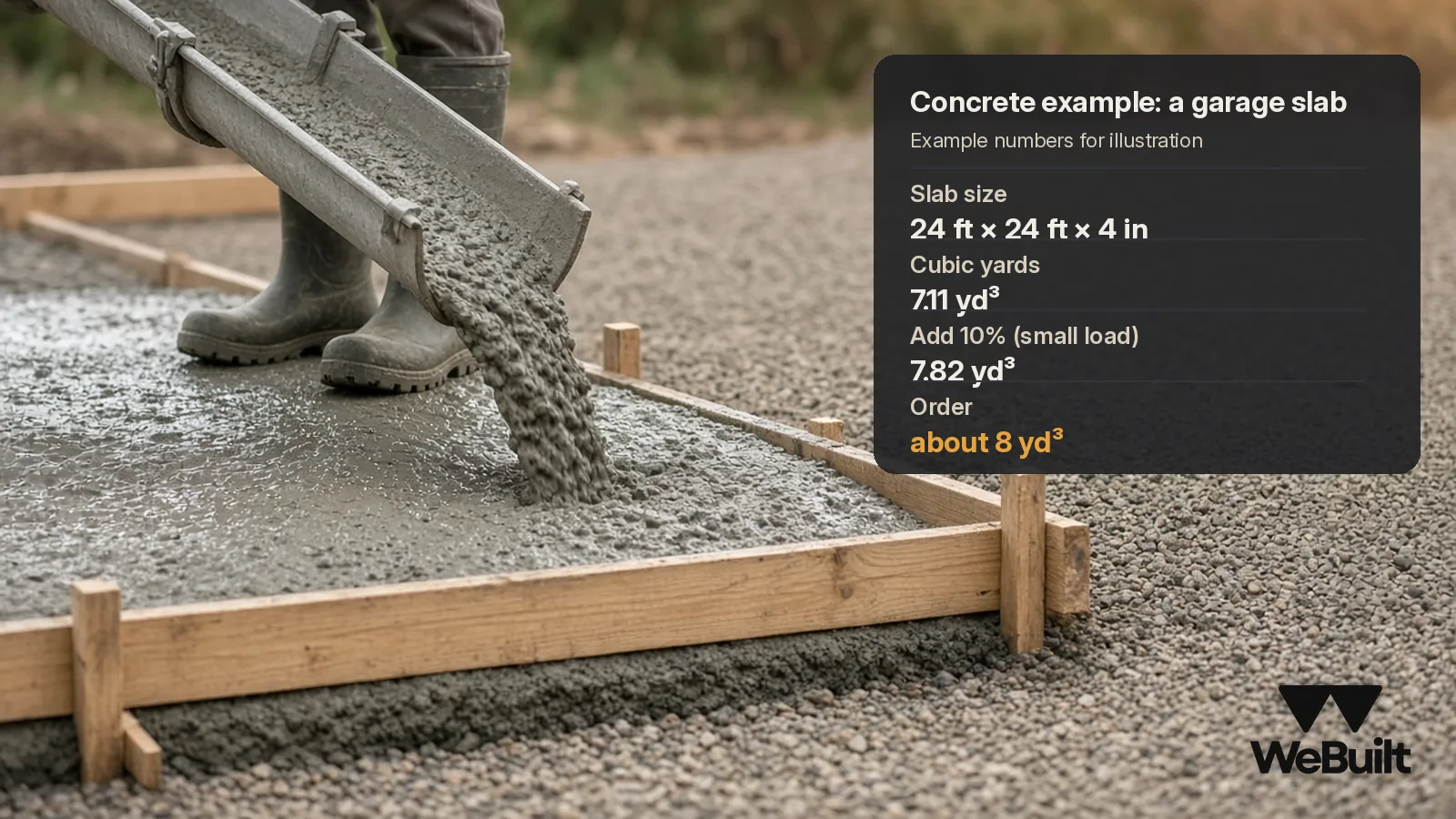
Concrete example: a garage slab
Example numbers for illustration:
| Step | Math | Result |
|---|---|---|
| Slab size | 24 ft × 24 ft × 4 in (0.333 ft) | 192 cu ft |
| Cubic yards | 192 ÷ 27 | 7.11 yd³ |
| Add 10% (small load) | 7.11 × 1.10 | 7.82 yd³ |
| Order | round up to supplier's increment | about 8 yd³ |
Increments and minimums differ by ready-mix supplier, so confirm before you schedule [4][5]. And ask how returned concrete is handled. Too much overage has its own cleanup and disposal costs [4].
Why coming up short costs more
CalcRig puts it the way experienced finishers do: it's always cheaper to send back a quarter yard than to come up a quarter yard short. A short pour can mean a cold joint, a callback, and possibly a tear-out [6]. On roofs, under-ordering can mean a second delivery and shingles from a different lot that don't quite match.
But more isn't always better. CalcRig's advice is to know before the truck shows up where any extra concrete will go, like a small pad or a few fence posts, because dumping wet concrete on the ground is wasteful and creates a disposal headache [6]. The goal is a planned buffer, not a guess.
Quick notes for other trades
CalcSummit's general rule for construction materials is at least 10% extra, with more for tile (15%) and stone (20%) [7]. Whatever your trade, the same steps apply:
- Calculate the exact quantity from real measurements.
- Add a waste factor based on the job's complexity.
- Round up to what you can actually buy: full bundles, boxes, sheets, or the supplier's increment.
- Write down what was left over so next time's factor is based on your jobs.
Track what you actually used
Waste factors get better when you write down what you ordered and what was left over. Record it with the job's material costs, and after a few jobs you'll know your real number for each roof style or slab type.
WeBuilt tracks material costs on every job, so overruns and leftovers show up in the job's profit. See the platform.
FAQ
What waste factor should I use for a hip roof?
About 15%, compared with 10% for a simple gable, according to CalcSummit's table citing NRCA [1].
How much extra concrete should I order?
Commonly 10-15% on small loads and 5-10% on larger orders, per ACI [3]. Adjust for your site.
Should waste be applied to the footprint or the roof area?
The sloped roof area. Apply the pitch factor first, then the waste [1].
How WeBuilt helps
A waste factor is a guess until you check it against what actually happened on the job. WeBuilt tracks each job's actual costs against your estimate, so when a roof needs a second shingle delivery or a slab takes an extra half yard, the extra cost shows up on that job. Over a season, you can see whether your 15% on hip roofs or 10% on slabs is about right, too tight, or leaving money in the dumpster. It also shows what each job made after the material overruns. WeBuilt doesn't measure roofs or calculate yardage for you, but it shows you whether your waste numbers are holding up on real jobs.
Want to see it on your own jobs? Book a 15-minute walkthrough with Ian.
Tighten up your material numbers
Book a 15-minute walkthrough with Ian. Founding 25 spots are open for Utah roofers and concrete crews.
Sources
- CalcSummit, Roofing Calculator: Squares, Bundles & Pitch (waste factor table and hip roof example). Accessed November 2, 2026.
- Professional Roofing (NRCA), Asphalt shingle guidance (review of ARMA residential manual). Accessed November 2, 2026.
- American Concrete Institute, CCS-1 Concrete Craftsman Series preview (quantity calculation). Accessed November 2, 2026.
- EasyConcreteCalc, Concrete Waste and Overage Guide. Accessed November 2, 2026.
- BuildNumerics, How to Calculate Concrete With Waste. Accessed November 2, 2026.
- CalcRig, Concrete Estimating: Get Your Order Right. Accessed November 2, 2026.
- CalcSummit, Free Construction Calculators (contractor waste tip). Accessed November 2, 2026.