Guide
Job Costing for Roofers: Tracking Tear-Off, Materials, and Crew Days
Roofers price by the square, but roofs make or lose money in tear-off, disposal, waste, and crew days. What to track per roof and compare after each one.
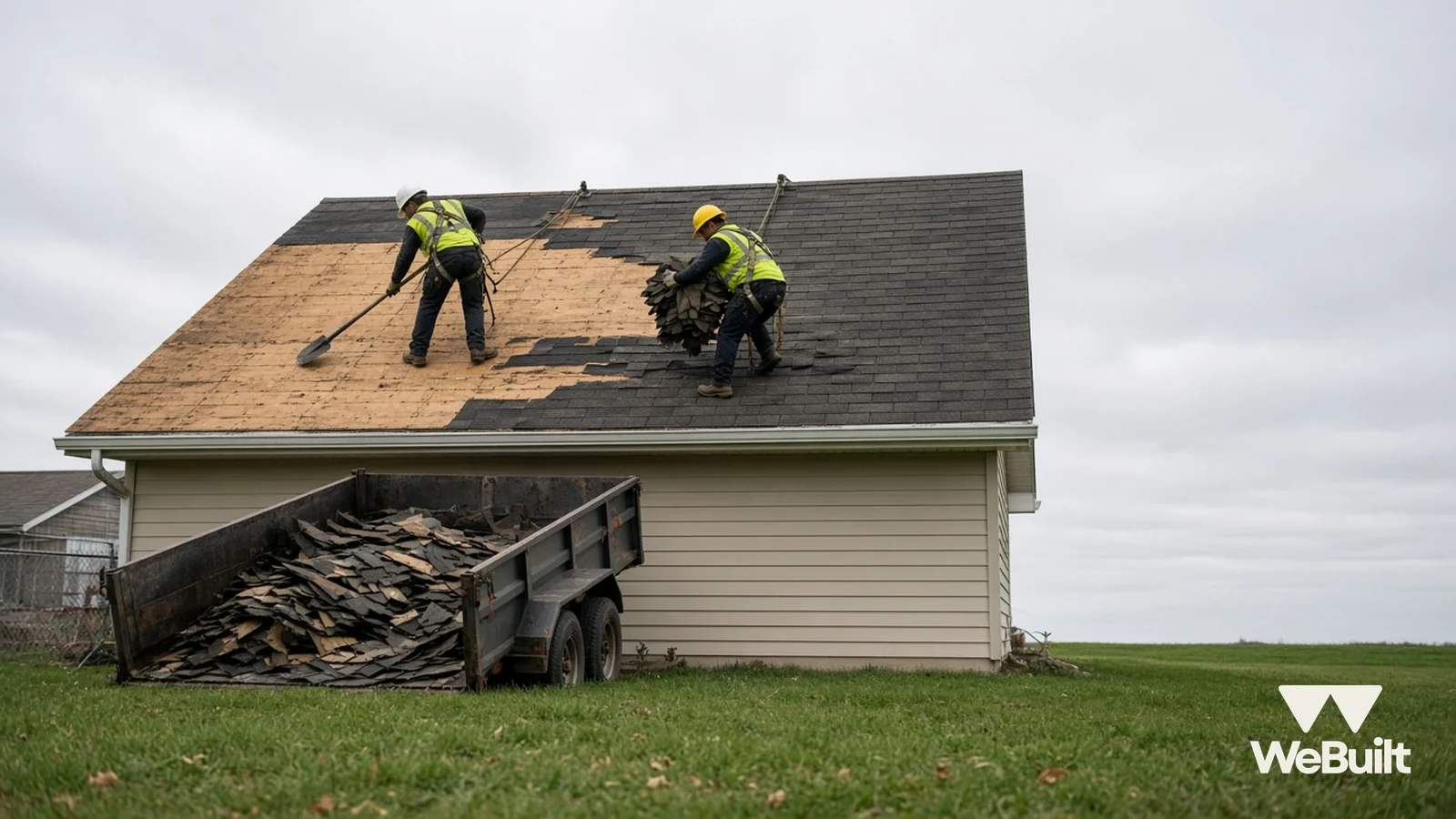
Roofers price by the square. But two roofs with the same square count can end up thousands of dollars apart in profit. The difference is almost always in the same places: tear-off, extra layers, rotten decking, disposal, waste, and how many days the crew was up there.
Job costing a roof means tracking those things on every job and comparing them to your estimate when the roof is done. Here's how to do it without turning it into a second job.
The unit: what a square really is
A roofing square is 100 square feet of roof area, a 10-by-10 [1]. That's roof area, not the house's footprint. A steep or cut-up roof has a lot more squares than the floor plan suggests.
For most standard asphalt shingles, 3-tab and architectural, there are three bundles per square. Some specialty shingles need up to five [1]. Roofers use squares to price materials, including shingles, underlayment, and water barriers, plus labor [1]. That's why cost per square is the number to track after every job.
The cost buckets on every roof
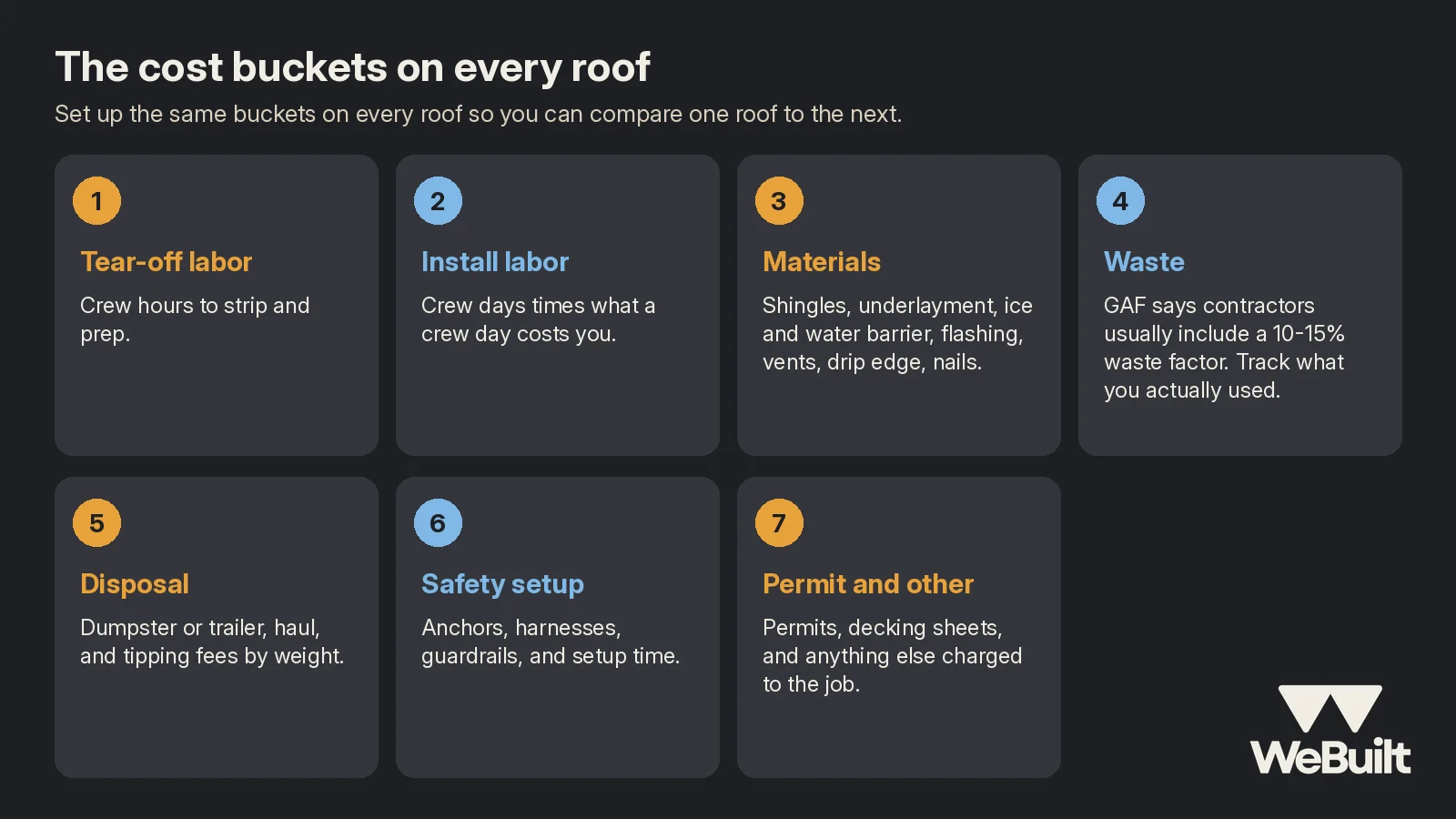
Set up the same buckets on every roof so you can compare one roof to the next:
- Tear-off labor. Crew hours to strip and prep.
- Install labor. Crew days times what a crew day costs you.
- Materials. Shingles, underlayment, ice and water barrier, flashing, vents, drip edge, nails.
- Waste. GAF says contractors usually include a 10-15% waste factor [1]. Track what you actually used.
- Disposal. Dumpster or trailer, haul, and tipping fees by weight.
- Safety setup. Anchors, harnesses, guardrails, and setup time.
- Permit and other. Permits, decking sheets, and anything else charged to the job.
Tear-off: where estimates break
Most roofing surprises show up after the first course comes off: a second or third layer, soft decking, rotted fascia. Record two things on every tear-off:
- Layers found versus layers you estimated.
- Decking sheets replaced versus your allowance.
After a season, those two notes tell you whether your tear-off pricing and decking allowances match what you actually find in your area.
Crew days: the biggest number that moves
Labor is where a roof's margin goes. To see what a crew day costs, start with wages and add your burden (payroll taxes, workers' comp, and so on). For scale, the national median wage for roofers was $55,440 a year in May 2025, or $26.65 an hour [2]. Use your own wages, not the national median, and add your actual burden.
The work is hard and seasonal. Roofers often carry bundles that weigh 60 pounds or more, and in northern states roofing work may be limited in winter [2]. Fewer good days means each crew day has to be planned and costed well.
Disposal: keep the weigh tickets
Disposal is a real cost line, and it's charged by weight at many landfills. As one Utah example, North Pointe Solid Waste Special Service District lists construction and demolition loads over 500 pounds at $34.00 per ton, effective January 1, 2026 [5]. Your district's rates will differ. Check them.
Keep every weigh ticket and record the tons against the roof. After a few jobs, you'll know about how many tons per square your typical tear-off produces, which makes your next disposal line much more accurate.
Materials and Utah sales tax
On a furnish-and-install roof, Utah treats the roofer as the last owner of the materials. You pay sales tax when you buy them, and your charge to the homeowner isn't taxable [6]. So include the tax you paid in your materials cost. If you leave it out, every roof looks a little more profitable than it is.
Safety is a cost line
Fall protection costs time and gear, and it belongs in the job cost. Under OSHA's rule, each employee on a steep roof with unprotected sides and edges 6 feet or more above lower levels must be protected by guardrails with toeboards, safety nets, or personal fall arrest systems [3]. Residential construction work 6 feet or more above lower levels carries a similar requirement unless another provision allows an alternative [3].
It matters. Fatal falls, slips, and trips among construction and extraction workers were 370 in 2024 [4]. Price the setup into every roof so nobody is tempted to skip it to save time.
Example: one 28-square tear-off
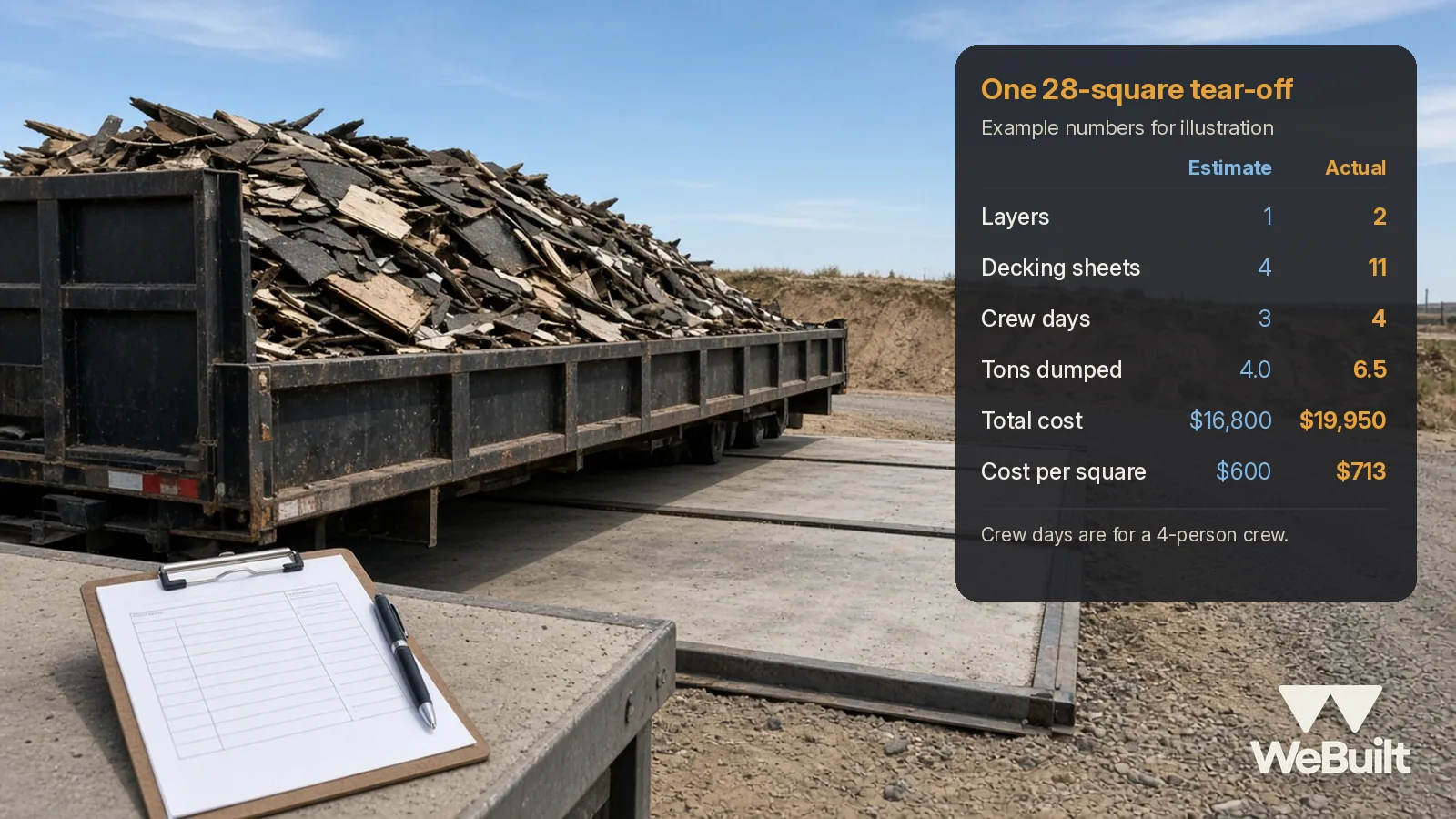
Example numbers for illustration:
| Line | Estimate | Actual |
|---|---|---|
| Squares | 28 | 28 |
| Layers | 1 | 2 |
| Decking sheets | 4 | 11 |
| Crew days (4-person crew) | 3 | 4 |
| Tons dumped | 4.0 | 6.5 |
| Waste | 12% | 15% |
| Total cost | $16,800 | $19,950 |
| Cost per square | $600 | $713 |
The roof sold for $22,400. The estimate planned $5,600 of gross profit. Actual was $2,450. The second layer added a crew day and 2.5 tons of disposal, and the extra decking added material and time.
That's not a reason to panic. It's a reason to check your contract. If it covered extra layers and decking by the sheet, most of that difference becomes a change order, and the next estimate in that neighborhood assumes two layers.
Compare five numbers after every roof
When the roof is done, write down:
- Estimated vs. actual squares
- Estimated vs. actual crew days
- Estimated vs. actual tons dumped
- Estimated vs. actual waste %
- Estimated vs. actual cost per square
Keep a running average by roof type: simple gable, cut-up hip, low-slope. In a season you'll know your real cost per square for each, and your bids will show it.
How WeBuilt helps
Every roof is its own job in WeBuilt. Record crew labor, materials, dump tickets, and the extra decking against that roof as they happen, and WeBuilt shows revenue, cost, and margin for the job. When the roof is done, you can compare actual cost against what you estimated and see profit per job, then carry the real numbers into your next bid. You still keep the weigh tickets and decide how to price. WeBuilt keeps the money side of each roof in one place. See what's included today.
FAQ
What is a roofing square?
100 square feet of roof area, or 10 feet by 10 feet [1].
How much waste should I figure on a roof?
GAF says contractors usually include 10-15% [1]. Track your actual waste on each roof and adjust for roof type.
Should I include sales tax in my roofing material cost in Utah?
On furnish-and-install work, you pay the tax when you buy materials [6], so yes, include it in materials cost.
See your cost per square
Book a 15-minute walkthrough with Ian and bring your last three roofs. Founding 25 spots are open for Utah roofers.
Sources
- GAF, How Many Bundles of Shingles Are in a Square? (Aug 24, 2026). Accessed November 2, 2026.
- U.S. Bureau of Labor Statistics, Occupational Outlook Handbook: Roofers. Accessed November 2, 2026.
- eCFR, 29 CFR 1926.501 Duty to have fall protection (current text). Accessed November 2, 2026.
- U.S. Bureau of Labor Statistics, Census of Fatal Occupational Injuries Summary, 2024. Accessed November 2, 2026.
- North Pointe Solid Waste Special Service District, Fees & Charges (Exhibit A, Utah Public Notice Website). Accessed November 2, 2026.
- Utah State Tax Commission, Publication 42, Sales and Use Tax Information for Contractors (Rev. 07/26). Accessed November 2, 2026.