Checklist
Your Estimate Is From Spring. Your Costs Aren't: A Weekly Job Check
Material prices rose fast this year and bids are hard to raise. A 15-minute weekly estimate-vs-actual check that catches margin leaks on active jobs.

A lot of the jobs on your board right now were priced in the spring or summer. The lumber, wire, pipe, and fuel you're buying for them this week were not. If you only find out how a job did when it's finished, the margin you lost is already gone.
This checklist is a 15-minute habit for every Monday (or Friday, whatever works): line up each active job's estimate against what you've actually spent, and deal with the gaps while the job is still open.
The squeeze: costs up, prices hard to raise
The numbers this fall are not subtle. Associated Builders and Contractors reported that construction input prices rose 2.2% in September from August and are up 11.2% year over year [1].
The Associated General Contractors of America, looking at a different index (the producer price index for inputs to new nonresidential construction), found it up 11.9% from September 2025 to September 2026, the most in four years [2]. Those are two separate measures, so don't add or average them. Either way, the direction is the same.
Some line items moved even faster. AGC reports the diesel fuel index more than doubled, rising 115.2%, and truck transportation of freight rose 19.3% [2]. That shows up in delivery charges and in what it costs to run your own trucks.
For remodelers, NAHB's Remodeling Input Price Index shows input costs up over 51% from Q1 2019 to Q3 2026 [3]. In NAHB's third-quarter survey, remodelers in some parts of the country reported "issues with high material costs and finding enough labor to finish projects on time" [4].
And here's the hard part: AGC says construction firms "appear to be absorbing most of the cost increases amid relatively soft demand" [2]. In plain terms, many contractors are eating it.
Why end-of-job costing is too late
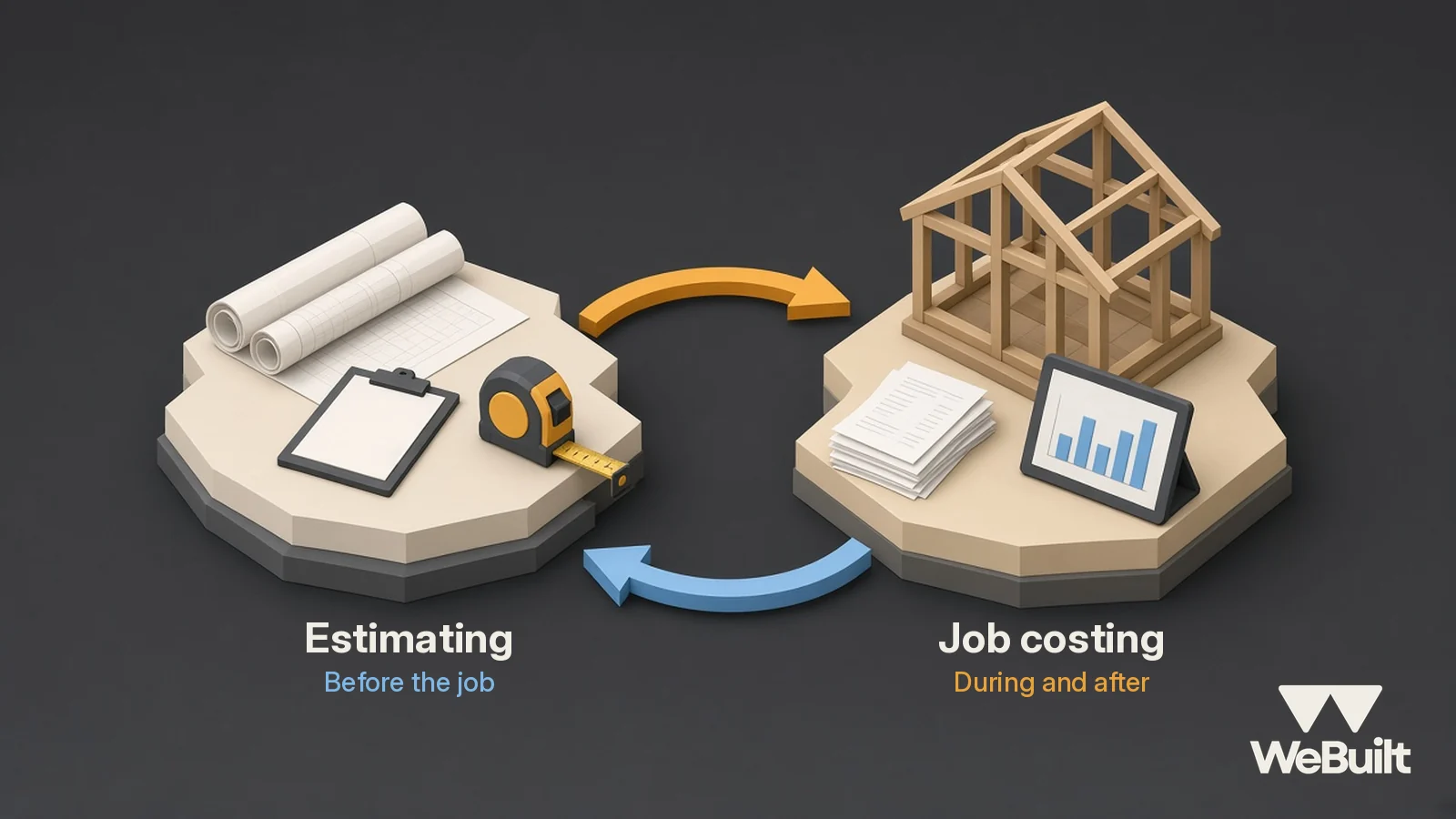
If you wait until closeout to compare estimate to actual, you learn the lesson but you can't use it on that job. By then:
- The materials are bought and installed.
- The homeowner has stopped expecting any price conversation.
- Extra work that should have been a change order is just "part of the job."
A weekly check moves that conversation up to the moment you can still re-order, re-sequence, or write a change order.
The 15-minute weekly check
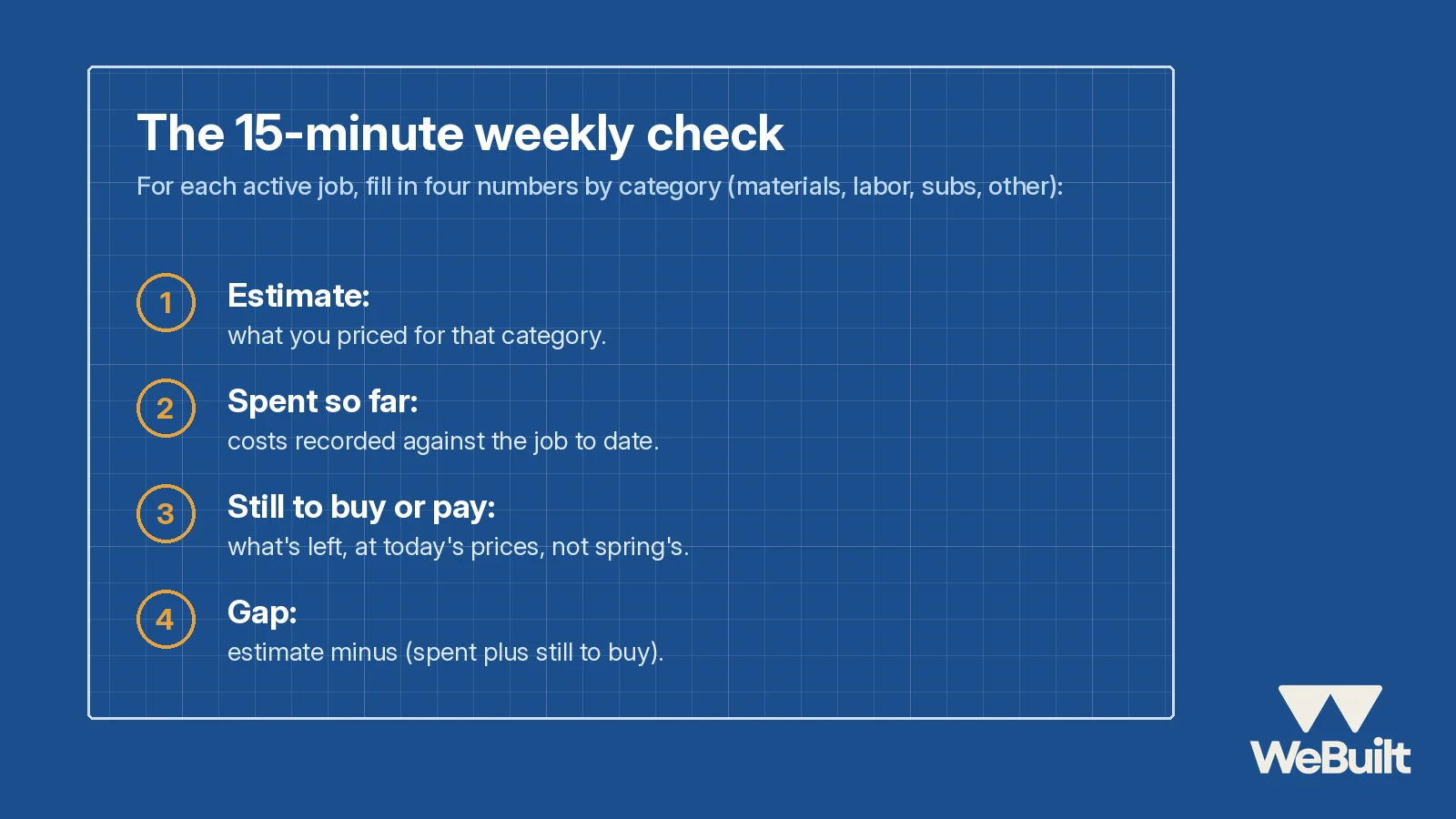
For each active job, fill in four numbers by category (materials, labor, subs, other):
- Estimate: what you priced for that category.
- Spent so far: costs recorded against the job to date.
- Still to buy or pay: what's left, at today's prices, not spring's.
- Gap: estimate minus (spent plus still to buy).
Then run down this list:
- Every receipt and crew hour from the past week is recorded against a job.
- Remaining materials are re-priced with a current supplier quote, not the old estimate.
- Any category with a negative gap has a note: change, timing, or miss.
- Any change the homeowner asked for has a written change order.
- Big upcoming orders (cabinets, fixtures, wire, steel) have a confirmed price and delivery date.
That's it. The first week takes longer. After that, 15 minutes covers a handful of jobs.
What to do with a gap
A gap is information, not a verdict. Sort it into one of three buckets:
It's a change. The homeowner upgraded the tile, or you found rot behind the wall. Write the change order now, with a photo, a price, and the days it adds, while the homeowner can still see why.
It's a price jump. Your remaining materials cost more than you priced them at. Look at what can still move: lock in a price on the next big order, offer an equivalent product, or check your contract for any price-adjustment language. If your contract has none, that's a note for the next one, and a reason to put a good-through date on every estimate. Talk to your attorney before adding escalation language.
It's a miss. The crew is running long, or you under-counted. Fix what you can on the remaining work and write down the real number for next time.
Example: a bathroom remodel at the halfway mark
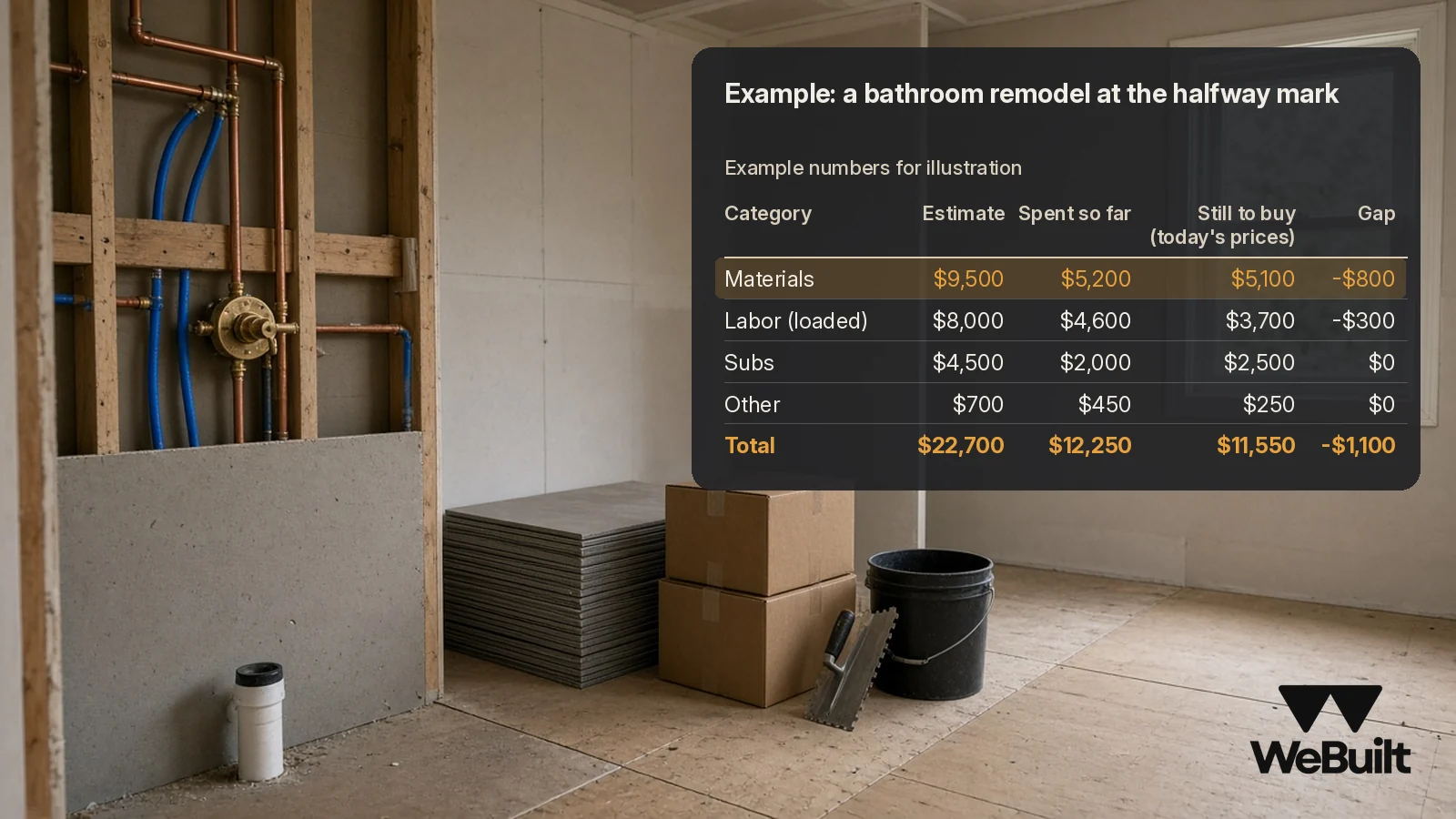
Example numbers for illustration:
| Category | Estimate | Spent so far | Still to buy (today's prices) | Gap |
|---|---|---|---|---|
| Materials | $9,500 | $5,200 | $5,100 | -$800 |
| Labor (loaded) | $8,000 | $4,600 | $3,700 | -$300 |
| Subs | $4,500 | $2,000 | $2,500 | $0 |
| Other | $700 | $450 | $250 | $0 |
| Total | $22,700 | $12,250 | $11,550 | -$1,100 |
On a $28,000 contract, the estimate planned for $5,300 of gross profit. The weekly check says it's now heading for $4,200, and you know why before the job is done:
- $500 of the materials gap is the homeowner's upgraded shower valve, which becomes a change order.
- $300 is a price increase on the remaining fixtures. Not much to do on this job, but the next estimate gets current pricing.
- The labor overrun is a slow tile layout. You talk with the crew and plan the remaining days.
Without the weekly check, you'd learn all this at closeout, minus the change order.
Keep a running list of what makes money
Once you're doing the weekly check, keep one more list: at closeout, write down each job type, the estimated margin, and the actual margin. After a season you'll see which kinds of work hold their margin when prices move, and which ones always slip. That's the list that should shape what you chase next year.
How WeBuilt helps
The weekly check is easier when the numbers are already in one place. In WeBuilt, each job keeps its own record: the customer, the estimate you priced it with, and the costs you record against it as the job runs. WeBuilt shows revenue, cost, and margin for each job, so your Monday review starts with profit per job instead of a pile of receipts. You still decide what to re-price and when to write a change order. It doesn't replace your accounting software; it tracks the job costs you record. See what's included today.
FAQ
How often should I compare estimate to actual on a job?
Weekly on every active job. It's the only way to act on a gap before the work is finished.
Should I combine different material price indexes to get one number?
No. ABC's 11.2% [1] and AGC's 11.9% [2] measure different things. Cite each on its own.
What if my contract doesn't let me raise the price?
Focus on what you can control: change orders for real changes, current pricing on remaining orders, and better terms on your next estimate. Ask an attorney about escalation clauses.
Join the Founding 25
Founding 25 spots are open for Utah contractors who want profit per job on every active job. See the platform and the Founding 25 offer, or book a 15-minute walkthrough.
Sources
- Associated Builders and Contractors, Construction Materials Prices Jump 2.2% in September, Up 11.2% Year Over Year (Oct 15, 2026). Accessed November 2, 2026.
- Associated General Contractors of America, Construction Input Costs Rise 11.9% From September 2025 to September 2026 (Oct 15, 2026). Accessed November 2, 2026.
- NAHB via LBM Journal, ADUs on the Rise for Remodelers, per NAHB (Oct 26, 2026). Accessed November 2, 2026.
- NAHB, Remodeling Market Sentiment Remains Stable in Third Quarter Despite Headwinds (Oct 8, 2026). Accessed November 2, 2026.