Checklist
Year-End Moves for Contractors: A November Checklist for Your CPA Meeting
A November checklist to bring to your CPA: 2026 Section 179 limits, bonus depreciation, estimated taxes, open jobs, and the 1099 and W-2 records to gather.

November is the last month you can still do something about 2026. In January, your CPA can only report what already happened.
This is a checklist to bring to that meeting. It isn't a list of tax tricks, and it won't tell you what you'll save. This is general information, not tax advice. Tax rules depend on your situation. Review every item with your CPA or tax professional before you act.
Why November, not January
Most year-end choices only count if they happen by December 31: buying and placing equipment in service, deciding how much to take out of the business, and how open jobs close out. A meeting in mid-November leaves six weeks to act. A meeting in February leaves none.
Book it now, and bring your numbers.
1. Equipment: know the 2026 limits
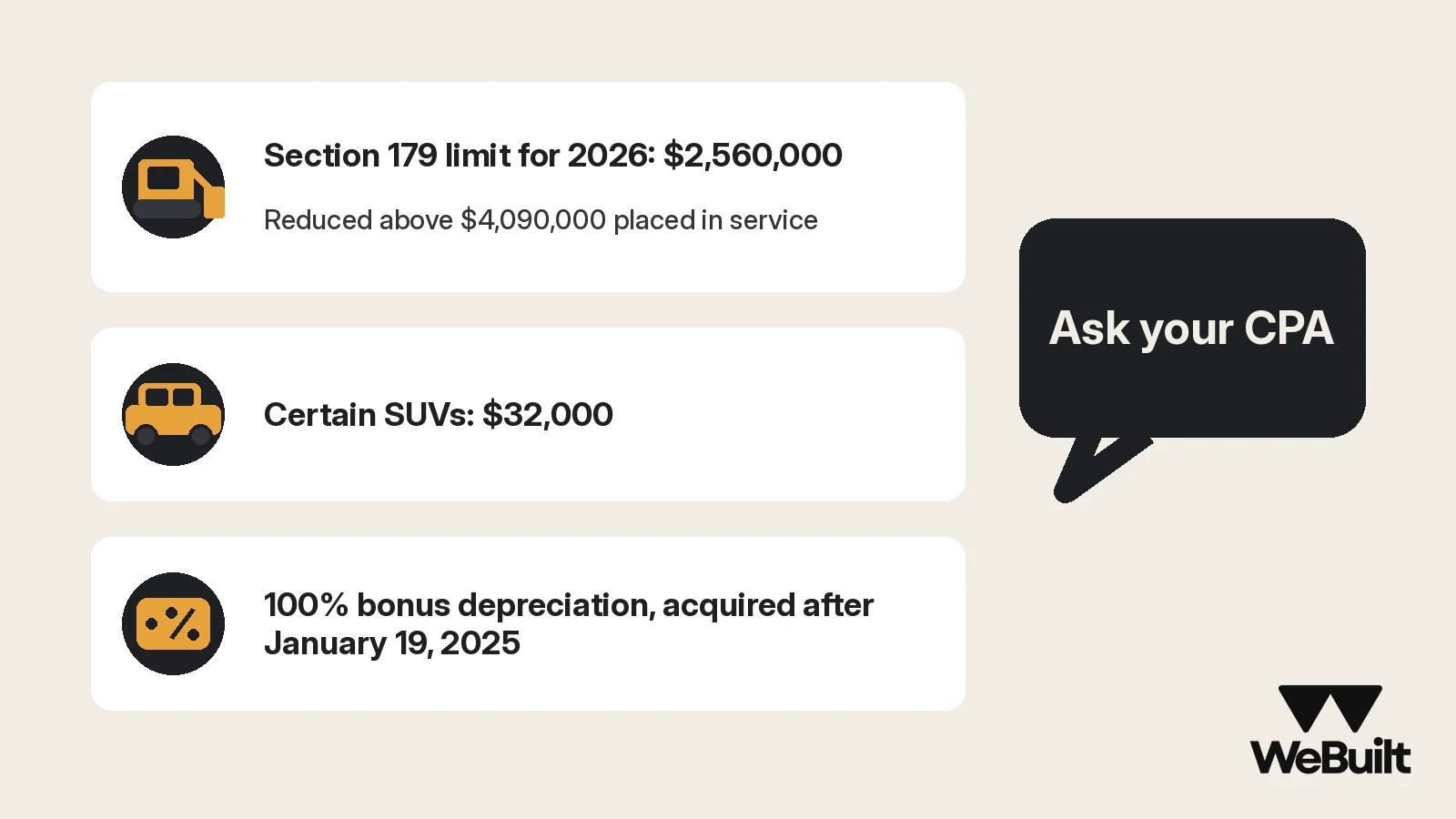
If you're thinking about a truck, trailer, skid steer, or tools, the IRS figures for 2026 are:
- Section 179: for tax years beginning in 2026, the maximum deduction is $2,560,000. That limit is reduced by the amount the cost of Section 179 property placed in service during the year goes over $4,090,000 [1].
- SUVs: the 2026 Section 179 limit for certain SUVs is $32,000 [1].
- Bonus depreciation: the law now has a permanent 100% first-year depreciation deduction for qualified property acquired after January 19, 2025 [2].
For comparison, the 2025 figures were $2,500,000, $4,000,000, and $31,300 [1].
Two cautions. First, a deduction is not free money. You still spend the cash, and you only get back the tax on it. Buy equipment because the business needs it. Second, there are rules about when property counts as "placed in service" and which method fits your situation. That's exactly the conversation for your CPA.
2. Small purchases: the de minimis question
The IRS has a de minimis safe harbor that lets many businesses deduct smaller purchases instead of depreciating them. For taxpayers without an applicable financial statement, it's up to $2,500 per item or per supplier bill. With one, it's $5,000 [3].
Most small contractors don't have an applicable financial statement, but ask. Also ask whether you've actually elected the safe harbor on your return. A $1,800 tile saw is handled differently depending on that answer.
3. Owner pay and estimated taxes
How much you take out of the business, and how, is a question for your CPA. We're not going to give you a percentage or a rule of thumb here.
What you should know going into the meeting:
- Individuals generally have to pay estimated tax if they expect to owe $1,000 or more [5].
- The fourth-quarter estimate for 2026 is due January 15, 2027 [4]. You can skip that one if you file your 2026 return by February 1, 2027 and pay the full balance due [4].
- The safe harbor is generally paying at least 90% of this year's tax or 100% of last year's, whichever is smaller [5]. If your 2025 adjusted gross income was more than $150,000 ($75,000 if married filing separately for 2026), substitute 110% for 100% [4].
A good year can mean a surprise in April if your estimates were based on a slow one.
4. Open jobs: what finishes before December 31?
Make a list of every job that's running or sold but not started. For each one, note how much of the contract you've collected, how much cost you've spent, and whether it finishes before or after December 31.
How those jobs show up on your 2026 return depends on your accounting method. That's a big enough topic for its own conversation with your CPA, and it changes what "finished before December 31" means for your numbers. Bring the list and let your CPA tell you what it means.
5. Records to gather now
Don't wait for January to chase paperwork from subs:
- A W-9 from every sub you paid this year.
- Contract labor totals by payee. For tax years beginning after 2025, the 1099-NEC threshold went up to $2,000 [6]. Know who crossed it.
- Payroll totals for W-2s.
- Receipts and dates for any equipment placed in service in 2026.
6. Deadlines to put on the calendar
- 1099-NEC: due on or before January 31, and a deadline that falls on a weekend or holiday moves to the next business day [6]. January 31, 2027 is a Sunday, so by our calculation the 2027 deadline is Monday, February 1, 2027 [6].
- Utah W-2s: Utah says employers must file all required W-2s and 1099-Rs electronically by January 31 [7]. A Utah due date that falls on a Saturday, Sunday, or legal holiday moves to the next business day [8], and the Tax Commission lists Monday, February 1, 2027 as the deadline to file 2026 W-2s [9].
- Fourth-quarter estimate: January 15, 2027 [4].
Example: a one-page sheet for the CPA meeting
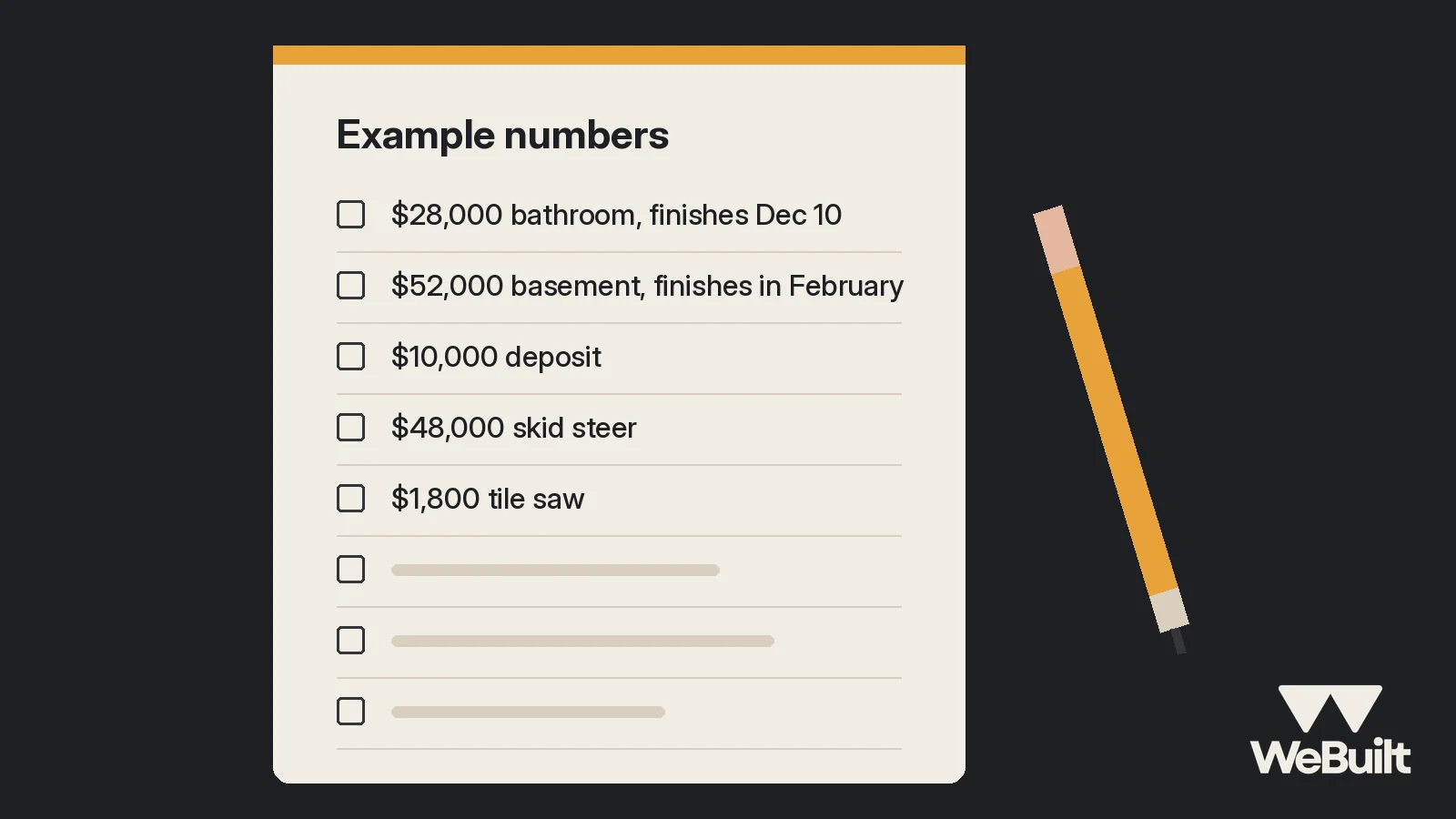
Example numbers for illustration, made up for this post. A five-person remodeling company brings this to its November meeting:
| Item | Status as of Nov 15 |
|---|---|
| Bathroom job, $28,000 contract | About 80% done, finishes Dec 10 |
| Basement finish, $52,000 contract | Sold, starts Dec 1, finishes in February |
| Deposit on the basement | $10,000, due at signing in November |
| Equipment being considered | $48,000 used skid steer, $1,800 tile saw |
| Subs paid $2,000 or more this year | 6, W-9s on file for 4 |
| Estimated tax for 2026 | First three quarters sent on time |
The questions for the CPA write themselves: Does the basement deposit count as 2026 income for us? Is the skid steer worth buying this year, or should we wait? Did we elect the de minimis safe harbor? Who do we still need W-9s from? None of those answers come from this post. They come from the person who knows your return. This is general information, not tax advice. Review every item with your CPA or tax professional before you act.
How WeBuilt helps
The CPA meeting goes better when you walk in knowing which jobs made money. WeBuilt keeps your customers, estimates, and jobs together and shows revenue, cost, and margin for each job as you record costs against it. That gives you profit per job for the jobs you closed this year, and a clear picture of what's been spent on the jobs still open going into 2027. WeBuilt doesn't do your taxes, file 1099s, or replace your accounting software. It keeps the job-by-job numbers clear so your CPA conversation is about decisions, not digging. See what's included today.
FAQ
What is the Section 179 limit for 2026?
The maximum deduction is $2,560,000, reduced once Section 179 property placed in service goes over $4,090,000 [1]. Ask your CPA whether it fits your situation.
When is the fourth-quarter estimated tax due?
January 15, 2027 for the 2026 tax year [4]. You can skip it if you file by February 1, 2027 and pay the full balance due [4].
What's the 1099-NEC threshold now?
For tax years beginning after 2025, it's $2,000 [6].
Join the Founding 25
Founding 25 spots are open for Utah contractors who want profit per job ready for the next CPA meeting. See the platform and the Founding 25 offer.
Sources
- IRS, Publication 946, How To Depreciate Property. Accessed November 2, 2026.
- IRS, Working Families Tax Cuts provisions for businesses. Accessed November 2, 2026.
- IRS, Tangible Property Final Regulations. Accessed November 2, 2026.
- IRS, Form 1040-ES (2026), Estimated Tax for Individuals. Accessed November 2, 2026.
- IRS, Estimated Taxes. Accessed November 2, 2026.
- IRS, Instructions for Forms 1099-MISC and 1099-NEC (Rev. December 2026). Accessed November 2, 2026.
- Utah State Tax Commission, Withholding overview. Accessed November 2, 2026.
- Utah State Tax Commission, Publication 14, Withholding Tax Guide. Accessed November 2, 2026.
- Utah State Tax Commission, Annual Due Date: Jan-Dec 2026. Accessed November 2, 2026.